
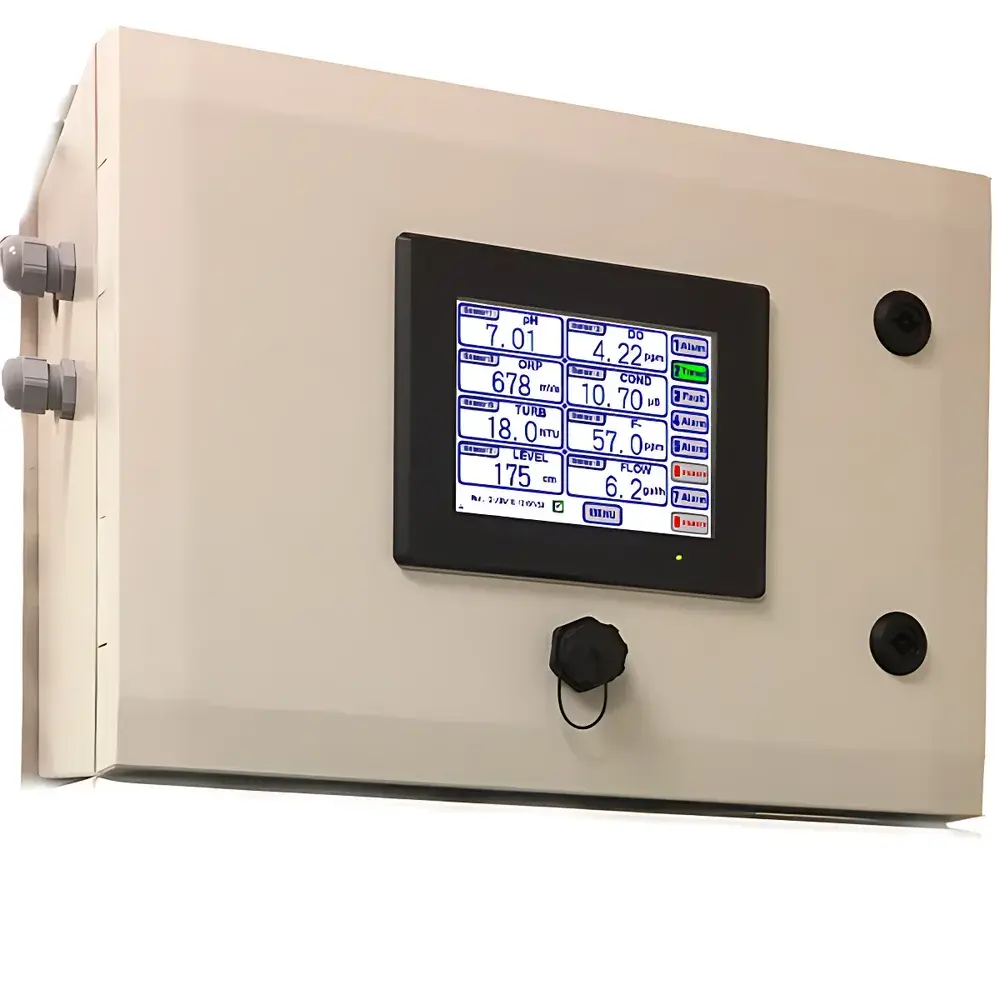
Purity LQ800 Multi-Parameter Ion Analyzer
| Brand | Purity |
|---|---|
| Origin | USA |
| Model | LQ800 |
| Instrument Type | Online Multi-Ion Analyzer |
| Max Sensor Channels | 8 |
| Response Time | 10 s |
| Operating Temperature Range | 0–80 °C |
| Enclosure Rating | NEMA 4X / IP65 |
| Display | 120 mm × 90 mm Color Touchscreen |
| Power Supply | 110–240 VAC / 80 VA / 50–60 Hz or 24 VDC |
| Dimensions | 43 cm × 30 cm × 23 cm |
| Weight | 9 kg |
| Analog Outputs | Eight 4–20 mA |
| Digital Communication | Ethernet |
| Data Storage | Removable USB-compatible SD card |
| Relay Outputs | Eight configurable SPDT relays (15 A, 250 VAC resistive) |
| Compatible Parameters | pH, ORP, Conductivity, Salinity, Dissolved Oxygen, Turbidity, TSS, TDS, and >20 ISE-based ions |
Overview
The Purity LQ800 Multi-Parameter Ion Analyzer is an industrial-grade online monitoring platform engineered for continuous, real-time quantification of multiple ionic species in aqueous process streams, wastewater effluents, drinking water distribution systems, and environmental sampling stations. It operates on the potentiometric principle using Ion-Selective Electrodes (ISEs), which generate a Nernstian voltage response proportional to the logarithm of the activity of target ions in solution. The system supports up to eight simultaneously connected ISE sensors—each pre-calibrated and digitally encoded—enabling concurrent measurement of ions such as nitrate, fluoride, chloride, sodium, ammonium, copper, lead, and cyanide, alongside complementary parameters including pH, ORP, conductivity, dissolved oxygen, turbidity, TSS, and TDS. Designed for deployment in demanding field environments—from municipal treatment plants to chemical manufacturing facilities—the LQ800 integrates robust mechanical architecture with embedded analytical computation and audit-ready data handling capabilities compliant with GLP and GMP-aligned operational frameworks.
Key Features
- Modular 8-channel architecture supporting simultaneous acquisition from up to eight ISE sensors or hybrid parameter modules (pH, DO, conductivity, etc.)
- Digital sensor interface with embedded calibration memory: each ISE stores factory calibration coefficients, slope, offset, and date-stamped validation history
- Intelligent auto-recognition: the analyzer identifies connected sensor type, range, and configuration upon insertion—eliminating manual setup errors
- Industrial-grade enclosure rated NEMA 4X / IP65, suitable for outdoor wall mounting with optional sunshade, bracket, or pedestal kits
- High-resolution color touchscreen (120 mm × 90 mm) with intuitive menu navigation optimized for glove-compatible operation and remote visualization via Ethernet
- Built-in analytical engine performing automatic unit conversion (ppm ↔ mol/L), charge balance correction, temperature compensation (based on built-in Pt100 RTD), and cross-sensitivity compensation per ISE specification
- Eight isolated 4–20 mA analog outputs assignable to any measured or calculated parameter, supporting integration into DCS/SCADA systems
- Eight programmable SPDT alarm relays (15 A, 250 VAC resistive load) configurable for high/low limits, rate-of-change thresholds, or maintenance alerts
Sample Compatibility & Compliance
The LQ800 accommodates a broad spectrum of aqueous matrices—including raw surface water, clarified effluent, brackish influent, cooling tower recirculation loops, and industrial process liquors—with minimal sample conditioning required. Sensor compatibility extends across aggressive chemistries via customizable wetted materials: standard 316 stainless steel housings; optional titanium, Hastelloy C-22, PVDF, or polypropylene bodies; and chemically resistant O-ring options (Viton, EPDM, Kalrez, CV75). All ISEs meet ASTM D1129 (Standard Terminology Relating to Water), ISO 10523 (pH determination), and USP (conductivity), while the analyzer’s data logging architecture supports 21 CFR Part 11-compliant electronic records when paired with validated software configurations. Calibration traceability follows NIST-traceable standards, and sensor verification protocols align with EPA Method 300.0 (for anions) and APHA Standard Methods 4500 series.
Software & Data Management
Data acquisition, storage, and retrieval are managed through an embedded firmware platform supporting cyclic logging at user-defined intervals (1 s to 24 h). Raw and processed data are stored on a removable SD card formatted for FAT32 compatibility, enabling direct USB transfer to laboratory workstations without proprietary drivers. Timestamped records include sensor ID, measured value, temperature, status flags (e.g., “calibration due”, “signal drift”), and diagnostic codes. Optional cloud synchronization (via MQTT or Modbus TCP) allows centralized dashboarding and trend analysis across distributed sites. Audit trails capture all configuration changes, calibration events, and relay activations with operator ID and timestamp—essential for GLP audits and regulatory reporting under ISO/IEC 17025 and EU Water Framework Directive requirements.
Applications
- Municipal wastewater treatment: real-time monitoring of NH₄⁺, NO₃⁻, Cl⁻, and F⁻ to optimize denitrification, disinfection, and fluoridation dosing
- Power plant cooling water management: detection of Na⁺, Cu²⁺, and Cl⁻ to prevent corrosion and scaling in condenser tubes
- Pharmaceutical manufacturing: inline verification of ion profiles in purified water (PW) and water-for-injection (WFI) loops per USP
- Food & beverage processing: control of Na⁺, K⁺, and NO₂⁻ levels in brine solutions and rinse waters
- Environmental compliance monitoring: automated reporting of Cd²⁺, Pb²⁺, and CN⁻ in discharge permits under NPDES or REACH Annex XVII
- Academic and regulatory laboratories: flexible platform for method development, inter-laboratory comparison studies, and reference material validation
FAQ
Can the LQ800 operate in pressurized piping systems?
Yes—insertion-type and retractable valve-style sensors support process pressures up to 100 psig (e.g., Na⁺ sensor) or 50 psig (most others), depending on model and sealing configuration.
Is sensor recalibration required in the field?
While factory calibration ensures initial accuracy, periodic verification against certified standards is recommended per ISO/IEC 17025 Clause 7.7; the system supports one-point or two-point recalibration with full audit trail logging.
Does the analyzer support Modbus RTU or Profibus protocols?
Native communication is Ethernet-based (TCP/IP); Modbus TCP is supported out-of-the-box; Modbus RTU and Profibus require external protocol gateways compatible with the LQ800’s 4–20 mA or digital relay interfaces.
How is temperature compensation handled for ISE measurements?
Each channel incorporates automatic temperature compensation using either the integrated Pt100 RTD in the analyzer or an optional inline temperature probe wired directly to the sensor housing.
What is the expected service life of an ISE sensor?
Typical operational lifespan exceeds 18 months under continuous use in non-abrasive, non-fouling applications; electrode elements are replaceable, extending total sensor service life beyond five years with proper maintenance.
Related Products







