
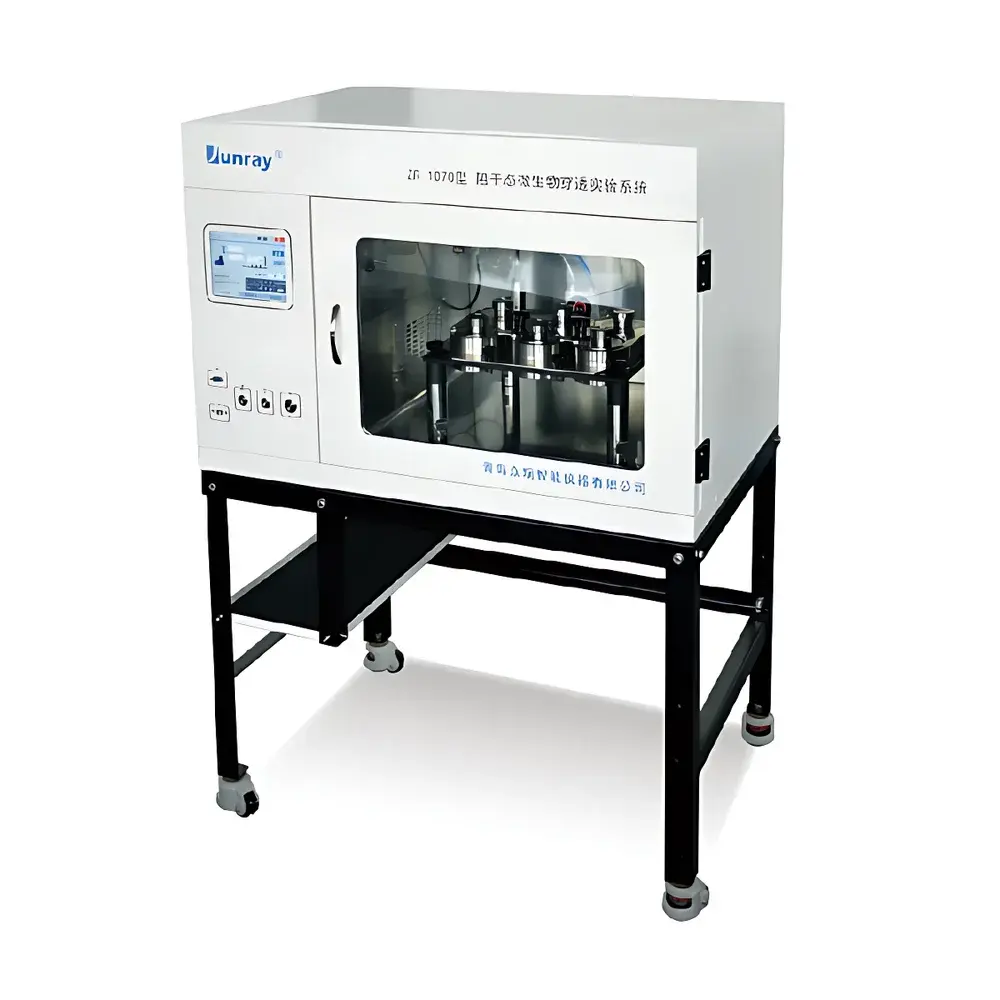
Junray ZR-1070 Dry-State Microbial Penetration Test System
| Brand | Junray |
|---|---|
| Origin | Shandong, China |
| Manufacturer Type | Direct Manufacturer |
| Product Origin | Domestic (China) |
| Model | ZR-1070 |
| Pricing | Upon Request |
Overview
The Junray ZR-1070 Dry-State Microbial Penetration Test System is an engineered laboratory instrument designed to evaluate the barrier performance of medical textiles—specifically surgical drapes, gowns, and cleanroom garments—against dry-state microbial challenge under standardized mechanical stress. It operates on the principle of controlled vibration-induced particle mobilization, simulating real-world handling conditions where dry microorganisms (e.g., Bacillus atrophaeus spores) are mechanically dislodged from contaminated surfaces and challenged against the test material under negative pressure. The system conforms strictly to YY/T 0506.5–2009, the Chinese national standard equivalent to ISO 22612 for dry microbial penetration testing, and supports regulatory validation pathways aligned with ISO 13485 quality management systems and FDA QSR 820 requirements for medical device manufacturers.
Key Features
- Negative-pressure test chamber with integrated high-efficiency particulate air (HEPA) filtration on both intake and exhaust paths—ensuring operator safety and environmental containment during spore aerosol generation and challenge.
- Dual-stage vibration mechanism compliant with YY/T 0506.5–2009, delivering reproducible mechanical agitation to simulate garment handling while maintaining consistent energy input across test cycles.
- Industrial-grade 7-inch high-brightness capacitive touchscreen HMI with intuitive navigation, real-time parameter monitoring, and embedded calibration routines traceable to internal reference standards.
- Stainless-steel inner chamber (304 grade), fully welded and passivated, housed within a flame-retardant, thermally insulated outer enclosure made of powder-coated cold-rolled steel.
- Front-access laminated glass door with gas-tight sealing gasket and quick-release latch—enabling unobstructed visual observation without compromising containment integrity.
- Modular support frame with dual-mode casters (locking for stability, swivel for mobility), facilitating repositioning in QC laboratories or shared ISO Class 7 cleanroom environments.
- Integrated safety architecture including residual-current circuit breaker (RCCB), LED task lighting with shadow-free illumination, and automated fault detection with audible/visual alerts and emergency shutdown protocol.
Sample Compatibility & Compliance
The ZR-1070 accommodates flat-panel textile specimens up to 300 mm × 300 mm, mounted in standardized sample holders per YY/T 0506.5–2009 Annex A. Compatible materials include nonwovens, laminated composites, coated fabrics, and reusable woven textiles used in surgical and pharmaceutical settings. All system components—including airflow dynamics, vibration amplitude control, and pressure differentials—are validated against the performance criteria defined in YY/T 0506.5–2009 and referenced in ISO/TR 16142-2 for biocompatibility evaluation of protective barriers. The system supports audit-ready documentation for GLP-compliant testing and meets essential requirements for GMP-aligned process validation under ICH Q5A(R2) for biological product container-closure integrity assessment.
Software & Data Management
The proprietary Junray TestSuite™ v3.2 software provides full lifecycle test control—from method setup and parameter configuration (vibration duration, frequency, negative pressure setpoint) to real-time logging of chamber pressure, motor current draw, and system status flags. All user actions, parameter changes, and alarm events are timestamped and stored locally with optional export to CSV or PDF formats. Audit trail functionality complies with ALCOA+ principles and supports 21 CFR Part 11 readiness when deployed with external identity management (e.g., LDAP integration and electronic signature modules). Raw data files retain metadata including operator ID, calibration certificate IDs, and environmental monitoring logs (temperature/humidity if externally interfaced).
Applications
- Quality control testing of disposable surgical gowns and drapes prior to sterilization release.
- Comparative evaluation of barrier efficacy across fabric architectures (spunbond-meltblown-spunbond vs. SMS laminates).
- Developmental validation of novel antimicrobial coatings or hydrophobic finishes under dry-state challenge conditions.
- Regulatory submission support for Class II and III medical devices requiring ISO 10993-10 biocompatibility and barrier performance evidence.
- In-house verification of supplier claims regarding dry microbial resistance for cleanroom apparel used in aseptic processing suites (ISO 14644-1 Class 5–8).
FAQ
Does the ZR-1070 comply with international standards beyond YY/T 0506.5–2009?
Yes—it is functionally aligned with ISO 22612:2005 and supports cross-referenced validation protocols accepted by EU Notified Bodies and Health Canada.
Can the system be integrated with laboratory information management systems (LIMS)?
Yes, via configurable RS-232/RS-485 serial output or optional Ethernet TCP/IP interface using Modbus RTU or ASCII command sets.
What biosafety level (BSL) is required to operate this system?
Operation requires BSL-2 containment practices; the integrated HEPA filtration enables safe use in standard microbiology labs without dedicated BSL-3 infrastructure.
Is routine calibration traceable to national metrology institutes?
Calibration certificates for vibration amplitude, pressure transducers, and timer modules are issued annually and traceable to CNAS-accredited calibration laboratories in China.
How is microbial recovery quantified in dry-state testing?
The ZR-1070 itself does not perform enumeration; it delivers standardized challenge conditions—the downstream microbial recovery and enumeration follow YY/T 0506.5–2009 Section 7, typically using membrane filtration and colony-forming unit (CFU) counting on tryptic soy agar.
Related Products



