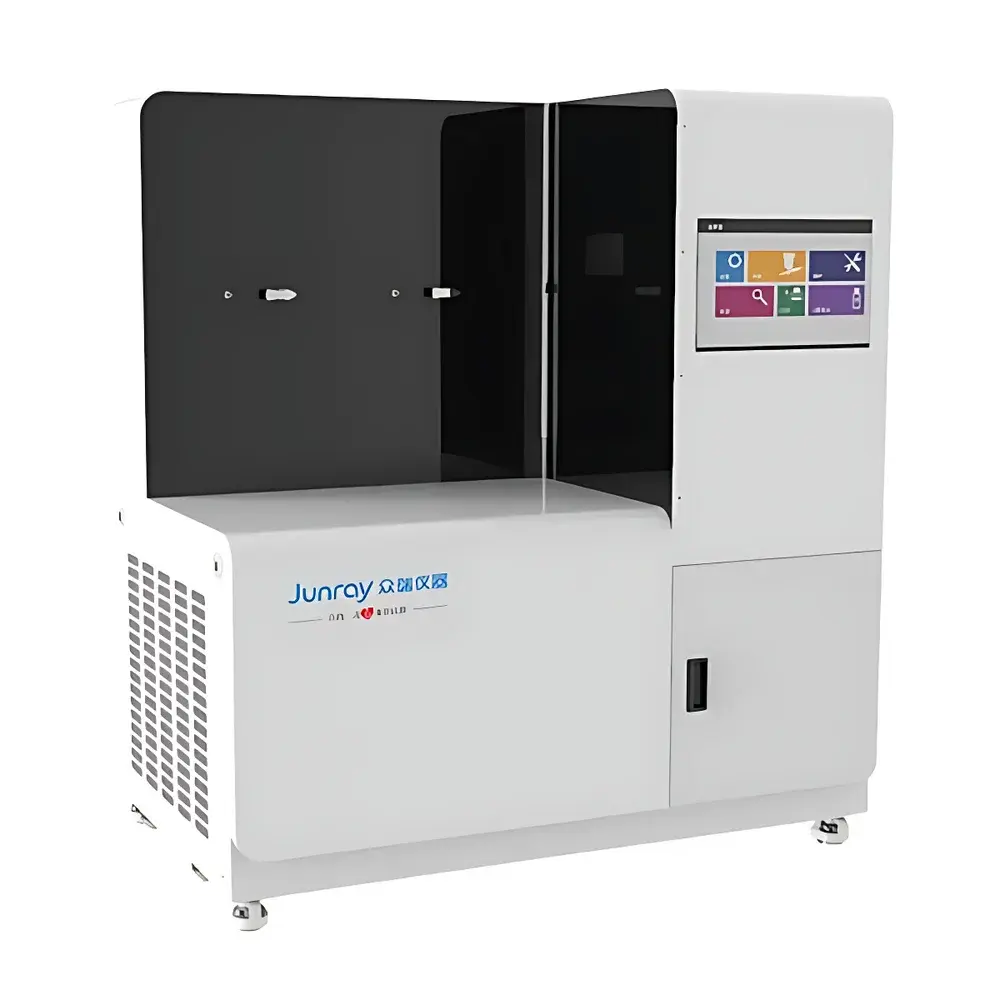
Junray ZR-1320 Aerosol Generation and Dynamic Dilution Mixing System
| Brand | Junray |
|---|---|
| Origin | Shandong, China |
| Manufacturer Type | Direct Manufacturer |
| Model | ZR-1320 |
| Power Supply | 220 V AC |
| Compliance | JJF 1800–2020 Calibration Specification for Aerosol Photometers |
| Display | 10.4-inch HD capacitive touchscreen |
| Safety Protection | High-current air circuit breaker, pre-installed HEPA filter, integrated dehumidification and impact-resistant housing |
| Aerosol Control | Real-time adjustment via aerosol generator pressure and fan speed |
Overview
The Junray ZR-1320 Aerosol Generation and Dynamic Dilution Mixing System is a precision-engineered calibration-grade instrument designed to produce stable, traceable, and dynamically adjustable aerosol concentrations for the verification and performance validation of aerosol photometers, particle counters, and related airborne particle measurement devices. It operates on a dual-stage principle: first, a high-concentration aerosol is generated from a clean, dry carrier gas (e.g., compressed air or nitrogen) using a controlled nebulization or thermal generation mechanism; second, the aerosol stream is introduced into a precisely engineered dilution and mixing chamber where turbulent flow dynamics and calibrated mass flow control ensure homogeneous dispersion and reproducible concentration reduction. This system enables continuous, real-time concentration modulation—critical for multi-point calibration curves, linearity verification, and dynamic range assessment per JJF 1800–2020.
Key Features
- Dynamic aerosol concentration control through synchronized regulation of generator pressure and axial fan speed—enabling seamless transition across low-, medium-, and high-concentration output ranges without manual reconfiguration.
- Integrated pre-filtration architecture featuring a certified HEPA filter (≥99.97% @ 0.3 µm) upstream of the aerosol generator to eliminate ambient particulates and safeguard internal components against contamination and wear.
- 10.4-inch high-resolution capacitive touchscreen interface with intuitive graphical navigation, real-time parameter visualization (e.g., setpoint vs. actual flow rates, pressure feedback), and context-sensitive operation prompts—designed for glove-compatible use in cleanroom and laboratory environments.
- Robust mechanical enclosure with impact-resistant casing, internal moisture management system (condensate trap + desiccant stage), and thermal-stabilized airflow pathways to maintain consistent aerosol physical properties (e.g., droplet size distribution, evaporation kinetics) during extended operation.
- Compliance-ready electrical safety design including a dedicated high-current air circuit breaker (IEC 60947-2 compliant), grounded chassis, and isolated power input—meeting general laboratory equipment safety requirements under IEC 61010-1.
Sample Compatibility & Compliance
The ZR-1320 is compatible with standard calibration aerosols including polydisperse sodium chloride (NaCl), dioctyl phthalate (DOP), diethylhexyl sebacate (DEHS), and polystyrene latex (PSL) suspensions—provided they are supplied in validated generator-compatible formats (e.g., liquid reservoirs or solid thermal sources). Its output stability and repeatability support adherence to national metrological verification protocols, particularly JJF 1800–2020, which specifies tolerance limits for aerosol concentration deviation (< ±5% RSD over 30 min), temporal stability (drift < 2% per hour), and spatial uniformity across sampling ports. While not certified to ISO/IEC 17025 itself, the system’s design facilitates integration into GLP- and GMP-aligned calibration workflows when paired with traceable reference instruments and documented SOPs.
Software & Data Management
The ZR-1320 operates as a standalone hardware platform with embedded firmware—no external PC dependency required for basic operation. All configuration parameters (e.g., target dilution ratio, fan RPM setpoints, pressure thresholds) are stored in non-volatile memory with timestamped change logs. The touchscreen UI supports export of session records (CSV format) via USB port, including timestamps, operator ID fields, and measured system status variables. For laboratories requiring auditability, the device’s internal event log meets foundational data integrity expectations for calibration equipment under FDA 21 CFR Part 11—though full electronic signature capability requires integration with third-party LIMS or ELN systems.
Applications
- Primary and secondary calibration of aerosol photometers used in HVAC filter testing (e.g., EN 1822, ISO 14644), cleanroom monitoring, and pharmaceutical isolator qualification.
- Linearity verification and zero-point validation of optical particle counters (OPCs) across ISO Class 3–8 cleanroom classifications.
- Generation of challenge aerosols for filter efficiency testing (e.g., MERV, HEPA, ULPA) per ASHRAE 52.2 and ISO 16890.
- Research-grade studies of aerosol transport behavior, coagulation dynamics, and deposition efficiency in inhalation toxicology and respiratory drug delivery modeling.
- Training and proficiency testing for laboratory personnel conducting airborne particle instrumentation maintenance and metrological verification.
FAQ
What aerosol materials are supported by the ZR-1320?
The system is compatible with liquid-based (e.g., NaCl solution, DEHS) and thermally vaporized aerosol precursors. Compatibility depends on the external generator module used; Junray provides application notes for common aerosol types.
Does the ZR-1320 require external compressed air or nitrogen?
Yes—it requires a clean, oil-free, and dried carrier gas supply (pressure range: 0.2–0.6 MPa) meeting ISO 8573-1 Class 2:2:2 specifications for particulate, water, and oil content.
Can the ZR-1320 be integrated into automated calibration systems?
It supports analog 0–10 V and digital RS-485 Modbus RTU interfaces for remote start/stop, concentration setpoint adjustment, and status reporting—enabling integration with PLC-controlled test benches or custom calibration software.
Is routine maintenance required, and what does it involve?
Scheduled maintenance includes quarterly HEPA filter replacement, biannual calibration of internal pressure transducers (traceable to NIST standards), and annual verification of dilution ratio accuracy using gravimetric or condensation particle counter reference methods.
What documentation is provided with the instrument?
Each unit ships with a Factory Calibration Report (including as-delivered dilution accuracy at three concentration levels), JJF 1800–2020 conformance statement, electrical safety certificate, CE Declaration of Conformity, and comprehensive English-language user manual with troubleshooting flowcharts and SOP templates.