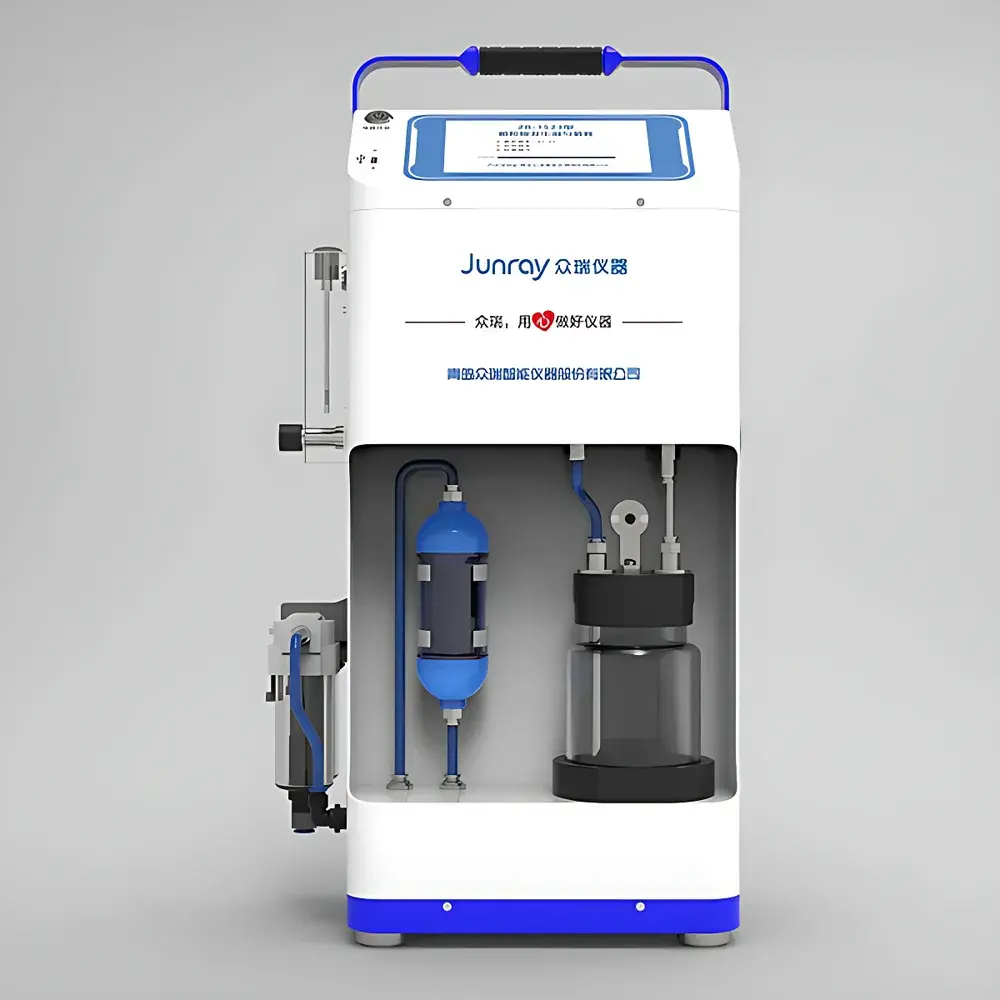
Junray ZR-1523 Aerosol Generation and Homogenization System (Compliant with JJF 1716–2018)
| Brand | Junray |
|---|---|
| Origin | Shandong, China |
| Manufacturer Type | Original Equipment Manufacturer (OEM) |
| Country of Manufacture | China |
| Model | ZR-1523 |
| Dimensions | 230 × 370 × 700 mm |
| Power Supply | AC Mains |
| Flow Control | Dual Mass Flow Controllers (MFCs), 0–50 L/min (Generation & Dilution) |
| Aerosol Concentration Range | 0–25 mg/m³ |
| Flow Stability | ≤1% FS |
| Display | 7-inch High-Brightness Touchscreen (Sunlight-Readable, Wide-Temperature Operation) |
| Integrated Sensors | Real-time Laser Dust Sensor |
| Mixing Mechanism | Magnetic Stirring System |
| Drying System | Heated Desiccation Module |
| Inlet Filtration | Water-Separating Filter |
| Calibration Ports | Three Independent, Uniformity-Validated Output Interfaces |
| Environmental Protection | Enhanced Moisture, Electrostatic, and Mechanical Shock Resistance |
Overview
The Junray ZR-1523 Aerosol Generation and Homogenization System is a metrologically traceable, laboratory-grade instrument engineered for the controlled, repeatable generation of stable solid particulate aerosols—primarily polydisperse sodium chloride (NaCl), ammonium sulfate ((NH₄)₂SO₄), or Arizona Test Dust (ATD)—using wet-generation methodology. It operates on the principle of nebulization followed by controlled dilution, heating-assisted drying, and active homogenization to produce well-characterized, temporally stable aerosol clouds within the 0–25 mg/m³ mass concentration range. Designed specifically for calibration and verification of optical, beta-attenuation, and gravimetric particulate matter (PM) measurement instruments—including PM₂.₅ monitors, industrial dust meters, and continuous emission monitoring systems (CEMS) for ambient and occupational environments—the ZR-1523 meets the technical requirements stipulated in JJF 1716–2018 “Type Evaluation Outline for Dust Concentration Measuring Instruments” and aligns with supporting metrological frameworks such as JJG 846–2015 “Verification Regulation for Dust Concentration Meters.” Its architecture integrates fluidic precision, thermal management, and real-time optical feedback to ensure metrological integrity across extended operational cycles.
Key Features
- Wet-generation aerosol source utilizing ultrasonic or pneumatic nebulization of standardized suspensions, enabling high reproducibility and low particle loss compared to dry dispersion methods.
- Dual-channel mass flow control (generation + dilution) with imported thermal mass flow controllers (0–50 L/min full scale), delivering flow stability ≤1% FS under variable backpressure conditions.
- Integrated heated desiccation module (adjustable 40–80°C) ensuring consistent removal of residual moisture from generated aerosols—critical for avoiding hygroscopic growth artifacts during calibration of optical scattering-based PM sensors.
- Real-time laser scattering sensor (calibrated against NIST-traceable reference standards) continuously monitors aerosol mass concentration at the primary output port, enabling closed-loop verification and dynamic adjustment.
- Active magnetic stirring system maintains suspension homogeneity prior to nebulization, preventing sedimentation of micron- and submicron-sized particles—essential for generating statistically representative particle size distributions (PSDs).
- Three independently isolated, geometrically symmetric calibration ports with demonstrated inter-port concentration deviation <±3% (measured per ISO 27826:2019 Annex B protocols), facilitating parallel multi-instrument validation.
- Ruggedized mechanical design featuring IP54-rated enclosure, anti-static coating, reinforced shock-absorbing chassis, and wide-temperature touchscreen (–20°C to +60°C operating range), validated for field-deployable metrology labs and mobile calibration units.
Sample Compatibility & Compliance
The ZR-1523 supports aqueous suspensions of certified reference materials (CRMs) including but not limited to ISO 12103-1 A2 Fine Test Dust, NaCl (for PM₂.₅ optical equivalence), and (NH₄)₂SO₄ (for hygroscopic calibration studies). All wet-generation protocols are compatible with ISO/IEC 17025–accredited calibration workflows. The system’s design adheres to national metrological regulations in the People’s Republic of China (JJF 1716–2018, JJG 846–2015) and incorporates engineering practices aligned with international aerosol metrology standards—including ISO 27826:2019 (Aerosol generation for instrument calibration), ASTM D6245–22 (Standard Guide for Indoor Air Quality Investigations), and EN 12341:2014 (Ambient air—Standardization of measurement methods for PM₁₀ and PM₂.₅). While not FDA 21 CFR Part 11–certified out-of-the-box, audit trails and user-access controls can be implemented via external LIMS integration for GLP/GMP-aligned environments.
Software & Data Management
The embedded firmware supports local data logging of all critical parameters—including generation/dilution flow rates, real-time sensor output, heater temperature, pump RPM, and timestamped concentration values—at configurable intervals (1 s to 60 s). Export formats include CSV and XML, compatible with third-party analysis platforms (e.g., MATLAB, Python Pandas, LabVIEW). The 7-inch capacitive touchscreen provides intuitive graphical configuration of operating modes (constant-concentration, step-ramp, time-series), alarm thresholds, and calibration history review. No cloud connectivity or remote access is enabled by default—ensuring data sovereignty and compliance with institutional IT security policies. Audit-ready event logs record operator login/logout, parameter changes, and system fault events with ISO 8601 timestamps.
Applications
- Primary and secondary calibration of regulatory-grade PM₂.₅ and TSP monitors used by environmental protection agencies and municipal air quality networks.
- Type evaluation and performance testing of new dust measurement instruments seeking market approval under Chinese metrological regulations.
- Method validation and uncertainty budgeting for laboratories accredited to CNAS-CL01 (equivalent to ISO/IEC 17025).
- Research into aerosol instrument response functions—including angular scattering dependence, humidity-induced bias, and cut-point verification for impactors and cyclones.
- Field service support for OEMs requiring portable, self-contained aerosol sources capable of operation in non-laboratory settings (e.g., construction sites, mining facilities, waste incineration plants).
FAQ
What aerosol materials can be used with the ZR-1523?
The system is validated for aqueous suspensions of ISO 12103-1 A2 test dust, NaCl, (NH₄)₂SO₄, and other non-volatile, non-reactive particulates with median diameters between 0.5 µm and 10 µm.
Does the ZR-1523 provide particle size distribution data?
No—it generates mass-based aerosols optimized for gravimetric and optical sensor calibration; complementary instrumentation (e.g., SMPS, APS, or OPS) is required for PSD characterization.
Is external compressed air required?
Yes—a clean, oil-free, dry air supply (≥6 bar, dew point ≤–20°C) is necessary for nebulizer actuation and dilution flow; the unit includes an integrated water-separating filter but does not incorporate an air compressor.
Can the ZR-1523 be integrated into automated calibration systems?
Yes—RS-232 and optional Ethernet interfaces support SCPI command sets for programmable control and synchronization with robotic sample changers or multi-channel analyzers.
What maintenance intervals are recommended?
Nebulizer capillaries and desiccant cartridges require replacement every 200 operational hours; magnetic stir bar and tubing should be inspected quarterly per CNAS-CL01 maintenance guidelines.