
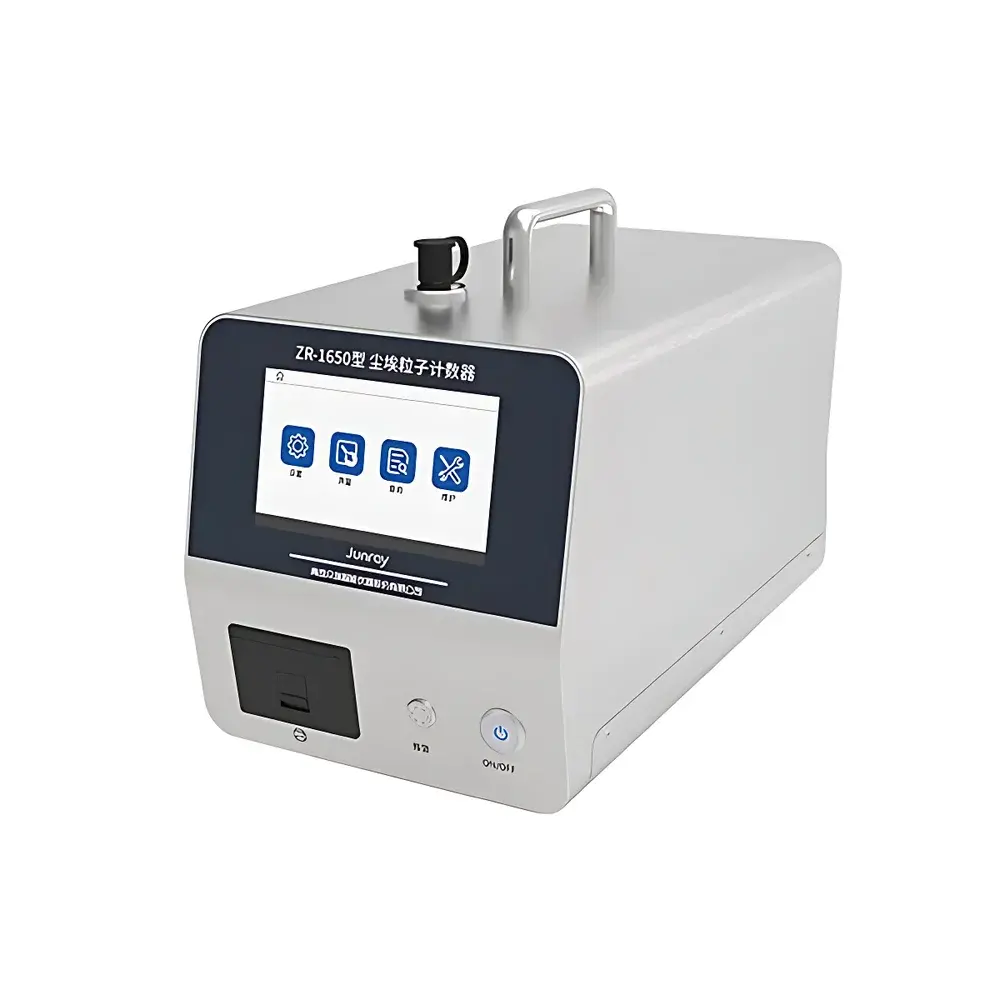
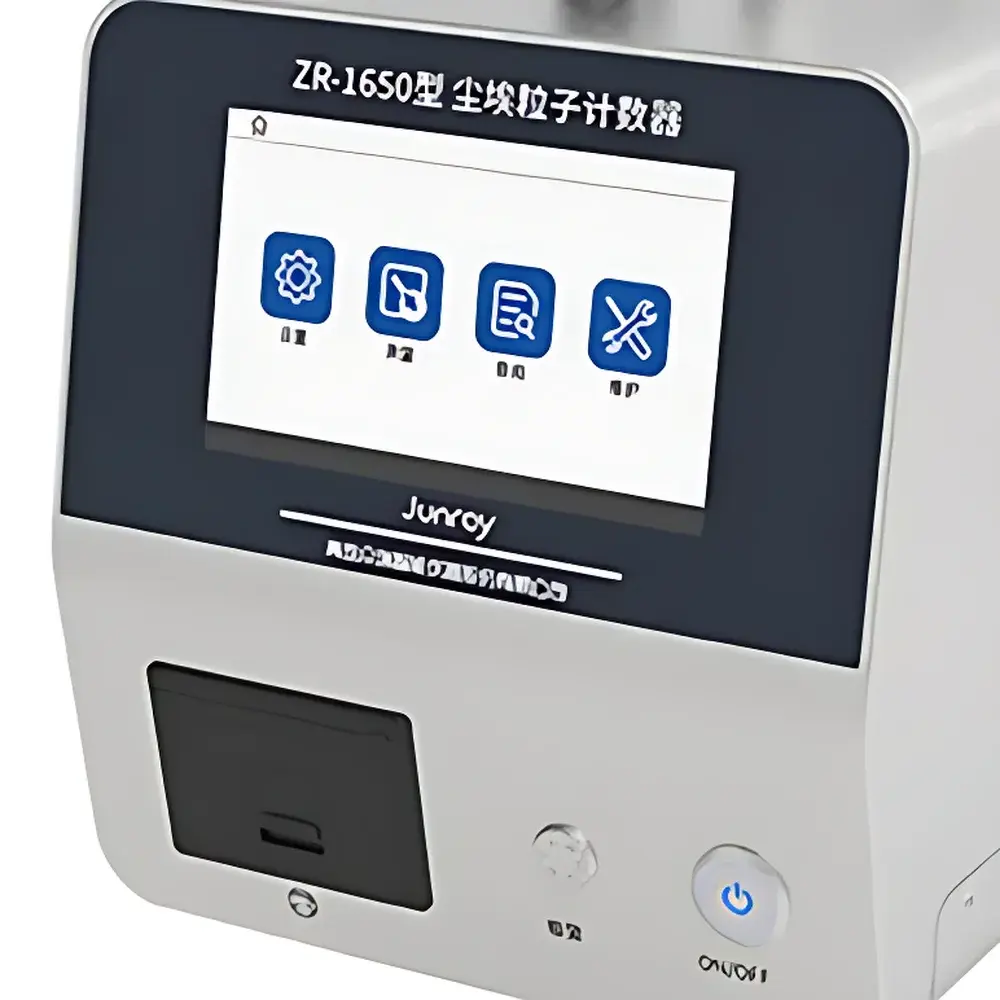
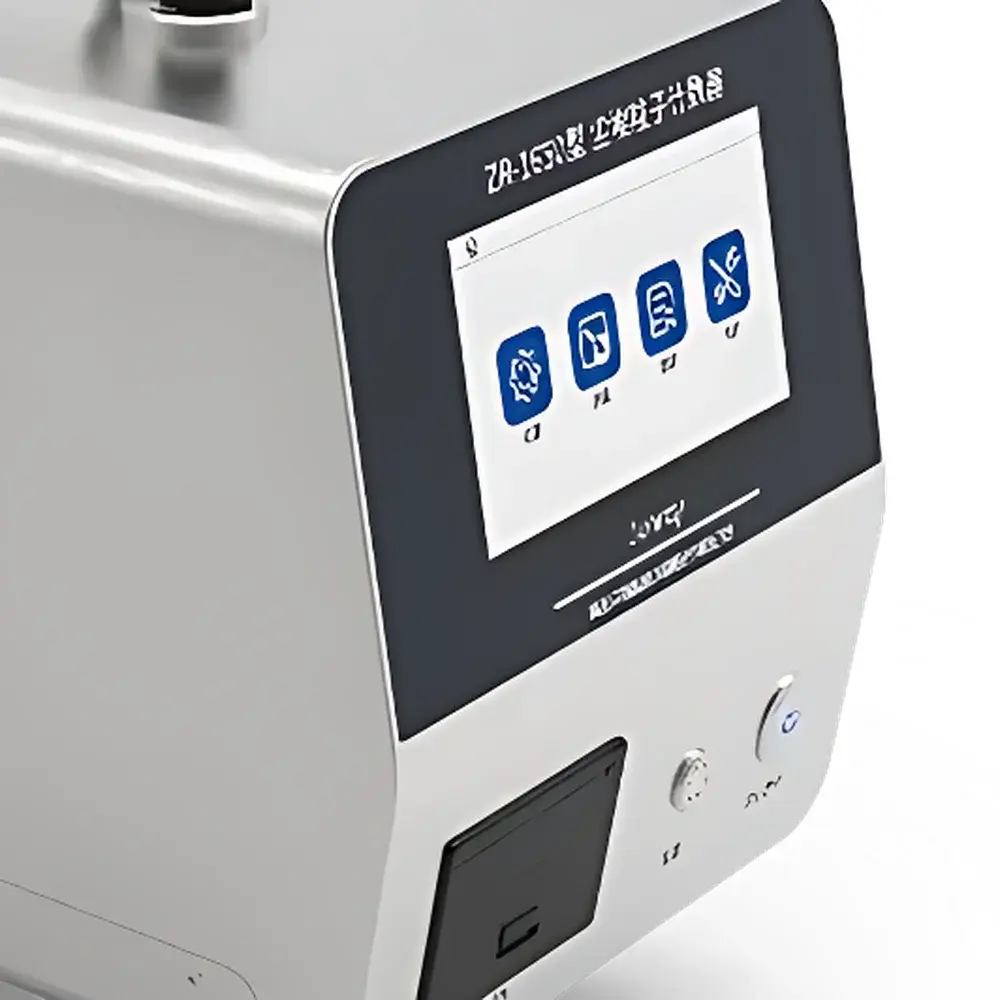
Junray ZR-1650 High-Sensitivity Laser Airborne Particle Counter (0.1 µm Detection Threshold)
| Brand | Junray |
|---|---|
| Origin | Shandong, China |
| Manufacturer Type | Direct Manufacturer |
| Product Category | Domestic |
| Model | ZR-1650 |
| Instrument Type | Laboratory-Grade Portable Particle Counter |
| Flow Rate | 28.3 L/min (1 CFM) |
| Flow Accuracy | ≤ ±2% |
| Timing Accuracy | Not Specified |
| Repeatability | ≤ 10% FS under Identical Measurement Conditions |
| Size Distribution Error | ≤ ±30% at 0.5 µm and 5.0 µm channels |
| Indication Error | ≤ ±30% FS at 0.5 µm channel after Warm-up |
Overview
The Junray ZR-1650 is a laboratory-grade, portable airborne particle counter engineered for high-fidelity monitoring of ultrafine particulate contamination in controlled environments. It operates on the principle of single-particle light scattering—where a collimated solid-state laser beam interrogates aerosol particles drawn through a precisely conditioned sampling flow path. Scattered light intensity is detected by a high-gain photodetector array and correlated to particle size via calibrated Mie scattering response curves. With a verified lower detection limit of 0.1 µm, the ZR-1650 supports up to nine user-selectable size channels (0.1, 0.15, 0.2, 0.25, 0.3, 0.5, 0.7, 1.0, and 5.0 µm), enabling granular analysis of submicron aerosol distributions critical for ISO Class 3–5 cleanrooms and advanced microfabrication facilities. Its 28.3 L/min (1 CFM) volumetric flow is actively stabilized via an integrated high-precision blower system, ensuring compliance with ISO 21501-4:2023 and JIS B 9921:2010 requirements for flow-dependent counting accuracy.
Key Features
- Nine-channel simultaneous particle sizing with configurable thresholds, supporting cumulative, differential, and concentration-based reporting modes.
- Onboard HEPA exhaust filtration (≥99.99% @ 0.3 µm) eliminates need for external filter assemblies; enables automatic self-cleaning cycles without external purge gas.
- Integrated environmental sensors for real-time logging of ambient temperature, relative humidity, and atmospheric pressure—correlated timestamped with particle data per ISO 14644-9:2022 Annex C.
- 7-inch capacitive touch display with Chinese/English bilingual GUI, optimized for glove-compatible operation in cleanroom gowning protocols.
- Triple-tier user access control (Operator, Supervisor, Administrator) with full audit trail per FDA 21 CFR Part 11 and EU Annex 11 requirements—including immutable event logs for login attempts, parameter changes, and report generation.
- Preloaded regulatory templates aligned with ISO 14644-1:2015, ISO 14698-1:2003, GB/T 25916.1-2010, and GMP Annex 1 (2022), enabling automated pass/fail evaluation against defined cleanliness classes.
- UCL (Upper Confidence Limit) calculation engine compliant with ISO 14644-1 Annex B for statistically valid classification of cleanroom zones.
Sample Compatibility & Compliance
The ZR-1650 is validated for use with ambient air, compressed gases (oil-free, dew point ≤ −40 °C), and recirculated HVAC streams in non-hazardous, non-corrosive environments. It meets mechanical and optical performance criteria specified in GB/T 6167-2007 and JJF 1190-2008 for calibration traceability to NIM (National Institute of Metrology, China). Its optical design satisfies ISO 21501-4:2023 requirements for resolution, coincidence loss correction (<5% at 2×10⁶ particles/m³), and pulse height stability. All firmware and calibration coefficients are digitally signed and cryptographically sealed to ensure integrity during GLP/GMP audits.
Software & Data Management
The embedded firmware includes a full-featured data acquisition suite supporting scheduled sampling, zone-mapped protocol assignment, and dynamic recipe deployment across multi-room facilities. Raw count data, environmental metadata, and operator annotations are stored in encrypted SQLite databases with SHA-256 hashing. Export options include CSV (ISO-compliant column headers), PDF reports with embedded UCL tables, and direct USB flash drive transfer. Optional PC software provides advanced trend analysis, spatial heat mapping, and deviation root-cause tagging—fully compatible with LIMS integration via ASTM E1384-compliant XML export.
Applications
- Qualification and routine monitoring of ISO Class 3–8 cleanrooms in semiconductor front-end fabs, photolithography labs, and MEMS packaging lines.
- Performance validation of ULPA/HEPA filters per GB/T 6165-2021 and IEST-RP-CC001.5, including leak scanning and efficiency testing at rated airflow.
- Biological containment verification in BSL-2/3 laboratories and aseptic processing suites per USP and EU GMP Annex 1.
- Environmental baseline characterization prior to equipment installation or facility commissioning (e.g., ASHRAE 110, ISO 14644-3).
- Filter media R&D—quantifying penetration efficiency down to 0.1 µm for next-generation nanofiber and electret-based media.
FAQ
What is the minimum detectable particle size, and how is it verified?
The ZR-1650 achieves a validated lower detection limit of 0.1 µm, confirmed through NIST-traceable polystyrene latex (PSL) standard aerosols and alignment with ISO 21501-4:2023 sensitivity verification protocols.
Does the instrument support remote data retrieval or network connectivity?
Yes—via optional Ethernet or Wi-Fi module (IEEE 802.11n), enabling secure TLS 1.2 communication with central monitoring systems using MODBUS TCP or custom RESTful API endpoints.
Is calibration traceable to international standards?
All factory calibrations are performed against PSL reference materials certified by NIM (China) and cross-validated with NIST SRM 1930; calibration certificates include uncertainty budgets per ISO/IEC 17025.
Can the ZR-1650 be used for continuous unattended monitoring?
Yes—when mounted on a fixed stand with external power and thermal management, it supports 24/7 scheduled sampling with auto-restart after power interruption and battery-backed real-time clock.
How is data integrity ensured during regulatory audits?
The system enforces write-once storage, cryptographic hash chaining of records, and time-stamped operator authentication—meeting ALCOA+ principles and supporting full 21 CFR Part 11 electronic record compliance when configured with digital signature modules.
Related Products







