
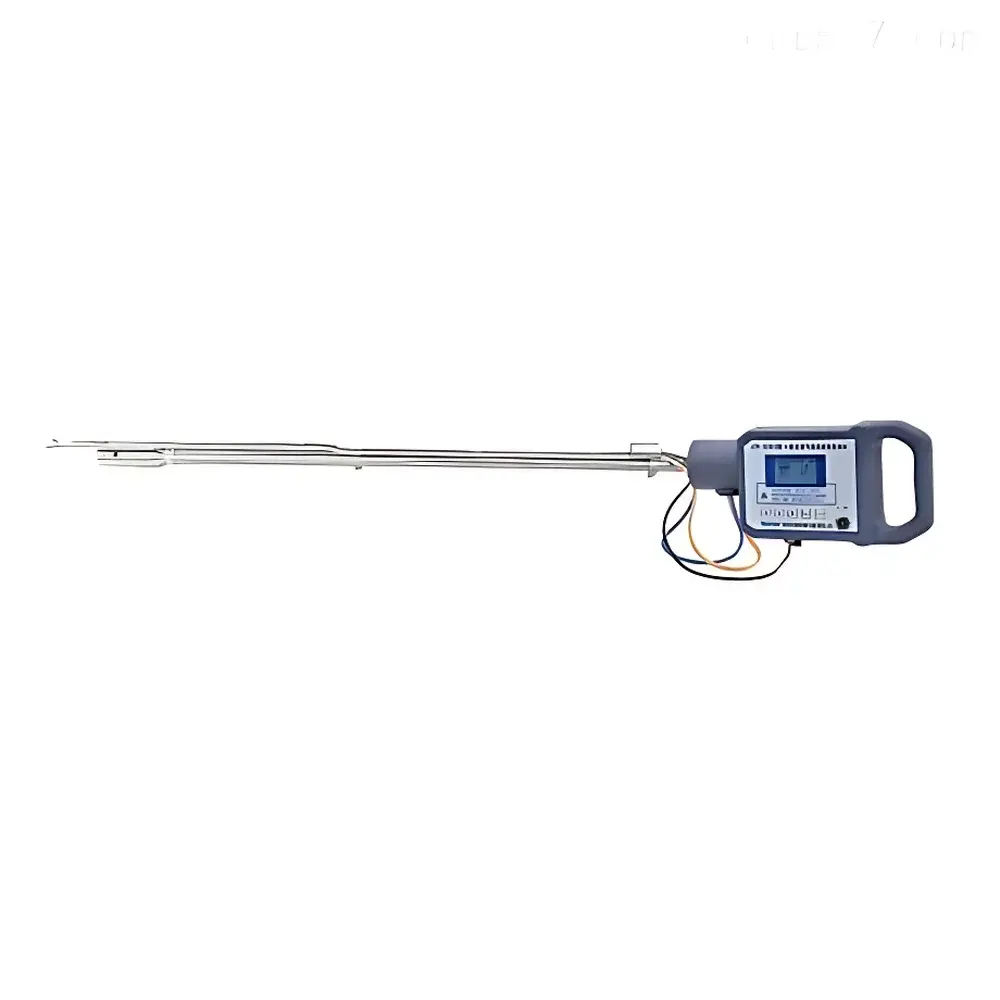
Junray ZR-3063 Integrated Flue Gas Velocity and Moisture Meter
| Brand | Junray |
|---|---|
| Model | ZR-3063 |
| Origin | Shandong, China |
| Manufacturer Type | Direct Manufacturer |
| Instrument Type | Portable Flue Gas Analyzer |
| Measurement Principle | Resistive-Capacitive (R-C) Hygrometry |
| Parameters Measured | Moisture Content (wet-basis %), Gas Velocity (m/s), Flue Gas Temperature (°C) |
| Accuracy | ≤ ±2% of reading |
| Operating Environment | High-temperature, high-humidity, high-dust, high-corrosion, electrostatic conditions |
| Display | Wide-temperature, high-brightness LCD |
| Power Supply | AC/DC dual-mode |
| Data Interface | RS485, Bluetooth printing, local storage & export |
| Structural Material | Corrosion-resistant stainless steel (standard probe length: 1 m) |
| Compliance Standards | GB/T 16157–1996, GB/T 11605–2005, HJ 836–2017, T/SSESB 1–2020 |
Overview
The Junray ZR-3063 Integrated Flue Gas Velocity and Moisture Meter is a field-deployable environmental monitoring instrument engineered for simultaneous, real-time measurement of flue gas moisture content (expressed as wet-basis volume percent), dynamic gas velocity, and stack temperature under demanding industrial emission conditions. It employs resistive-capacitive (R-C) hygrometry—a well-established, NIST-traceable method for in-situ humidity sensing in hot, corrosive gas streams—to deliver stable, low-drift moisture readings without optical interference or calibration drift associated with chilled-mirror or spectroscopic techniques. Unlike conventional modular setups requiring separate probes and signal conditioners, the ZR-3063 integrates a heated pitot tube, R-C humidity sensor, thermocouple, and pressure transducer into a single coaxial probe assembly—minimizing thermal lag, reducing cross-parameter interference, and eliminating inter-unit alignment errors. Its design adheres to the physical and metrological requirements defined in GB/T 16157–1996 (for isokinetic sampling compliance), GB/T 11605–2005 (humidity metrology), and T/SSESB 1–2020 (specific validation protocols for R-C-based flue gas moisture determination). The instrument operates across stack temperatures up to 200 °C (probe-rated), with active heating maintaining sensor surface temperature above dew point—critical for preventing condensate formation that compromises velocity and moisture accuracy.
Key Features
- Imported R-C humidity sensor with factory-calibrated traceability, offering long-term stability (<0.5% RH/year drift) and sub-second response time (t90 < 1.5 s) under transient flue conditions.
- Modular, rotatable, and detachable heated pitot tube—enabling precise alignment with flow direction and rapid cleaning/replacement without disassembling the main unit.
- Uniformly distributed heater circuit along the entire 1-meter stainless-steel probe (316L grade), maintaining ΔT > 15 °C above local dew point across full operating range to suppress condensation and salt deposition.
- Wide-temperature LCD display (–20 °C to 60 °C operational range) with backlight and intuitive menu navigation supporting multilingual UI (English default).
- Dual-power architecture: internal Li-ion battery (≥4 h runtime at 25 °C ambient) + universal AC adapter (100–240 VAC); automatic switchover ensures uninterrupted data logging during power transitions.
- Integrated differential pressure sensor for real-time static/dynamic pressure acquisition—used in velocity calculation algorithms per ISO 16911-1:2013 to correct for non-ideal flow profiles and barometric variations.
- Onboard memory (≥10,000 records) with timestamp, GPS-tagged location (optional), and configurable auto-save intervals; supports CSV export via USB or wireless Bluetooth thermal printing.
Sample Compatibility & Compliance
The ZR-3063 is validated for use in fixed-source emission stacks where flue gas exhibits particulate mass concentrations up to 50 g/Nm³, SO₂ levels ≤ 5,000 ppm, HCl ≤ 1,000 ppm, and relative humidity up to 95% RH at sensor surface. Its corrosion-resistant construction complies with ISO 9001 manufacturing controls and meets mechanical robustness requirements outlined in IEC 60068-2 for portable instrumentation. Regulatory alignment includes full traceability to Chinese national standards: GB/T 16157–1996 (sampling methodology), HJ 836–2017 (low-concentration PM measurement context), and T/SSESB 1–2020 (R-C sensor validation protocol—including linearity verification across 5–95% RH, repeatability ≤ ±0.8% RH, and temperature compensation error < ±0.3% RH/°C). While not certified to EU Measuring Instruments Directive (MID) or US EPA PS-11, its measurement uncertainty budget satisfies QA/QC requirements for routine CEMS support and regulatory reporting under China’s “Blue Sky Defense Campaign” framework.
Software & Data Management
Data acquisition and post-processing are managed via embedded firmware compliant with GLP principles: all measurements include immutable metadata (operator ID, calibration date, probe serial number, ambient pressure, and sensor health status). The device logs raw analog inputs (voltage, resistance, thermocouple EMF) alongside calculated parameters, enabling retrospective reprocessing if updated algorithms are deployed. Exported CSV files contain ISO 8601 timestamps, SI units, and uncertainty flags per parameter. Optional PC software (Junray DataLink v3.2) provides spectral trend analysis, multi-point profile mapping, and automated report generation aligned with HJ/T 75–2017 format templates. Bluetooth communication supports secure pairing (AES-128) and audit-trail logging per FDA 21 CFR Part 11 Annex 11 guidelines when used in regulated QA environments.
Applications
- Continuous emissions monitoring system (CEMS) commissioning and periodic performance verification in coal-fired power plants.
- In-stack validation of wet FGD (flue gas desulfurization) outlet moisture prior to chimney release—critical for plume opacity assessment and corrosion risk modeling.
- Process optimization in petrochemical crackers and reformers, where steam-to-hydrocarbon ratio control depends on accurate flue moisture feedback.
- Thermal efficiency auditing of industrial boilers and kilns, integrating velocity, temperature, and humidity to compute actual volumetric flow and enthalpy balance.
- Regulatory stack testing for cement, glass, and metallurgical facilities subject to provincial emission limits on water vapor mass loading (e.g., Shandong DB37/2372–2019).
- Environmental chamber qualification—measuring humidity and airflow uniformity inside climate-controlled tobacco curing rooms and pharmaceutical stability test chambers.
FAQ
What measurement principle does the ZR-3063 use for humidity detection?
It uses resistive-capacitive (R-C) hygrometry, where polymer-based sensing elements change impedance proportionally to water vapor partial pressure—calibrated against saturated salt standards per GB/T 11605–2005.
Can the instrument operate in acidic, sulfur-rich flue gas?
Yes—the 316L stainless-steel probe and chemically inert sensor housing provide proven resistance to SO₂, NOₓ, and HCl at typical combustion concentrations; optional ceramic-coated variants available for severe corrosion zones.
Is isokinetic sampling capability built-in?
No—isokinetic sampling requires external flow control valves and real-time velocity feedback; however, the ZR-3063 provides the essential velocity and temperature inputs needed to calculate and maintain isokinetic sampling rates per GB/T 16157–1996.
Does the device support remote data transmission via cellular or LoRaWAN?
Not natively—but RS485 output enables integration with third-party SCADA gateways or edge controllers for cloud telemetry using Modbus RTU protocol.
How often does the R-C sensor require recalibration?
Annual calibration is recommended under normal use; the instrument stores calibration history and prompts users 30 days before expiry—traceable to national metrology institutes via Junray’s accredited service centers.
Related Products







