
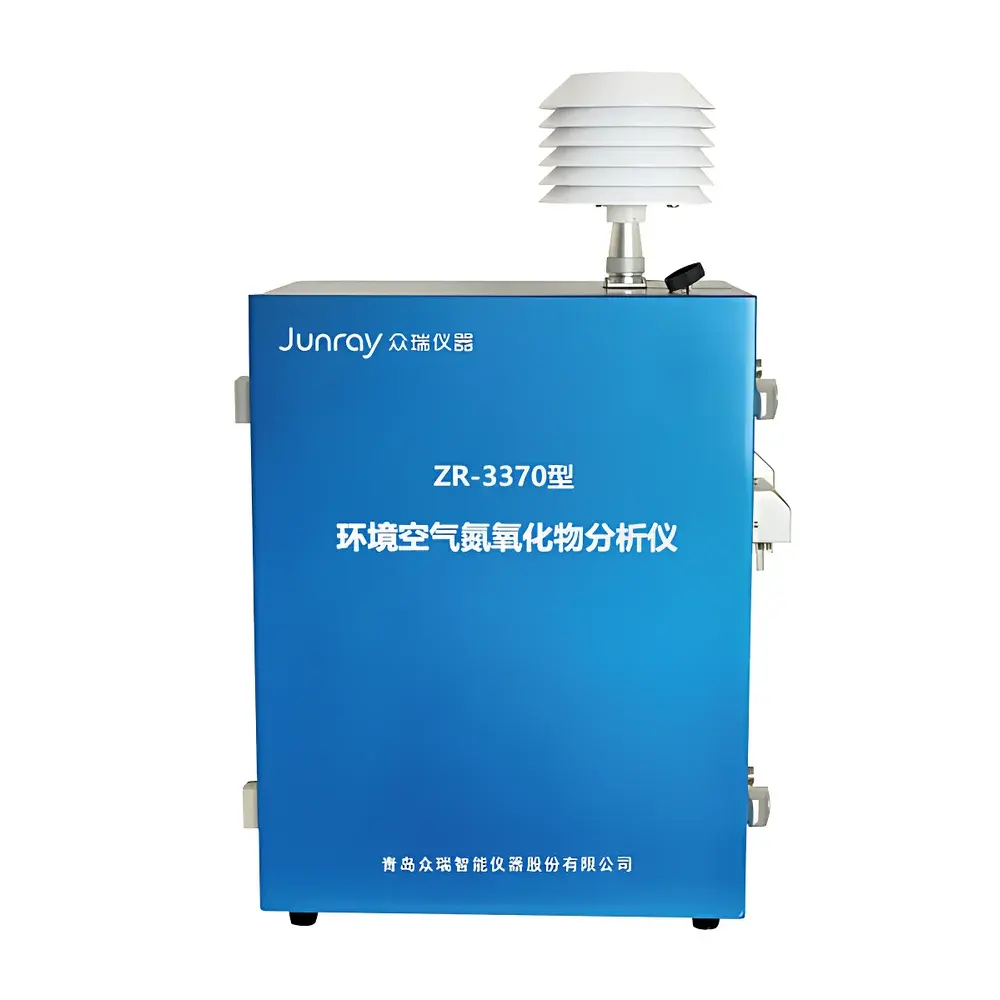
Junray ZR-3370 Environmental Air Nitrogen Oxides (NOₓ) Analyzer
| Brand | Junray |
|---|---|
| Model | ZR-3370 |
| Origin | Shandong, China |
| Manufacturer Type | Direct Manufacturer |
| Regional Classification | Domestic (China) |
| Price Range | USD 7,000 – 14,000 (FOB) |
Overview
The Junray ZR-3370 Environmental Air Nitrogen Oxides (NOₓ) Analyzer is a fully integrated, field-deployable gas analyzer engineered for continuous, real-time measurement of nitric oxide (NO) and nitrogen dioxide (NO₂) in ambient air. It operates on the principle of chemiluminescence detection—a well-established, reference-grade methodology standardized under multiple Chinese environmental monitoring regulations. In this process, gaseous NO reacts quantitatively with ozone (O₃) to form electronically excited nitrogen dioxide (NO₂*), which emits photons upon relaxation to the ground state. The intensity of emitted light—measured by a low-noise photomultiplier tube (PMT)—is linearly proportional to the NO concentration. To determine total NOₓ (NO + NO₂), ambient air passes through a high-efficiency catalytic molybdenum (Mo) converter that quantitatively reduces NO₂ to NO prior to reaction with ozone. This dual-channel configuration enables selective, interference-resistant measurement of NO and NO₂ with high specificity and minimal cross-sensitivity to common atmospheric interferents such as CO, SO₂, or hydrocarbons.
Key Features
- Chemiluminescence-based detection compliant with HJ 1043–2019 and JJG 801–2004 metrological verification requirements
- Detection limit ≤ 50 ppt (NO) with full-scale range options from 0–200 ppb to 0–20 ppm, configurable per site requirements
- Response time (T₉₀) < 60 seconds for both NO and NO₂ channels, supporting dynamic ambient monitoring
- Integrated Mo-converter with >95% NO₂-to-NO conversion efficiency across 0–40°C and 20–90% RH operating conditions
- Compact, weatherproof enclosure (IP65-rated) with internal temperature and pressure compensation; designed for unattended outdoor deployment
- Onboard zero/span calibration capability using internal solenoid valves and certified calibration gases (optional external gas cabinet integration)
- Low power consumption (< 150 W) and wide input voltage range (100–240 VAC, 50/60 Hz), suitable for solar-powered remote stations
Sample Compatibility & Compliance
The ZR-3370 is validated for direct analysis of ambient air without pre-concentration or filtration beyond standard particulate removal (e.g., 2.5 µm cyclone or Teflon membrane filter). It meets the physical and performance specifications outlined in HJ 193–2013 (installation and acceptance), HJ 654–2013 (technical requirements and testing methods), and HJ 818–2018 (operation and quality control). All critical measurement parameters—including flow rate (1.0 ± 0.1 L/min), reaction chamber temperature stability (±0.5°C), and ozone generator output consistency—are continuously monitored and logged. Data outputs conform to HJ 663–2013 ambient air quality evaluation protocols, enabling seamless integration into national and provincial air quality monitoring networks (e.g., CNEMC platform). The instrument supports GLP-aligned audit trails for calibration events, maintenance logs, and fault diagnostics.
Software & Data Management
The analyzer runs embedded Linux-based firmware with a web-accessible interface (HTTPS-enabled) for remote configuration, diagnostics, and real-time data visualization. Measurement data are timestamped with GPS-synchronized UTC and stored locally on industrial-grade microSD (up to 32 GB) with automatic rollover. Export formats include CSV and XML, structured to align with China’s “Environmental Monitoring Data Transmission Technical Specification” (HJ 212–2017). Optional Modbus TCP and RS-485 interfaces support integration into SCADA systems or centralized data acquisition platforms. Firmware updates are delivered via secure OTA (Over-The-Air) mechanism with digital signature validation. All user actions—including parameter changes, manual calibrations, and alarm acknowledgments—are recorded with operator ID, timestamp, and pre-/post-value logging, satisfying traceability requirements under HJ 818–2018 and supporting regulatory audits.
Applications
- Continuous ambient air quality monitoring at urban, suburban, roadside, and background stations
- Source attribution studies and emission plume tracking in industrial zones and port areas
- Method validation and inter-comparison campaigns against federal equivalent methods (FEM) or reference analyzers
- Short-term intensive field campaigns for photochemical modeling input (e.g., ozone formation potential assessment)
- Mobile monitoring deployments on vehicle-mounted or drone-carried platforms (with optional vibration-dampened mounting kit)
- Compliance monitoring for environmental impact assessments (EIA) and post-construction environmental supervision
FAQ
What regulatory standards does the ZR-3370 comply with?
It is fully aligned with HJ 1043–2019 (chemiluminescence method), HJ 654–2013 (performance requirements), HJ 818–2018 (QA/QC procedures), and JJG 801–2004 (metrological verification).
Can the ZR-3370 measure NO and NO₂ separately?
Yes—it operates in dual-mode: direct NO measurement and total NOₓ (via Mo-converter); NO₂ concentration is derived by difference (NOₓ − NO).
Is ozone generation internal or external?
Ozone is generated internally via UV photolysis of ambient air or purified oxygen, with real-time ozone concentration feedback control.
Does the analyzer support remote diagnostics and firmware updates?
Yes—via secure HTTPS web interface and optional OTA update capability with cryptographic integrity verification.
What maintenance intervals are recommended?
Standard maintenance includes quarterly PMT gain verification, biannual converter efficiency check (using certified NO₂ gas), and annual full system calibration per HJ 818–2018 guidelines.
Related Products







