
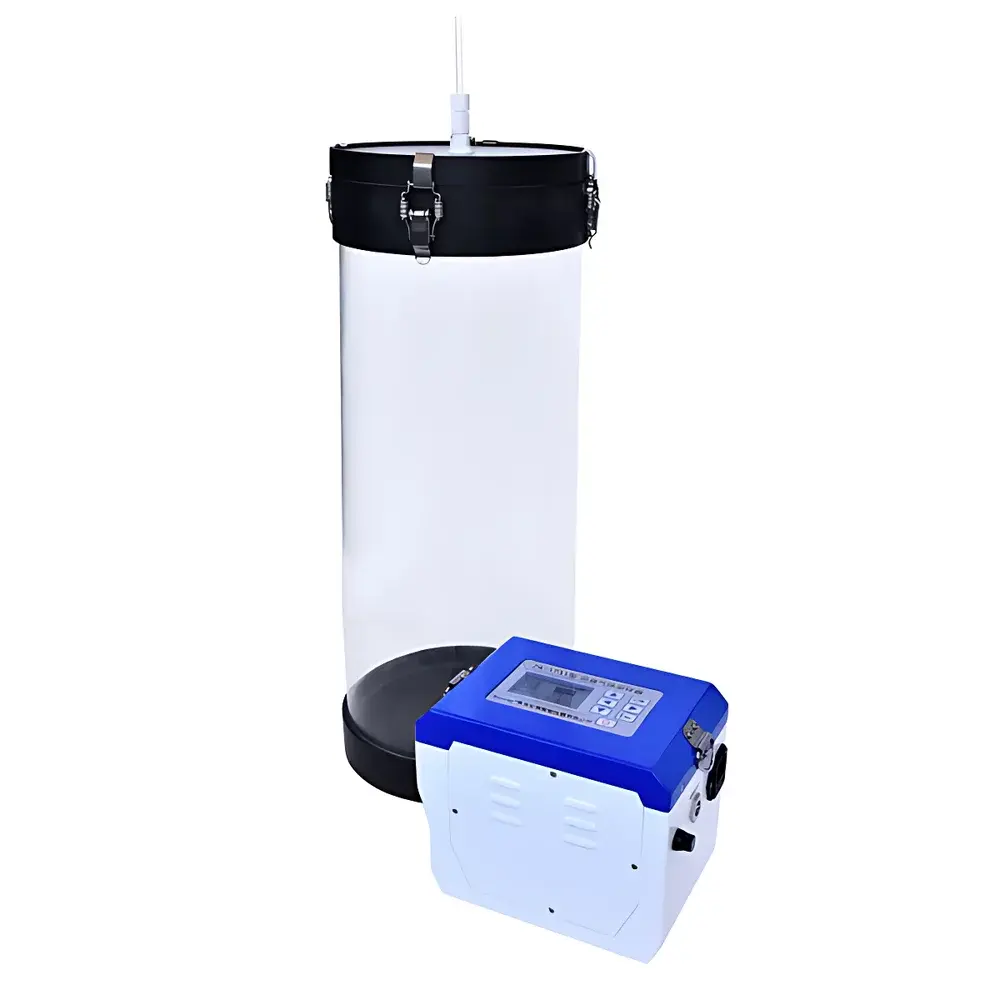
Junray ZR-3731 Portable Odor Gas Sampler
| Brand | Junray |
|---|---|
| Origin | Shandong, China |
| Manufacturer Type | Direct Manufacturer |
| Product Category | Domestic |
| Model | ZR-3731 |
| Instrument Type | Portable |
| Sampling Principle | Passive Negative-Pressure Bag Sampling |
| Flow Rate | 6 L/min |
| Operating Temperature Range | (−20 to 50) °C |
| Operating Relative Humidity Range | 0–85% RH |
| Battery Life | >6 hours (built-in Li-ion) |
| Bag Capacity Compatibility | 1–10 L Tedlar® or FEP gas sampling bags |
| Flow Control | 3-step adjustable speed |
| Pressure Monitoring & Auto-Stop Protection | Yes |
| Tubing Material | PTFE (inert) |
| Valve Type | Inert electromagnetic valve with auto-leak check and programmable purge cycles |
| Filtered Sampling Probe | Included for fixed-source stack sampling |
| Compliance Standards | GB/T 14675–1993, HJ 905–2017 |
Overview
The Junray ZR-3731 Portable Odor Gas Sampler is a field-deployable, battery-powered sampling instrument engineered specifically for compliant collection of odorant-laden air and emissions from environmental ambient sites, wastewater treatment facilities, landfills, composting operations, industrial stacks, and other fugitive or point sources. It implements a passive negative-pressure bag sampling methodology—where ambient or source air is drawn directly into inert gas sampling bags without active pressurization or mechanical compression—thereby preserving the chemical integrity of volatile organic compounds (VOCs), reduced sulfur compounds (e.g., H₂S, mercaptans), nitrogenous species (e.g., NH₃, amines), and other odor-active trace gases susceptible to adsorption, catalytic degradation, or oxidation during conventional pump-driven sampling. This principle aligns with the foundational requirements of standardized olfactometric analysis, particularly where subsequent laboratory evaluation via dynamic dilution olfactometry (e.g., EN 13725 or ASTM E679) depends critically on representative, unaltered sample composition.
Key Features
- Passive negative-pressure sampling architecture minimizes turbulence, shear stress, and contact surface area—reducing analyte loss and cross-contamination risks inherent in positive-displacement or high-shear pump systems.
- Integrated high-efficiency lithium-ion battery supports continuous operation for over six hours, enabling extended field campaigns without AC power dependency—critical for remote or infrastructure-limited monitoring locations.
- High-capacity, low-pulsation sampling pump delivers stable 6 L/min flow across variable backpressure conditions, including use with particulate filters, moisture traps, or long sampling lines typical in stack or duct applications.
- Electromagnetic valves constructed from perfluoroelastomer (FFKM)-sealed PTFE components ensure chemical inertness and support automated leak-check routines, programmable purge sequences (1–5 cycles), and fail-safe pressure cutoff.
- Real-time internal pressure sensing triggers automatic sampling termination when bag fill pressure exceeds user-defined thresholds—preventing over-pressurization, bag rupture, or membrane deformation that could compromise analytical validity.
- All wetted surfaces—including tubing, connectors, and internal manifolds—are fabricated from virgin PTFE, eliminating hydrophobic/hydrophilic adsorption sites for polar and nonpolar odorants alike.
- Three-stage manual flow rate adjustment allows optimization for varying matrix viscosities, humidity levels, and bag volume capacities (1 L to 10 L), ensuring consistent fill times and minimizing wall effects during transfer.
Sample Compatibility & Compliance
The ZR-3731 is validated for use with standard odor sampling bags manufactured from fluorinated ethylene propylene (FEP) or polyvinyl fluoride (Tedlar®), both of which meet ASTM D6196 and EN 13725 specifications for VOC retention and odorant stability over 24–48 hour hold times. Its design adheres strictly to Chinese national standards GB/T 14675–1993 (Air Quality — Determination of Odor by Triangular Forced-Choice Olfactometry) and HJ 905–2017 (Technical Specification for Odor Pollution Environmental Monitoring), supporting legally defensible data acquisition in regulatory reporting contexts. While not certified to ISO/IEC 17025 for calibration traceability, the instrument’s mechanical repeatability and pressure-controlled termination protocol contribute to inter-laboratory comparability when paired with accredited olfactometry labs.
Software & Data Management
The ZR-3731 operates as a standalone hardware platform with no embedded firmware-based data logging or Bluetooth/Wi-Fi connectivity. Sample metadata—including start/stop timestamps, selected flow rate, bag size, ambient temperature and humidity (when externally recorded), and operator ID—are documented manually on standardized chain-of-custody forms aligned with GLP principles. For laboratories operating under FDA 21 CFR Part 11 or ISO 17025 frameworks, integration with LIMS requires external barcode scanning or digital entry of instrument-specific batch IDs assigned per sampling event. Firmware updates are not applicable; mechanical calibration verification (e.g., flow rate validation via primary rotameter or bubble meter) is recommended prior to each deployment cycle.
Applications
- Ambient air monitoring near municipal waste handling facilities and agricultural operations.
- Fugitive emission screening at chemical storage areas, rendering plants, and tanneries.
- Stack testing for compliance with local odor emission limits under provincial environmental protection bureau directives.
- Baseline odor characterization during environmental impact assessments (EIAs) for new industrial developments.
- Source apportionment studies using parallel bag sampling across multiple emission points followed by GC-MS or GC-Olfactometry analysis.
- Quality assurance for odor control system performance verification (e.g., biofilter or activated carbon bed efficiency).
FAQ
Does the ZR-3731 support quantitative concentration measurement?
No. It is a sampling device only—not an analyzer. Quantification requires subsequent laboratory analysis using olfactometers, GC-MS, or sensor arrays calibrated against certified standards.
Can it be used for hydrogen sulfide (H₂S) or ammonia (NH₃) grab sampling?
Yes—provided sampling bags are pre-evacuated and analyzed within 4 hours for H₂S or 8 hours for NH₃ per EPA Method TO-15 and HJ 732–2014 guidance on reactive gas stability.
Is PTFE tubing compatible with chlorine-containing compounds?
PTFE exhibits excellent resistance to Cl₂, chlorinated VOCs, and acidic gases; however, prolonged exposure to high-concentration hypochlorous acid vapor may affect long-term seal integrity and is not recommended.
What maintenance intervals are recommended?
Valve purge cycles should be performed after every 10 sampling events; battery health verification every 6 months; and full flow calibration annually using NIST-traceable reference meters.
Does the instrument include calibration certification?
No factory calibration certificate is supplied. Users must perform initial and periodic flow verification using independent metrological equipment compliant with ISO 6145-1 or equivalent.







