
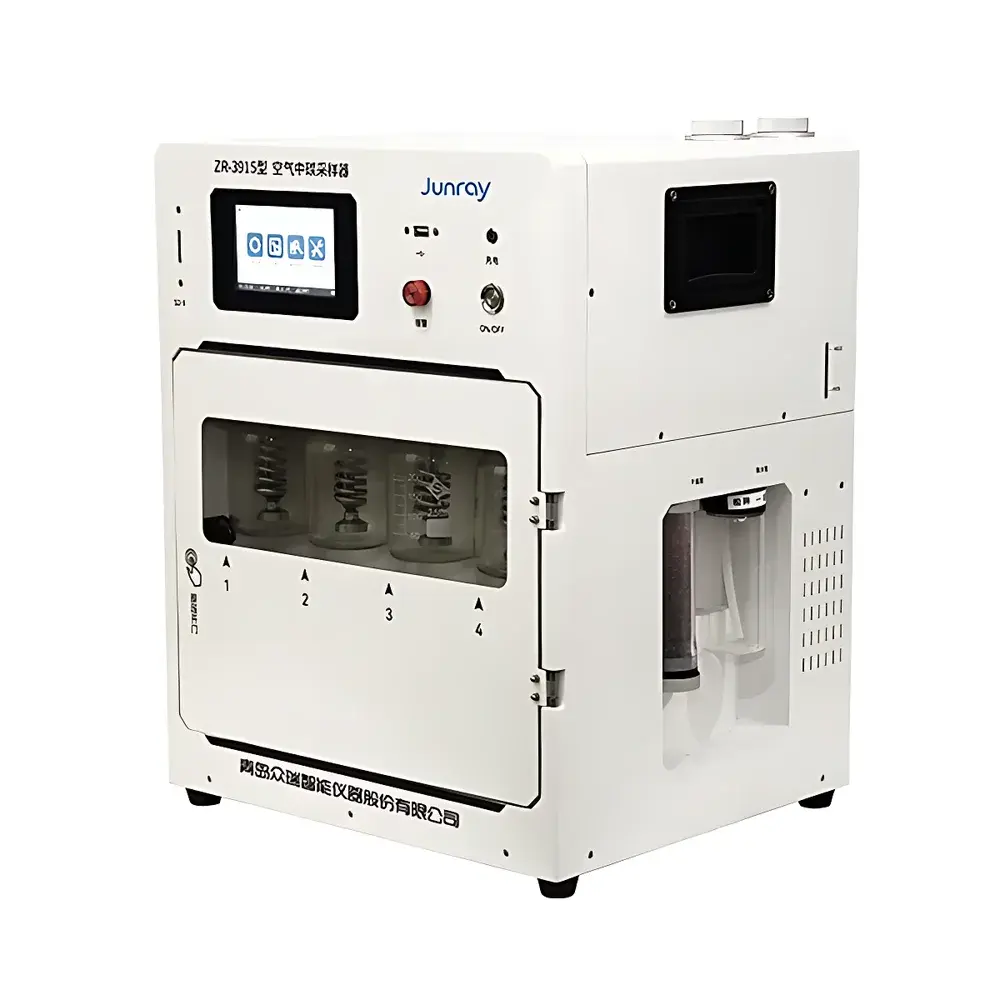
Junray ZR-3915 Airborne Carbon-14 Sampling System
| Brand | Junray |
|---|---|
| Origin | Shandong, China |
| Manufacturer Type | OEM Manufacturer |
| Country of Origin | China |
| Model | ZR-3915 |
| Pricing | Upon Request |
Overview
The Junray ZR-3915 Airborne Carbon-14 Sampling System is a field-deployable, high-integrity environmental monitoring instrument engineered for the quantitative collection of airborne 14C-bearing species—including CO2, CO, and CH4—in radiation-prone environments. It operates on a validated multi-stage sampling principle: ambient air first passes through a pneumatic water trap and particulate filter to remove moisture and aerosols; residual carbonaceous gases (CO, CH4) are then catalytically oxidized to CO2 in a precisely controlled high-temperature oxidation furnace (typically 800–900 °C); finally, the resulting CO2 is quantitatively absorbed via bubbling into alkali solution (e.g., NaOH or KOH) contained in four low-potassium absorption bottles. This methodology ensures minimal isotopic fractionation and maximal recovery efficiency—critical for subsequent liquid scintillation counting (LSC) or accelerator mass spectrometry (AMS) analysis. Designed for regulatory compliance and operational resilience, the ZR-3915 meets the technical requirements outlined in HJ 61–2021 (Technical Specification for Radiation Environmental Monitoring), HJ 22–1998 (General Requirements for Sampling of Airborne Radioactive Substances), and EJ/T 1008–1996 (Sampling and Determination of 14C in Ambient Air).
Key Features
- Integrated lithium-ion battery enabling full instrument operation—including boot-up, data review, wireless transmission, and Bluetooth printing—without external AC power.
- Automatic shutdown upon tilt detection, preventing sample contamination and ensuring operator safety during transport or unstable deployment.
- Compressor-based cooling system with user-adjustable setpoint (5–8 °C), maintaining optimal absorption kinetics and minimizing CO2 volatilization from alkaline traps.
- Embedded RFID/NFC electronic tag supporting inventory management integration with the ZR-M04 Depot Management System for traceable asset tracking and GLP-compliant equipment lifecycle logging.
- Onboard flow calibration capability, compatible with the ZR-5411 Portable Flow & Pressure Calibrator for ISO/IEC 17025-aligned volumetric flow verification prior to and after sampling campaigns.
- Embedded digital manual accessible via touchscreen—providing context-sensitive guidance, maintenance checklists, and troubleshooting protocols without external documentation.
- Real-time graphical display of instantaneous flow rate (L/min), including minute-by-minute trend visualization and exportable CSV logs for QA/QC audit trails.
- Multi-mode sampling control: time-based (e.g., 24-hr continuous), volume-triggered (e.g., 1000 L total), or interval-driven (e.g., 30-min on / 30-min off).
- Power-fail memory retention: automatically saves all active parameters, elapsed time, and accumulated volume; resumes sampling upon power restoration with audible and visual notification.
- 10.1-inch high-brightness capacitive touchscreen with intuitive Chinese GUI, ergonomic layout, and IP54-rated front panel for field durability.
- Four standardized wide-mouth absorption bottles (≥250 mL each), constructed from low-potassium borosilicate glass to minimize background 40K interference during radiometric analysis.
Sample Compatibility & Compliance
The ZR-3915 is validated for sampling across diverse atmospheric matrices: ambient outdoor air, stack effluents, ventilation exhausts, and emergency response zones. Its oxidation furnace achieves >99.5% conversion efficiency for CO and CH4 at standard flow rates (0.1–1.0 L/min), as verified per EJ/T 1008–1996. All wet chemistry components—including tubing, valves, and absorption vessels—are chemically inert to strong alkalis and resistant to thermal degradation under sustained operation. The system supports traceability frameworks required by national nuclear regulatory authorities and aligns with IAEA Safety Standards Series No. RS-G-1.8 (Environmental Monitoring for Regulatory Purposes). While not certified to ISO 17025 itself, its design facilitates method validation per ISO/IEC 17025:2017 Clause 7.2.2 (Validation of Non-Standard Methods) when deployed within accredited laboratory workflows.
Software & Data Management
Data integrity is maintained through dual-layer logging: internal flash memory stores timestamped flow profiles, temperature logs, alarm events, and user actions with immutable timestamps. Wireless transmission (Wi-Fi or optional LTE module) enables secure upload to centralized LIMS or cloud-based radiation monitoring platforms using TLS 1.2 encryption. USB-C port supports direct export of .csv and .pdf reports compliant with ALARA reporting templates. Bluetooth 5.0 interface pairs with certified portable printers for on-site hardcopy generation—fully traceable via embedded serial number and batch ID. Audit trail functionality records all configuration changes, user logins, and calibration events, satisfying GLP and GMP documentation requirements for nuclear environmental surveillance programs.
Applications
- Routine environmental surveillance around nuclear power plants, fuel fabrication facilities, and radioactive waste repositories.
- Emergency response monitoring following radiological incidents or unauthorized releases involving 14C-labeled compounds.
- Baseline characterization and long-term trend analysis in regulatory compliance programs mandated by national radiation protection agencies.
- Research-grade sampling for atmospheric carbon cycle studies where anthropogenic 14C signatures must be distinguished from natural cosmogenic background.
- Decommissioning site monitoring to verify absence of residual activation products in ventilation systems.
FAQ
What is the maximum recommended sampling duration per bottle set?
For optimal 14C recovery and minimal evaporation loss, continuous operation is limited to 72 hours per 250 mL bottle at 0.5 L/min flow—consistent with HJ 61–2021 guidance.
Can the ZR-3915 operate in sub-zero ambient conditions?
Yes—the compressor cooling system remains functional down to –10 °C ambient; however, battery performance degrades below 0 °C, and external thermal insulation of absorption bottles is recommended for extended cold-weather deployment.
Is the oxidation furnace temperature programmable?
No—the furnace operates at a fixed, factory-validated setpoint (850 ±10 °C) optimized for complete CO/CH4 conversion while avoiding catalyst sintering; temperature is continuously monitored and logged.
Does the system support remote firmware updates?
Firmware updates require local USB connection and authenticated administrator credentials; no over-the-air (OTA) update capability is implemented to preserve regulatory audit integrity.
How is background 14C minimized during sampling?
Through use of ultra-low-potassium glassware, pre-cleaned stainless-steel gas pathways, and rigorous procedural blanks—validated annually per ISO/IEC 17025 internal quality control protocols.
Related Products







