
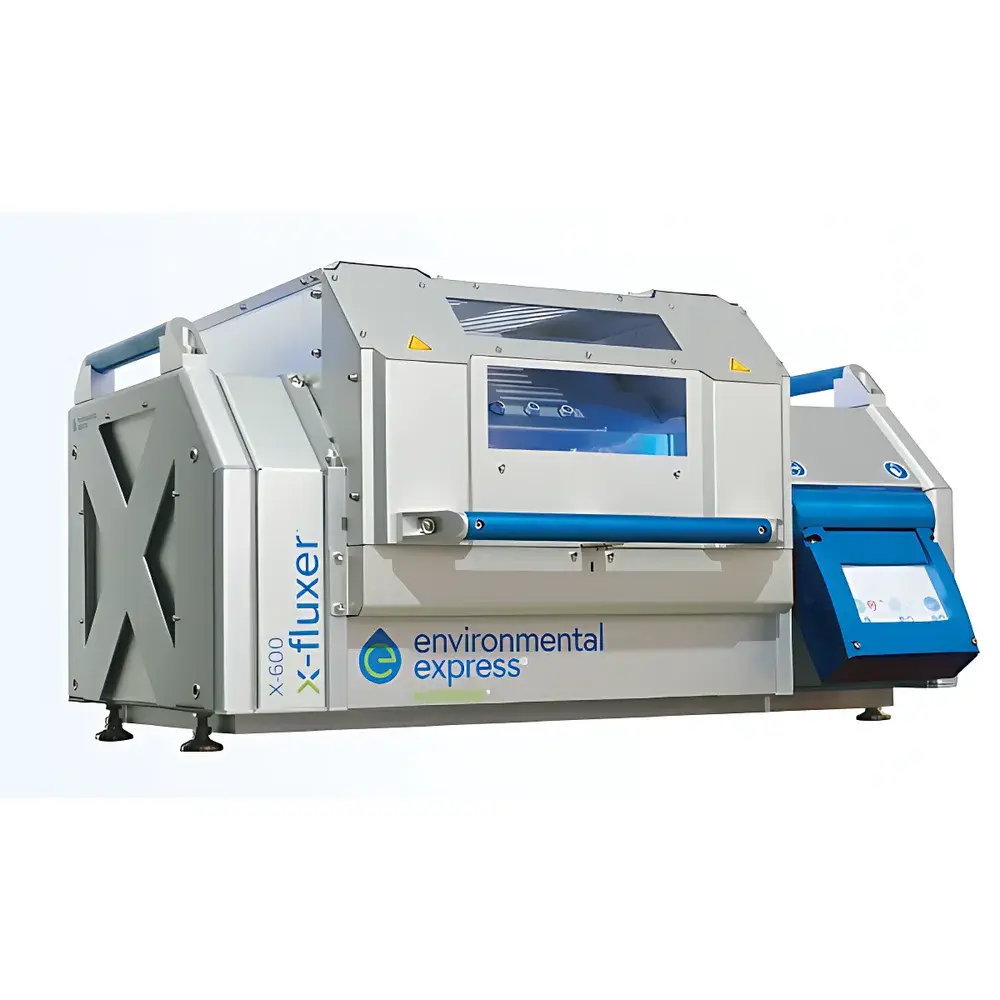
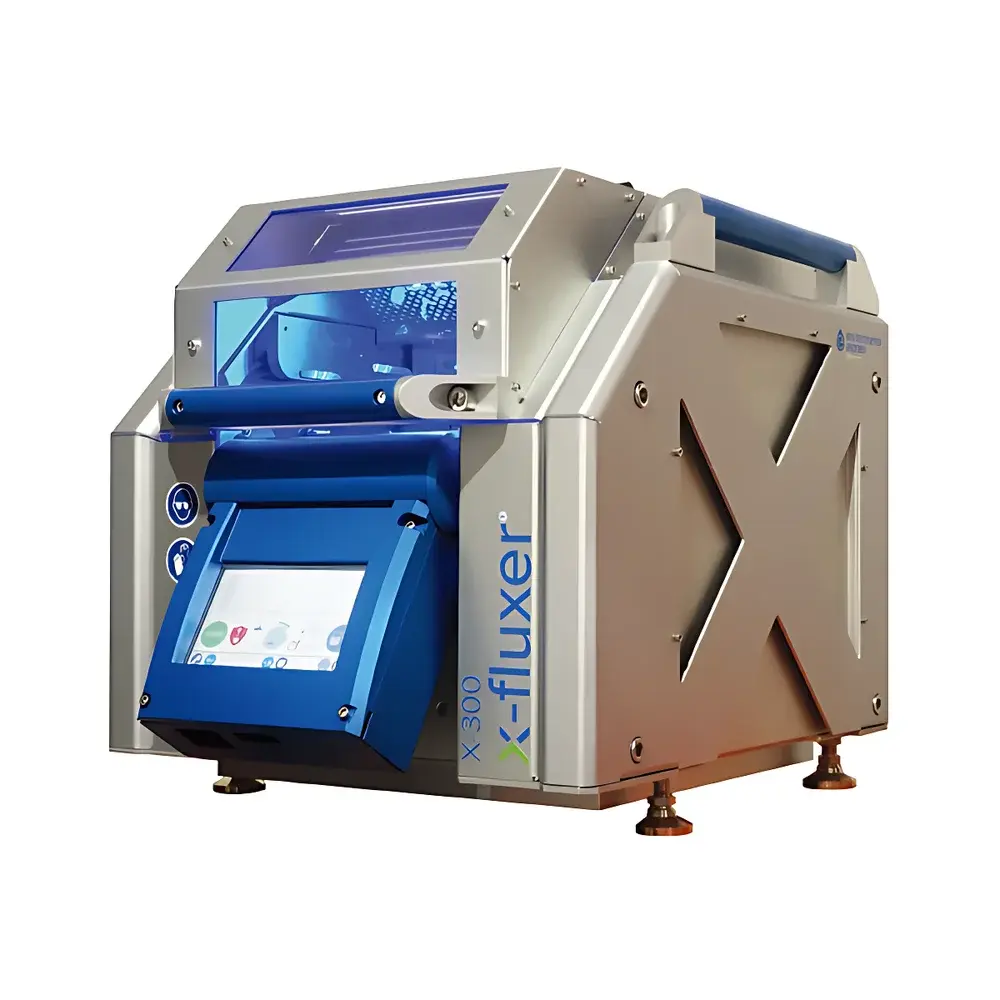
Katanax X-300 Electric Fusion Fluxer
| Brand | Katanax |
|---|---|
| Origin | USA |
| Model | X-300 |
| Operating Temperature Range | 50–1200 °C |
| Max. Power Consumption | 3000 W |
| Dimensions (H×W×D) | 51 × 48 × 63 cm |
| Weight | 45 kg |
| Sample Capacity | 2 crucibles (dual-position) |
| Heating Element | Black ceramic-coated composite heater |
| Temperature Uniformity Control | Dynamic Thermal Profiling (DTP) with per-element power calibration |
| Crucible Holder Material | 95% high-purity alumina |
| Mold Holder Material | High-density silicon nitride ceramic |
| Tilt Angle | ±30° |
| Tilting Speed | 0–100% (up to 60 cycles/min) |
| Slide Speed | 10 cm/s |
| Interface | Color LCD touchscreen with tilt adjustment |
| Data Export | USB port, optional FTP/LIMS integration |
| Safety | Integrated thermal shielding, no exposed metal in furnace chamber, visual & audible end-of-cycle alert |
| Compliance | Designed for GLP/GMP environments |
Overview
The Katanax X-300 Electric Fusion Fluxer is a precision-engineered laboratory instrument designed for the reproducible preparation of homogeneous fused beads and dissolution solutions for elemental analysis. It operates on the principle of controlled high-temperature flux fusion—where solid inorganic samples are dissolved in molten lithium tetraborate or lithium metaborate fluxes at temperatures up to 1200 °C. Unlike gas-fired furnaces or resistance-heated muffle ovens, the X-300 employs black ceramic-coated composite heating elements that deliver rapid thermal ramping (reaching 1200 °C in under 5 minutes), exceptional thermal stability (±1 °C control accuracy), and long-term resistance to oxidation-induced embrittlement. Its all-ceramic internal architecture—including silicon nitride mold holders and 95% alumina crucible supports—ensures chemical inertness against halide corrosion and mechanical integrity across repeated thermal cycling. The system is optimized for X-ray fluorescence (XRF) sample preparation but also supports solution generation for ICP-OES, ICP-MS, and atomic absorption spectroscopy (AAS) via optional agitation modules.
Key Features
- Dynamic Thermal Profiling (DTP) technology: Real-time per-element power calibration ensures uniform temperature distribution across dual crucible positions—critical for inter-sample comparability in quantitative XRF.
- Black ceramic composite heating elements: Rated to 1800 °C maximum, non-oxidizing, and individually replaceable—eliminating downtime associated with silicon carbide or molybdenum disilicide rod degradation.
- Dual-position configuration: Accommodates two 26 g platinum–gold alloy crucibles and two 21 g borosilicate or platinum molds simultaneously, enabling parallel processing without cross-contamination.
- Programmable mechanical motion: Step-motor-driven crucible tilting (±30°) and linear sliding (10 cm/s) ensure consistent flux mixing, bead formation, and slag separation during cooling.
- Industrial-grade human–machine interface: Full-color, tilt-adjustable LCD touchscreen with intuitive workflow navigation, password-protected method storage, and real-time thermal profile visualization.
- Integrated safety architecture: No open flame or combustible gas required; full thermal shielding, automatic overtemperature cutoff, and dual-mode end-of-cycle notification (visual flash + audible tone).
Sample Compatibility & Compliance
The X-300 accommodates a broad spectrum of geological and industrial matrices—including cement clinker, iron ore, slag, soil, sediment, refractory ceramics, glass frits, pigments, and alloy powders. All sample types are processed under standardized fusion protocols aligned with ASTM E1375, ISO 29581-2, and USP . The absence of metallic components within the furnace chamber prevents catalytic interference and meets stringent requirements for trace-metal analysis. When paired with validated software and audit-trail-enabled data capture, the instrument supports compliance with FDA 21 CFR Part 11, EU Annex 11, and GLP/GMP documentation standards. Optional barcode scanning and USB/FTP data export facilitate seamless integration into enterprise LIMS environments.
Software & Data Management
The X-300 firmware includes embedded method libraries for common flux-to-sample ratios (e.g., 10:1 Li₂B₄O₇ for silicates), preconfigured ramp–hold–cool sequences, and user-defined parameter sets. All run logs—including timestamped temperature profiles, tilt cycle counts, power consumption metrics, and operator ID—are stored internally and retrievable via USB flash drive. Remote monitoring is supported through Ethernet or Wi-Fi connectivity, allowing status checks and method initiation from desktop workstations or mobile devices. For regulated laboratories, optional software packages provide electronic signature capability, change control tracking, and automated report generation compatible with PDF/A-2b archival standards.
Applications
Primary applications include fused-bead preparation for wavelength-dispersive (WD-XRF) and energy-dispersive (ED-XRF) spectrometry, where matrix-matched homogeneity eliminates mineralogical and particle-size effects. Secondary use cases involve alkaline fusion for total digestion prior to ICP analysis—particularly for refractory oxides (e.g., Cr₂O₃, TiO₂, ZrO₂) resistant to acid leaching. The instrument’s precise thermal control also enables controlled oxidative decomposition of organic binders in metallurgical samples and thermal stabilization studies of flux systems. Its dual-position design makes it especially suited for method development labs requiring side-by-side comparison of flux chemistries or heating schedules.
FAQ
What is the maximum operating temperature of the X-300, and how quickly does it reach 1200 °C?
The X-300 achieves 1200 °C in less than 5 minutes from ambient, with a specified operating range of 50–1200 °C and thermal control accuracy of ±1 °C.
Can the X-300 be used for solution preparation for ICP analysis?
Yes—the X-300 supports solution-mode fusion using lithium-based fluxes; optional agitation modules enable simultaneous dissolution in both crucibles.
Are heating elements field-replaceable without specialized tools?
Yes—each black ceramic composite heating element is modular and can be replaced independently without furnace disassembly or recalibration.
Does the X-300 require external cooling or gas supply?
No—it operates solely on 230 V AC power (max. 3000 W) and requires no water cooling, compressed air, or fuel gas.
How is temperature uniformity verified across the two sample positions?
Through Dynamic Thermal Profiling (DTP), which performs per-element power calibration and spatial compensation to maintain ≤±2 °C inter-position deviation at 1100 °C.
Is the instrument compliant with regulatory data integrity requirements?
When configured with validated software and audit-trail logging, the X-300 meets core requirements of 21 CFR Part 11, including electronic signatures, record retention, and operation history traceability.



