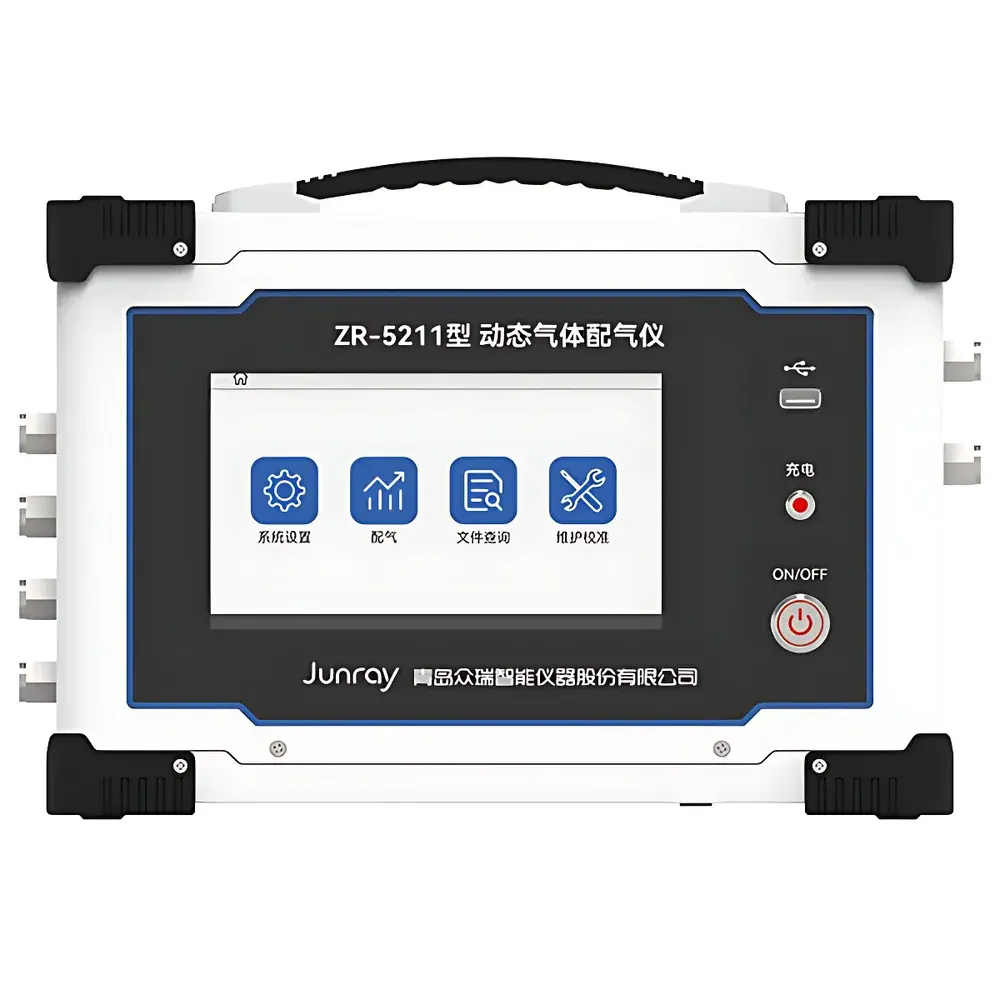
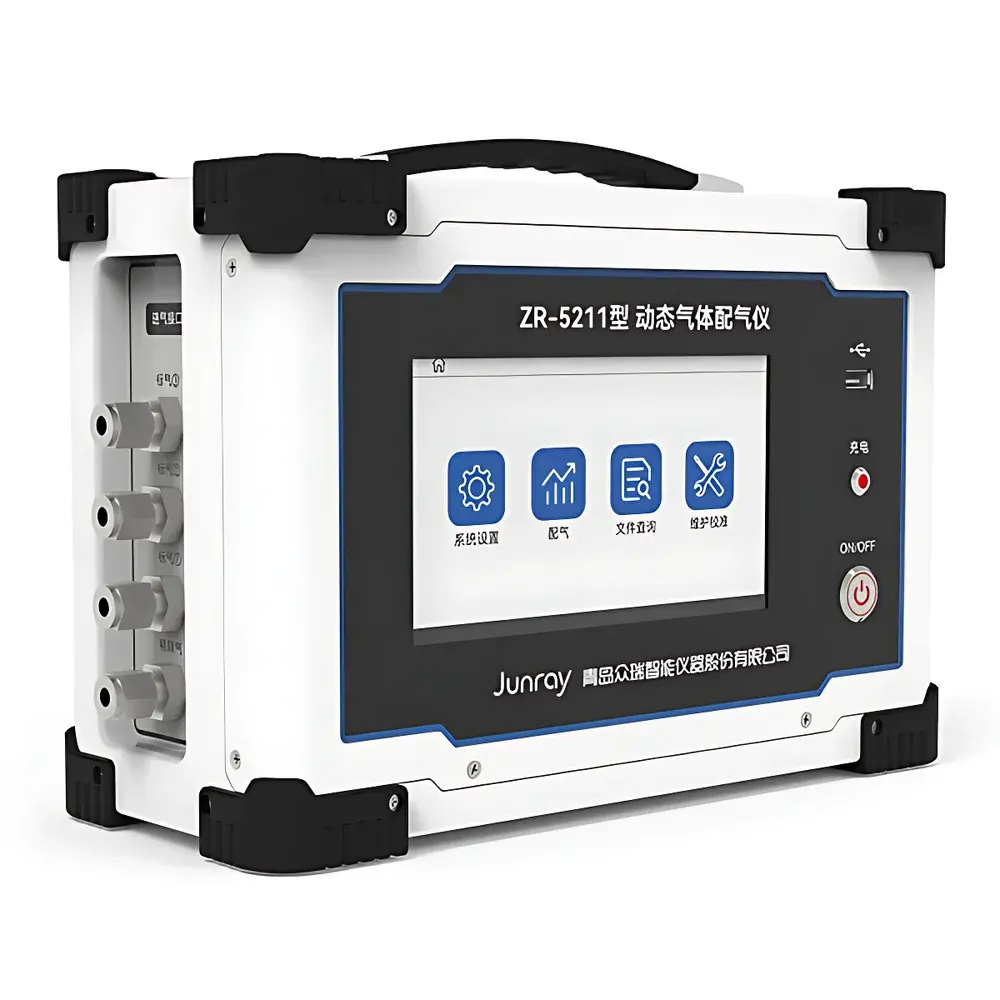
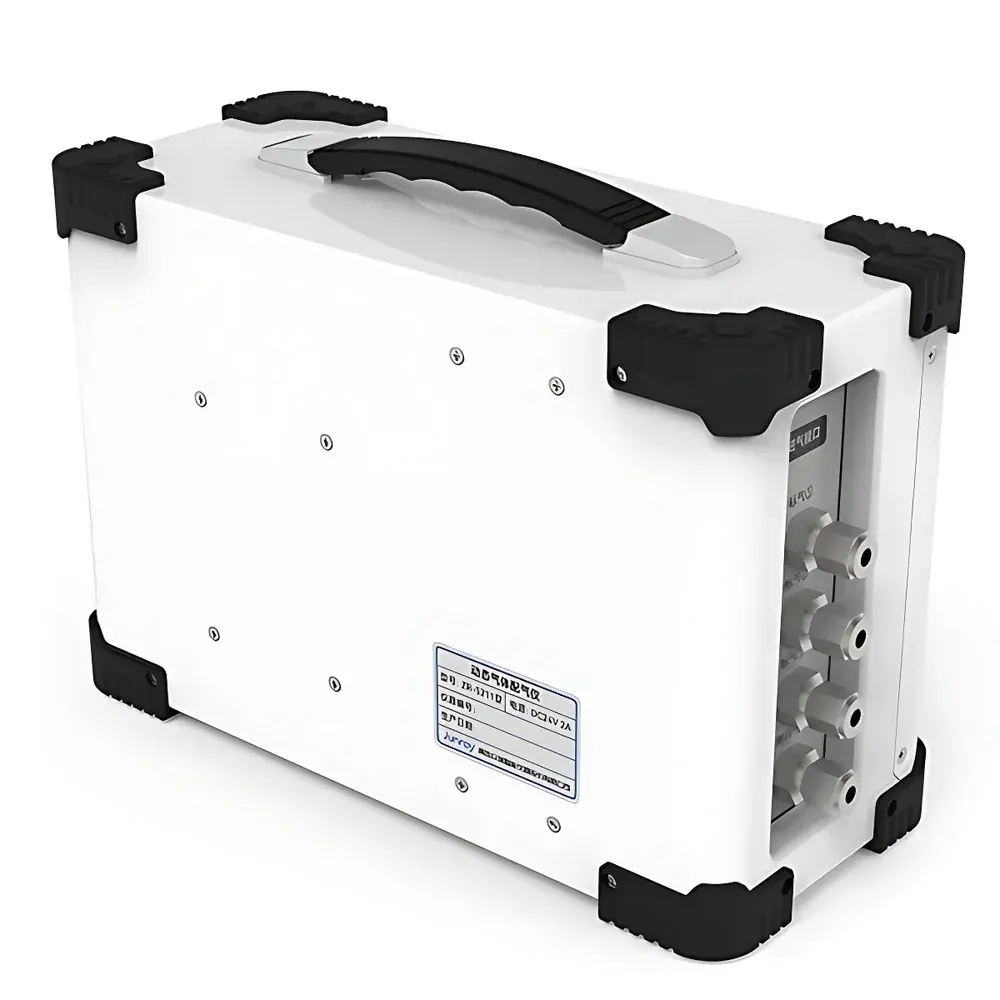
Junray ZR-5211 Dynamic Gas Dilution Calibrator
| Brand | Junray |
|---|---|
| Origin | Shandong, China |
| Manufacturer Type | Manufacturer |
| Product Category | Domestic |
| Model | ZR-5211 Dynamic Gas Dilution Calibrator |
| Pricing | Upon Request |
Overview
The Junray ZR-5211 Dynamic Gas Dilution Calibrator is an engineered precision instrument designed for the real-time, traceable preparation of low-concentration calibration gas standards from high-purity stock gases. It operates on the principle of dynamic dilution using mass flow control—where certified reference gases are metered via calibrated thermal mass flow controllers (MFCs) and mixed with ultra-pure diluent gas (e.g., zero air or nitrogen) in precisely defined volumetric ratios. This method ensures continuous, stable output concentrations across dilution ranges from 1:100 to 1:1000, enabling trace-level calibration of electrochemical, NDIR, UV-DOAS, chemiluminescence, and paramagnetic gas analyzers used in environmental monitoring, emissions testing, and metrological laboratories. Unlike static cylinder-based standards—which suffer from adsorption, permeation, and aging effects—the ZR-5211 delivers on-demand, compositionally stable calibration mixtures with minimized uncertainty propagation, supporting compliance with ISO/IEC 17025 accreditation requirements for gas standard generation.
Key Features
- Four independent, high-accuracy thermal mass flow controllers (MFCs) with ≤±1% full-scale repeatability and integrated temperature/pressure compensation.
- Corrosion-resistant and low-adsorption fluidic path constructed from electropolished 316L stainless steel, PTFE-lined tubing, and perfluoroelastomer (FFKM) seals—validated for use with SO₂, NOₓ, CO, O₃, H₂S, NH₃, and volatile organic compounds (VOCs).
- Dual-mode power architecture: supports both AC mains (100–240 VAC, 50/60 Hz) and DC input (12–24 VDC), enabling deployment in mobile labs, stack testing sites, and outdoor ambient air monitoring stations.
- 7-inch capacitive color touchscreen with intuitive Chinese-English bilingual GUI; fully menu-driven operation without external PC dependency.
- Integrated rechargeable lithium-ion battery pack providing ≥8 hours of continuous operation at nominal flow conditions (2 L/min total output).
- USB host interface for direct data export to FAT32-formatted USB flash drives—including time-stamped dilution logs, MFC calibration coefficients, and user-defined method files.
- Optional Bluetooth 5.0 module for wireless pairing with certified thermal printers (e.g., Zebra ZQ520), facilitating on-site generation of auditable calibration reports compliant with GLP documentation practices.
Sample Compatibility & Compliance
The ZR-5211 is validated for use with certified reference materials (CRMs) traceable to NIM (China National Institute of Metrology) or NIST SRMs, including but not limited to SO₂ (100 ppm in N₂), NO (50 ppm in air), CO (1000 ppm in N₂), and CH₄ (1000 ppm in air). Its dilution performance meets the procedural requirements of GB/T 5275.7–2014 (“Gas analysis — Preparation of calibration gas mixtures — Part 7: Dynamic volumetric method”) and supports method validation under HJ 57–2017 (“Determination of sulfur dioxide in exhaust gas from stationary sources — Potentiometric electrolysis method”). All internal flow paths comply with ISO 8573-1 Class 2 particulate and oil contamination limits. The system’s design adheres to IEC 61000-6-2 (immunity) and IEC 61000-6-3 (emission) standards for industrial environments.
Software & Data Management
The embedded firmware implements a deterministic real-time control loop (100 ms cycle time) for synchronized MFC actuation and concentration calculation. Calibration data—including span gas identity, target dilution ratio, actual measured output (via optional integrated sensor feedback), and operator ID—is stored locally with automatic timestamping (YYYY-MM-DD HH:MM:SS) and SHA-256 hash integrity verification. Exported CSV files contain column headers compliant with ASTM D6348–22 metadata conventions. Audit trail functionality records all parameter changes, method uploads, and system resets—supporting FDA 21 CFR Part 11-compliant electronic record retention when paired with validated third-party LIMS integration.
Applications
- Primary calibration of fixed-source emission analyzers (CEMS) for SO₂, NOₓ, CO, and O₂ in thermal power plants and cement kilns.
- Verification and span-checking of portable multi-gas detectors used in occupational health and safety assessments.
- Generation of intermediate calibration points for EPA Method 205 and EN 14181 QA/QC procedures.
- Traceability chain extension in provincial metrology institutes performing gas analyzer type approval per JJG 968–2019.
- On-site field calibration of open-path DOAS systems during ambient air quality network maintenance.
FAQ
What dilution ratios does the ZR-5211 support?
The instrument provides programmable dilution ratios from 1:100 up to 1:1000 (i.e., 1% to 0.1% v/v), with resolution of 0.1% and linearity deviation ≤±0.5% of setpoint across its operational range.
Can it be used with reactive gases such as Cl₂ or HF?
Yes—provided appropriate material selection (e.g., Hastelloy C-276 wetted parts and fluorosilicone diaphragms) is specified at order entry; standard configuration covers non-halogenated acidic and reducing species.
Is remote monitoring or SCADA integration possible?
The device features RS-485 Modbus RTU interface (standard) and optional Ethernet/IP module for integration into plant-wide automation systems and centralized calibration management platforms.
How often does the system require recalibration?
MFCs are factory-calibrated against NIM-traceable standards; annual verification against primary flow standards is recommended per ISO/IEC 17025 clause 6.5.2, with interim checks using certified check gases.
Does it meet requirements for accredited environmental testing labs?
Yes—the ZR-5211’s documented measurement uncertainty budget, traceable calibration hierarchy, and audit-ready data export fulfill key technical requirements of CNAS-CL01:2018 (equivalent to ISO/IEC 17025:2017) for gas standard generation activities.