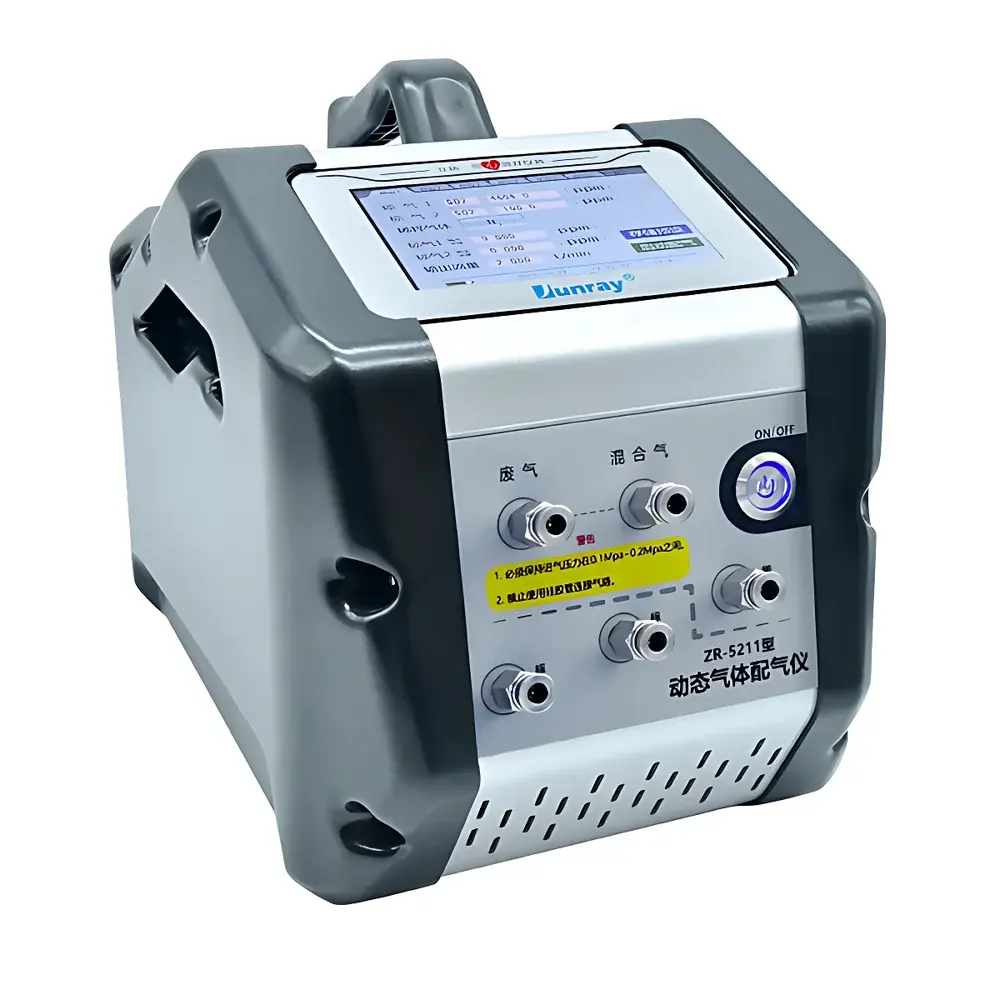
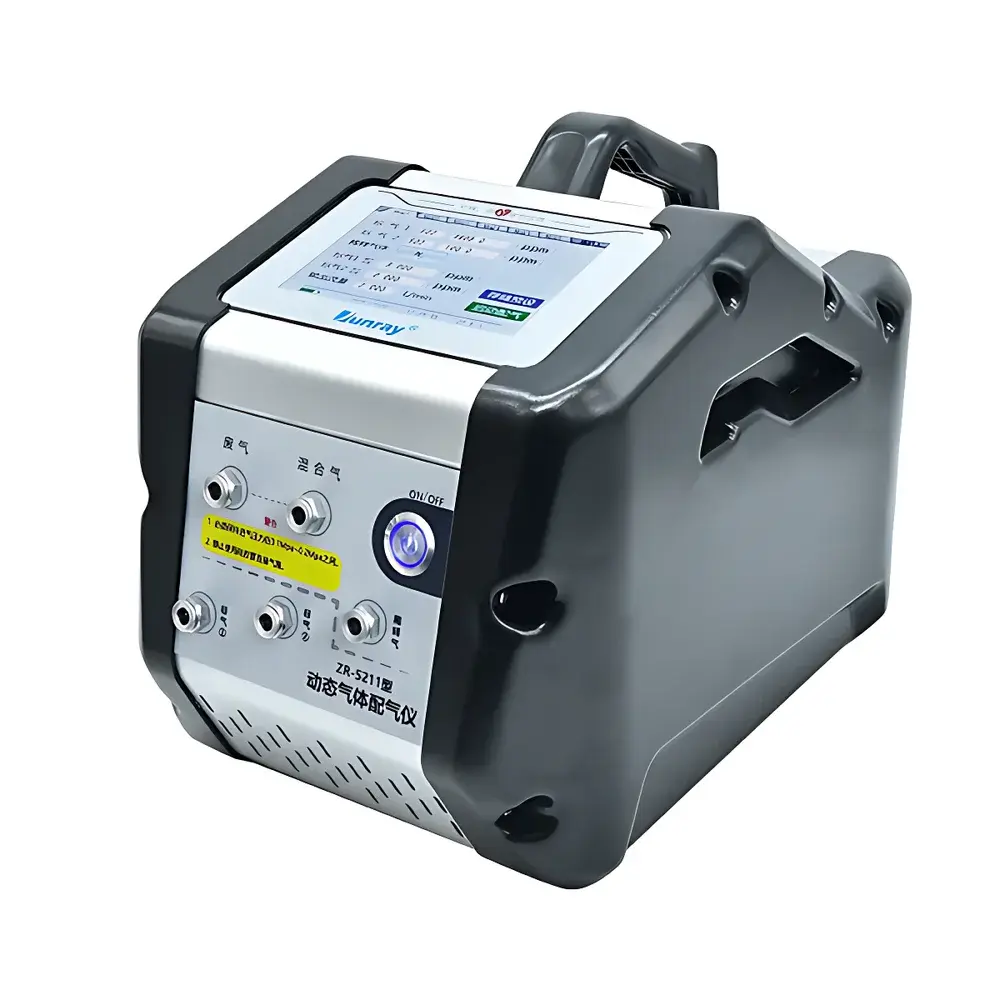
Junray ZR-5211 Dynamic Gas Dilution System
| Brand | Junray |
|---|---|
| Origin | Shandong, China |
| Manufacturer Type | Original Equipment Manufacturer (OEM) |
| Country of Origin | China |
| Model | ZR-5211 |
| Pricing | Available upon Request |
Overview
The Junray ZR-5211 Dynamic Gas Dilution System is an engineered precision instrument designed for the real-time, gravimetrically traceable preparation of low-concentration calibration gas mixtures from high-purity stock standards. Operating on the dynamic volumetric dilution principle—specifically compliant with GB/T 5275.7–2014 (equivalent to ISO 6145-7)—the system utilizes thermal mass flow control to achieve continuous, stable output of certified reference gas blends with programmable dilution ratios ranging from 1:10 to 1:10,000. It serves as a primary standard generator in metrological laboratories, environmental monitoring agencies, and OEM facilities producing gas analyzers (e.g., SO₂, NOₓ, CO, O₃), enabling traceable calibration across fixed-source emission monitoring systems (CEMS), portable UV absorption analyzers (per HJ 1131–2020 and HJ 1132–2020), and electrochemical sensors (per HJ 57–2017). Unlike static cylinder-based standards, the ZR-5211 eliminates cylinder aging effects, adsorption losses, and batch-to-batch variability—ensuring long-term stability and measurement reproducibility required under GLP and ISO/IEC 17025-accredited workflows.
Key Features
- Three independent thermal mass flow controllers (MFCs) with NIST-traceable calibration certificates, each rated for full-scale ranges from 0–50 sccm to 0–5 L/min, supporting simultaneous multi-gas dilution or sequential single-gas protocols.
- Chemically inert gas pathways constructed from electropolished 316L stainless steel, PTFE-sealed solenoid valves, and perfluoroalkoxy (PFA) tubing—minimizing surface adsorption, catalytic decomposition, and memory effects for reactive gases including SO₂, NO, NH₃, and Cl₂.
- Integrated dual-power architecture: operates seamlessly on 100–240 VAC (50/60 Hz) or 24 VDC input, enabling uninterrupted field deployment during stack testing, ambient air quality surveys, or mobile laboratory operations.
- 7-inch capacitive touchscreen interface with intuitive Chinese-language menu navigation, real-time flow visualization, and configurable alarm thresholds for pressure drop, MFC deviation (>±1.5% FS), and temperature drift.
- Modular chassis design with front-accessible filter cartridges, quick-disconnect fittings, and standardized DIN-rail mounting—facilitating preventive maintenance, ISO 17025 audit readiness, and integration into automated calibration stations.
Sample Compatibility & Compliance
The ZR-5211 supports dilution of non-corrosive and moderately reactive gases (e.g., CO, CO₂, CH₄, O₂, N₂, Ar) as well as regulated pollutants including sulfur dioxide (SO₂), nitrogen oxides (NO/NO₂), ozone (O₃), and hydrogen sulfide (H₂S), provided inlet concentrations remain within MFC linear operating ranges and compatibility limits of wetted materials. All flow paths conform to ASTM D6159–22 (Standard Practice for Calibration of Gas Analyzers Using Dynamic Dilution Systems) and are validated per GB/T 5275.7–2014 Annex B for uncertainty estimation (<±2.0% k=2 at 95% confidence). The system meets electromagnetic compatibility (EMC) requirements per GB/T 18268.1–2010 (IEC 61326-1) and safety specifications per GB 4793.1–2007 (IEC 61010-1). Documentation includes factory calibration reports, material compliance declarations (RoHS, REACH), and traceability statements aligned with CNAS accreditation criteria.
Software & Data Management
The embedded firmware supports data logging at 1 Hz resolution—including actual vs. setpoint flow values, internal ambient temperature, and system status flags—with timestamped CSV export via USB host port. Optional RS-485 Modbus RTU or Ethernet TCP/IP interfaces enable integration into SCADA platforms or centralized QA/QC databases. Audit trails record all parameter changes, user logins, and calibration events—supporting FDA 21 CFR Part 11-compliant electronic records when paired with validated third-party LIMS software. Firmware updates are delivered via signed binary packages with SHA-256 verification to ensure integrity and version control.
Applications
- Primary calibration of fixed and portable gas analyzers used in EPA Method 6C, 7E, and 10, including UV photometric SO₂ monitors and chemiluminescent NOₓ analyzers.
- Verification and linearity assessment of electrochemical and metal oxide semiconductor (MOS) gas sensors deployed in industrial hygiene and occupational safety instruments.
- Generation of intermediate calibration points for multi-point calibration curves in environmental laboratories accredited to ISO/IEC 17025.
- On-site validation of CEMS systems during performance qualification (PQ) and routine quality assurance (QA) per HJ 75–2017 and HJ 76–2017.
- Research-grade dilution studies requiring precise stoichiometric control—for example, kinetic investigations of catalytic converter efficiency or sensor response time characterization.
FAQ
What calibration standards does the ZR-5211 comply with?
It complies with GB/T 5275.7–2014 (dynamic volumetric method), ASTM D6159–22, and supports traceability to NIST SRMs via documented MFC calibration.
Can the system dilute corrosive gases such as chlorine or hydrogen fluoride?
No—wetted materials are not rated for HF, ClF₃, or anhydrous HCl; consult engineering support for custom Hastelloy-C276 or quartz-lined configurations.
Is remote operation supported out-of-the-box?
Yes—RS-485 Modbus RTU is standard; Ethernet and wireless options require optional communication modules and configuration.
How often must the mass flow controllers be recalibrated?
Annually under routine use; more frequently if exposed to particulate-laden or condensing gas streams—per ISO/IEC 17025 Clause 6.6.3.
Does the system provide uncertainty budgets for generated mixtures?
Yes—built-in calculation per GB/T 5275.7–2014 Annex B outputs combined standard uncertainty (k=2) based on MFC accuracy, temperature stability, and pressure compensation algorithms.