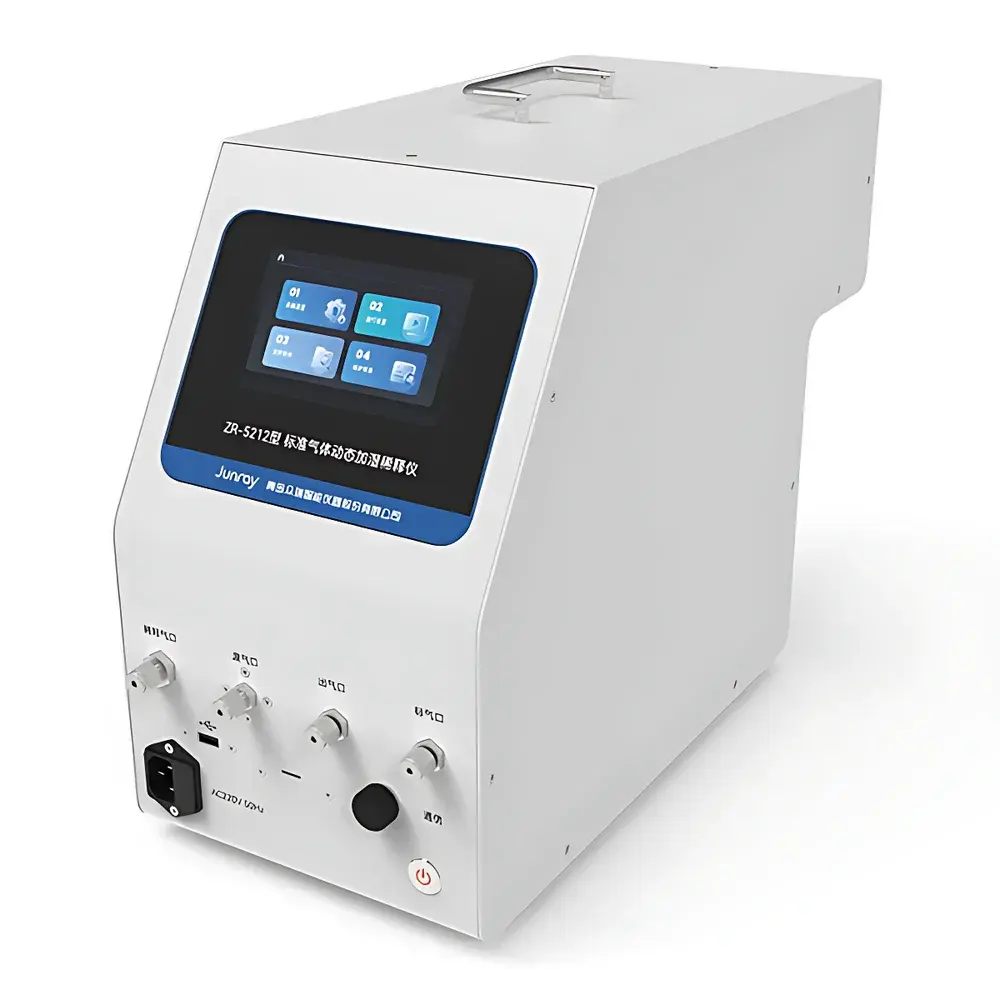
Junray ZR-5212 Dynamic Humidified Gas Dilution System
| Brand | Junray |
|---|---|
| Origin | Shandong, China |
| Manufacturer Type | Direct Manufacturer |
| Country of Origin | China |
| Model | ZR-5212 |
| Pricing | Upon Request |
| Standard Gas Flow Range | 0–10 mL/min |
| Diluent Gas Flow Range | 0–4 L/min |
| Humidity Control Range | 10–90 %RH |
| Display | High-Brightness Touchscreen (Chinese GUI, Wide-Temperature Operation) |
| Power Supply | AC Mains |
| Critical Components | Imported High-Accuracy Thermal Mass Flow Controllers (MFCs) |
| Gas Path Material | Passivated Metal Tubing |
Overview
The Junray ZR-5212 Dynamic Humidified Gas Dilution System is an engineered metrological instrument designed for the precise, real-time generation of trace-level calibration gas mixtures with controlled relative humidity. It operates on the dynamic dilution principle—using dual thermal mass flow controllers to meter high-concentration standard gases and dry diluent gas (e.g., zero air or nitrogen) independently, then combining them in a mixing chamber where humidity is introduced via a calibrated vapor generator. This enables continuous, stable output of humidified calibration standards across a wide concentration range (ppb to ppm), essential for validating and calibrating online volatile organic compound (VOC) analyzers deployed in ambient air monitoring networks, photochemical smog research stations, and regulatory compliance laboratories.
Key Features
- High-accuracy thermal mass flow controllers (imported, NIST-traceable calibration certificates available upon request) ensure long-term flow stability (<±0.5% FS repeatability) and low cross-sensitivity to temperature/pressure fluctuations.
- Passivated stainless-steel gas pathways minimize adsorption, desorption, and catalytic surface reactions—critical for reactive VOCs (e.g., aldehydes, terpenes, sulfur compounds) and ozone precursors.
- Integrated humidity generation module employs a temperature-controlled saturator and chilled-mirror-based feedback loop to maintain RH within ±2% RH accuracy across the full 10–90% RH operating range.
- Industrial-grade capacitive touchscreen interface supports intuitive parameter entry (target concentration, RH setpoint, dwell time), real-time flow/humidity trend visualization, and system diagnostics—all in a Chinese-language GUI optimized for field technicians and QA/QC personnel.
- AC-powered architecture enables uninterrupted operation over extended periods (7×24 h), supporting unattended calibration cycles required by EPA Method TO-15, EN 13528-3, and China’s HJ 1019–2019 protocols.
- Rugged mechanical design includes wide-temperature LCD operation (–20 °C to +50 °C), anti-glare optical bonding for outdoor readability, and IP54-rated enclosure for deployment in mobile labs or roadside monitoring shelters.
Sample Compatibility & Compliance
The ZR-5212 is compatible with certified reference materials (CRMs) traceable to NIM (China National Institute of Metrology) or NIST, including hydrocarbon blends (e.g., PAMS, TO-15), oxygenated VOCs (e.g., acetone, methanol), halogenated compounds (e.g., chloroform), and inorganic gases (e.g., NO, SO₂). Its dilution architecture conforms to the physical principles defined in GB/T 5275.7–2014 (“Gas analysis — Preparation of calibration gas mixtures using the dynamic volumetric method — Part 7: Thermal mass flow controllers”) and aligns with the metrological requirements outlined in JJF XXXX–202X (“Calibration Specification for Continuous Automatic Monitoring Systems of Ozone Precursor VOCs in Ambient Air”). The system supports GLP-compliant workflows through configurable audit trails, user access levels, and electronic record retention—facilitating readiness for CNAS-accredited laboratory audits and local environmental bureau inspections.
Software & Data Management
The embedded firmware records all operational parameters—including individual MFC setpoints and actual readings, RH setpoint vs. measured value, timestamps, and system status flags—at 1-second intervals. Data export is supported via USB flash drive in CSV format, enabling direct import into LIMS or statistical process control (SPC) platforms. Optional RS-485 Modbus RTU or Ethernet TCP/IP interfaces allow integration into centralized facility SCADA systems. All configuration changes are logged with operator ID and timestamp, satisfying basic data integrity requirements under China’s “Measures for the Supervision and Administration of Metrological Verification” and providing foundational traceability for ISO/IEC 17025 Clause 7.7 (result reporting).
Applications
- On-site calibration and verification of GC-FID, GC-MS, PTR-TOF, and SIFT-MS instruments used in ambient VOC monitoring networks.
- Generation of humidified challenge gases for evaluating humidity-dependent analyzer drift (e.g., humidity-induced bias in PID sensors or metal oxide semiconductor detectors).
- Method validation studies requiring matrix-matched standards (e.g., simulating humid urban air for emission source apportionment models).
- Performance testing of sampling interfaces, such as denuders, cryo-traps, and permeation tubes, under realistic RH conditions.
- Supporting inter-laboratory comparison exercises organized by provincial EPBs or national environmental monitoring centers.
FAQ
Does the ZR-5212 support automated concentration ramping or multi-step protocols?
Yes—the device accepts up to 10 pre-programmed sequences, each defining time-stamped target concentration, RH, and dwell duration, enabling unattended multi-point calibration runs.
Can it be used with corrosive gases such as HCl or Cl₂?
Not without customization: standard passivation is optimized for hydrocarbons and oxygenates. For highly corrosive species, optional Hastelloy C-276 wetted parts and enhanced sealing materials are available upon engineering review.
Is third-party calibration certification included with delivery?
Factory calibration is performed per internal SOP-DM-002; NIST-traceable calibration certificates for MFCs and RH sensor can be provided at additional cost and lead time.
What maintenance intervals are recommended?
MFC zero checks every 30 days; RH sensor verification quarterly; full system leak check and pathway cleaning semiannually—documented in the included Maintenance Logbook (EN ISO 17025 Annex A compliant format).
Is remote firmware update capability supported?
Firmware updates require local USB connection and authenticated access; no cloud connectivity or remote access functionality is implemented, ensuring data sovereignty and network isolation per China’s Cybersecurity Law requirements.