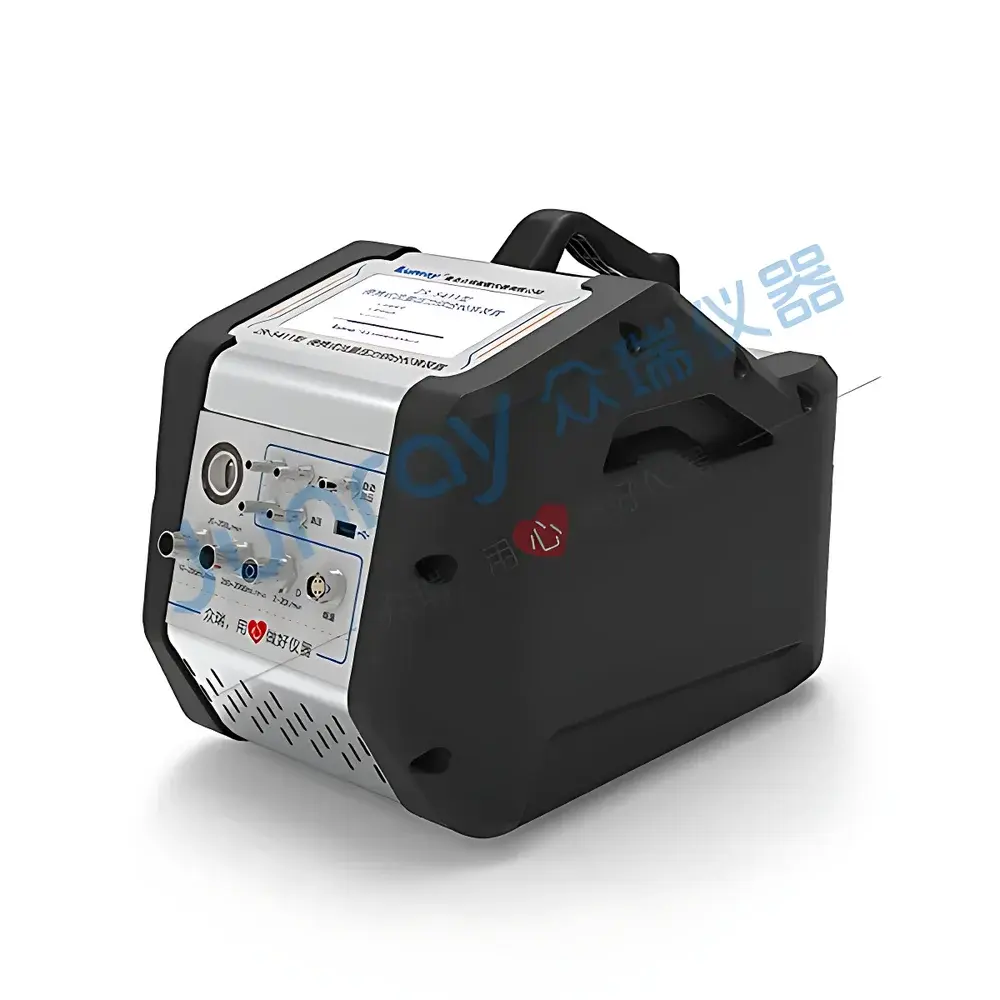
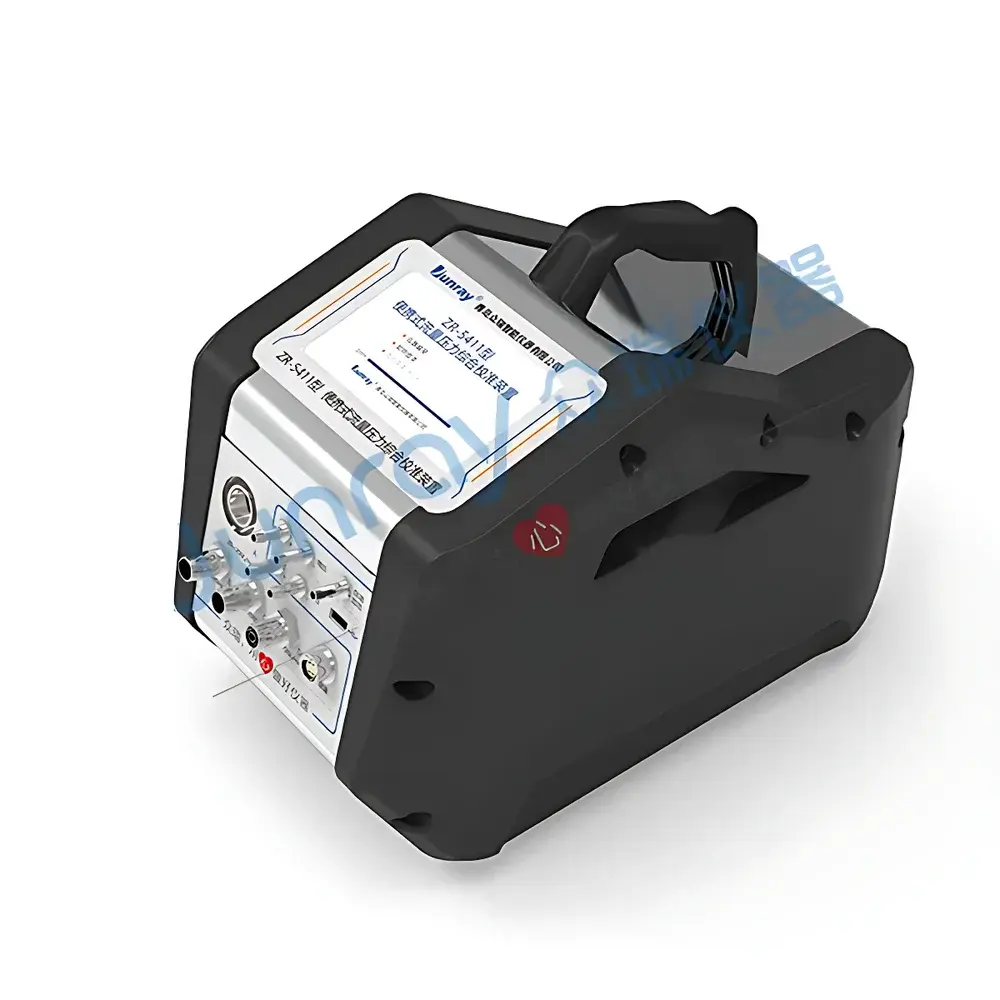
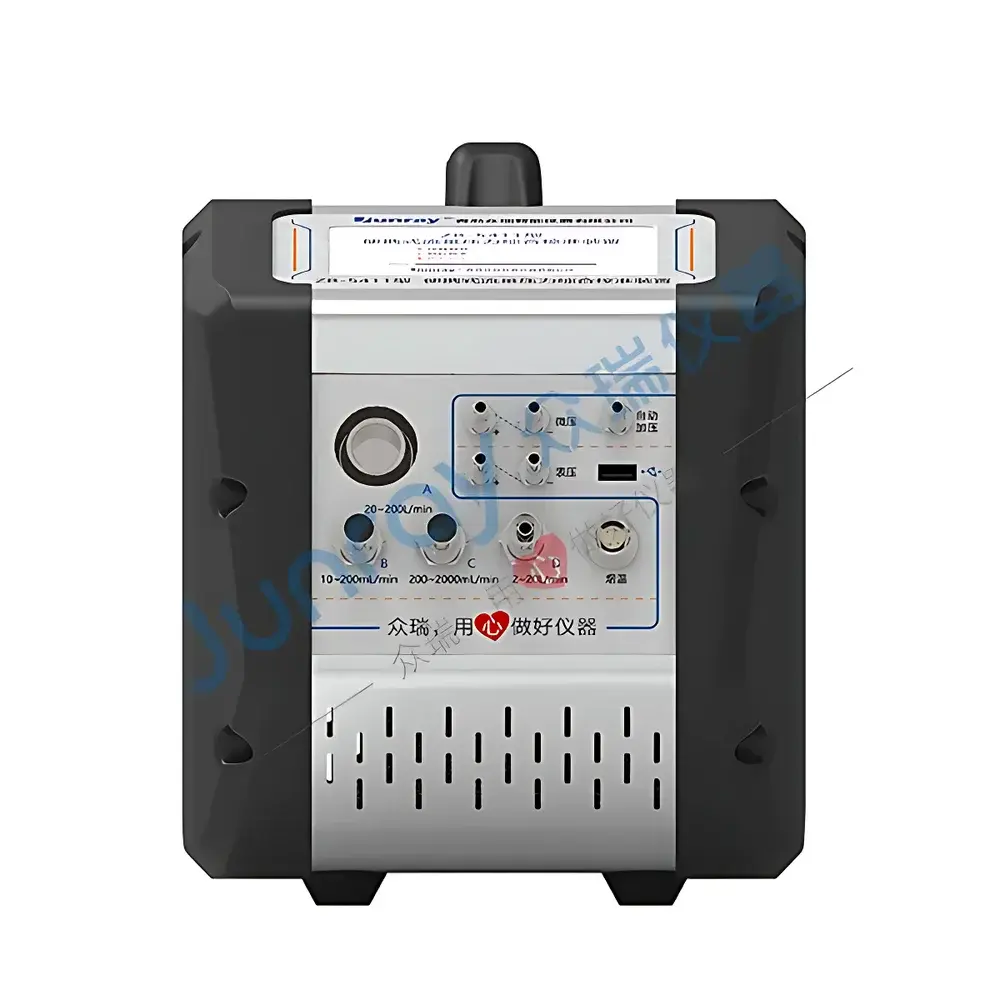
Junray ZR-5411 Portable Flow and Pressure Calibration System
| Brand | Junray |
|---|---|
| Origin | Shandong, China |
| Manufacturer Type | Original Equipment Manufacturer (OEM) |
| Country of Origin | China |
| Model | ZR-5411 |
| Pricing | Available upon Request |
| Calibration Principle | Orifice-based flow measurement |
| Pressure Sensor Accuracy | High-precision integrated sensor |
| Display | 5-inch color touchscreen |
| Power Supply | AC/DC dual-mode with built-in high-capacity lithium battery (>8 h runtime) |
| Data Storage | Large-capacity internal memory with query and print support |
| Expandability | Up to 7-channel configuration |
| Temperature Calibration Capability | Integrated precision resistor for flue gas temperature verification |
| Compliance Standard | HJ/T 368–2007 |
Overview
The Junray ZR-5411 Portable Flow and Pressure Calibration System is an engineered field-deployable instrument designed for traceable, on-site calibration of environmental sampling devices. It operates on the orifice flow measurement principle—compliant with HJ/T 368–2007—where volumetric flow rate is determined via differential pressure across a precisely characterized orifice plate under controlled laminar or transitional flow conditions. This physical foundation ensures metrological consistency when calibrating low-flow-rate sampling systems used in ambient air, occupational health, and stack emission monitoring. The system integrates dual-function capability: simultaneous real-time flow and static/differential pressure calibration, plus flue gas temperature verification using a calibrated reference resistor. Its compact, ruggedized chassis and battery-powered architecture enable uninterrupted operation in mobile laboratories, roadside monitoring stations, and industrial stack access platforms—without dependency on external power or fixed infrastructure.
Key Features
- Orifice-based primary flow calibration method—fully aligned with HJ/T 368–2007 requirements for TSP sampler verification.
- Integrated high-accuracy pressure transducer with documented long-term stability and thermal compensation.
- On-device conversion between actual flow, standard-condition flow (at 273.15 K, 101.325 kPa), and scaled instrument reading—eliminating manual correction errors.
- Modular channel expansion support: base unit configurable up to seven independent calibration channels for multi-instrument parallel verification.
- Dual-mode power architecture: AC adapter input (100–240 VAC, 50/60 Hz) and rechargeable lithium-ion battery pack delivering >8 hours of continuous operation at nominal load.
- 5-inch capacitive color touchscreen with intuitive GUI—designed for glove-compatible interaction in field environments.
- Built-in precision resistance network for flue gas temperature sensor (e.g., Pt100, thermistor) verification and linearity check per IEC 60751 or ASTM E230 standards.
- Local data persistence: ≥10,000 calibration records stored with timestamp, instrument ID, operator tag, ambient conditions, and pass/fail flags.
Sample Compatibility & Compliance
The ZR-5411 is validated for calibration of flow-sensitive environmental analyzers including volatile organic compound (VOC) samplers (e.g., SUMMA canisters, sorbent tubes), ambient air particulate samplers (PM2.5, PM10, TSP), and stack emission monitors such as opacity meters and isokinetic sampling trains. It supports both suction- and pressure-driven sampling configurations typical of EPA Method 5, ISO 9096, and HJ 732–2014 test protocols. All pressure and flow outputs are traceable to national metrological standards through factory calibration certificates (NIST-traceable where applicable). The device meets electromagnetic compatibility (EMC) requirements per GB/T 18268.1–2010 and environmental operating specifications (–10 °C to +50 °C, 20–95% RH non-condensing). For regulated environments, audit trails, user authentication, and electronic signature support can be enabled to align with GLP and ISO/IEC 17025 documentation expectations.
Software & Data Management
Calibration sessions are managed via embedded firmware supporting CSV export via USB mass storage or optional Bluetooth 5.0 wireless transfer. Each record includes raw sensor outputs, calculated flow values (actual and standard), pressure differentials, temperature readings, and operator-defined metadata. Optional PC software provides batch report generation compliant with HJ 630–2011 QA/QC reporting formats—including uncertainty budgeting per GUM (JCGM 100:2008) and graphical trend analysis across instrument fleets. Data integrity safeguards include write-once storage mode, tamper-evident file hashing, and configurable auto-lock after idle timeout—supporting alignment with FDA 21 CFR Part 11 principles where electronic records are subject to regulatory review.
Applications
- Field verification of flow accuracy for regulatory-compliant air quality monitoring networks (e.g., China’s National Urban Air Quality Monitoring Network).
- Pre- and post-maintenance calibration of workplace exposure assessment instruments per GBZ/T 189 series standards.
- Method validation and ongoing performance checks for laboratories accredited to CNAS-CL01 (equivalent to ISO/IEC 17025).
- Supporting third-party certification audits for environmental testing bodies under CMA (China Metrology Accreditation) scope.
- Teaching and research applications in environmental engineering programs requiring hands-on understanding of orifice metrology and sampling bias correction.
FAQ
Does the ZR-5411 provide NIST-traceable calibration certificates?
Yes—each unit ships with a factory calibration report referencing national primary standards; optional on-site recalibration services include NIST-traceable documentation.
Can it calibrate both mass flow controllers (MFCs) and volumetric samplers?
It is optimized for volumetric flow calibration via orifice; MFCs require additional density and composition inputs—ZR-5411 supports manual entry of gas composition for approximate standard-cubic conversion.
Is firmware upgradable in the field?
Yes—updates are delivered via USB flash drive with version-controlled release notes and backward-compatible configuration retention.
What is the maximum allowable backpressure during calibration?
The system maintains accuracy up to 25 kPa differential pressure; operation beyond this requires verification against manufacturer-specified flow range envelopes.
How is temperature calibration performed for flue gas sensors?
Using a four-wire Kelvin-connected precision resistor bank (±0.05 °C uncertainty at 0–200 °C), emulating RTD/thermistor output curves per IEC 60751 Class A tolerances.