
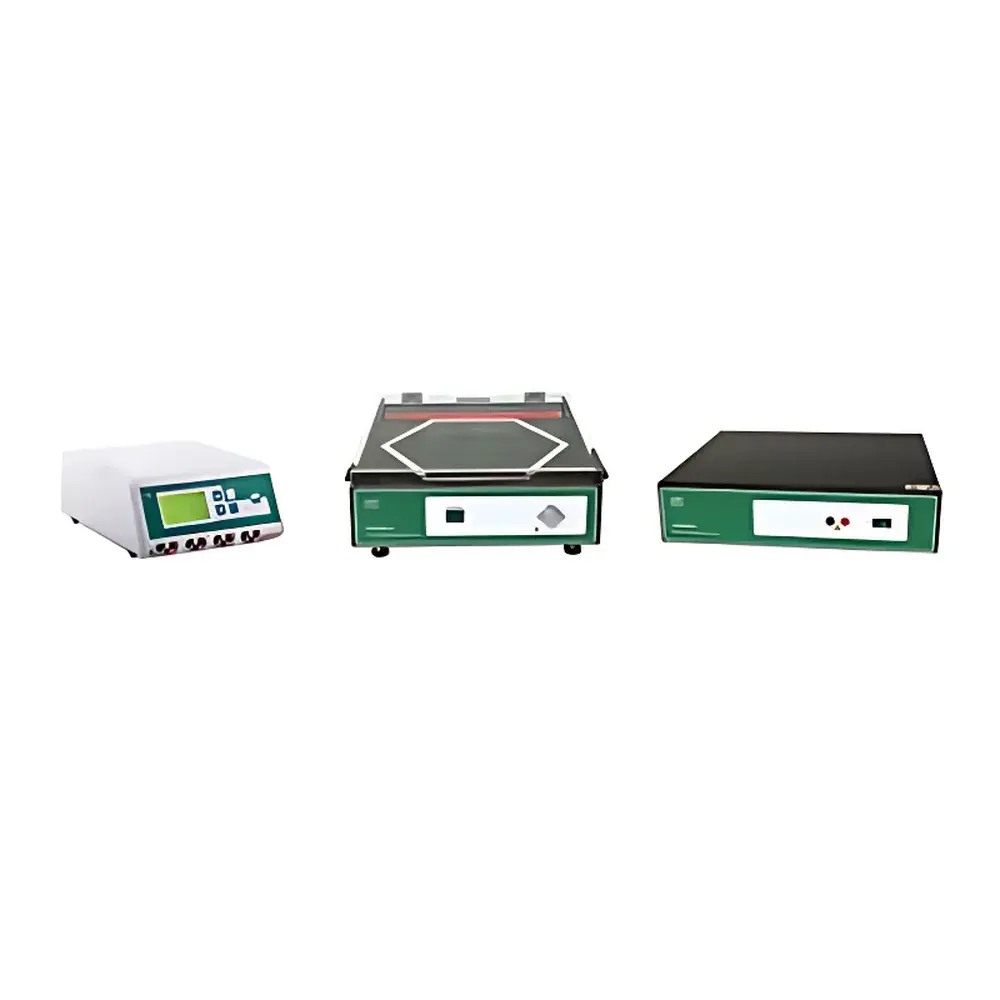
Junyi JY600MCS-3 Hexagonal Pulsed-Field Electrophoresis System
| Brand | Junyi |
|---|---|
| Origin | Beijing, China |
| Model | JY600MCS-3 |
| Gel Tray Dimensions | 120 × 120 mm |
| Sample Capacity | 13 lanes (with 2.0 mm gel thickness) |
| Max Voltage Gradient | 9.5 V/cm (adjustable in 0.1 V/cm increments) |
| Max Current | 0.5 A |
| Max Power | 300 W |
| Pulse Angle | ±120° |
| Pulse Width | 1–9999 s (fixed) or 1–20 s (linear ramp) |
| Temperature Control Range | 10–30 °C (±0.5 °C stability) |
| buffer temperature sensing accuracy | ±0.1 °C |
| Buffer Volume | ~3000 mL |
| System Weight | 85.2 kg |
| Display | Backlit LCD (128 × 64 pixels) |
| Timing Range | 1 min – 99 h 59 min |
| Electrode Architecture | Hexagonal array with 18 independently addressable electrode segments |
| Cooling | Integrated recirculating chiller module |
Overview
The Junyi JY600MCS-3 Hexagonal Pulsed-Field Electrophoresis System is an engineered platform for high-resolution separation of large DNA fragments ranging from 100 bp to 6 Mb. Unlike conventional slab-gel electrophoresis, which fails to resolve molecules above ~50 kb due to entropic trapping in the matrix, this system applies time-varying electric fields across a symmetric hexagonal electrode array—enabling controlled reorientation and directional migration of megabase-sized DNA through agarose gels. Its core architecture implements a true multi-angle pulsed-field configuration, where six sides of the hexagon each contain three independently driven sub-electrodes, allowing programmable field vector rotation—including dynamic field inversion and linear ramp pulse profiles. This design overcomes inherent limitations of traditional CHEF (Clamped Homogeneous Electric Field) systems, particularly in resolution homogeneity across the gel plane and recovery yield of intact high-molecular-weight DNA. The system operates under strict thermal regulation via integrated buffer recirculation and real-time liquid-phase temperature monitoring, ensuring reproducible migration kinetics essential for comparative genomic analysis.
Key Features
- Hexagonal electrode geometry with 18 individually addressable electrode segments—enabling precise spatiotemporal control of field direction, magnitude, and duration
- Programmable pulse modes: fixed-width (1–9999 s) and linear ramp (1–20 s), supporting both standard PFGE protocols and custom field-inversion strategies
- Microprocessor-based controller with non-volatile program memory, automatic power-off, lid-open safety interlock, and overload/underload detection
- Real-time buffer temperature monitoring via immersed sensor (±0.1 °C accuracy) coupled with active cooling (10–30 °C range, ±0.5 °C stability)
- Integrated recirculating chiller unit (350 × 200 × 480 mm) with corrosion-resistant pump and flow-regulated delivery to maintain uniform thermal conditions across the 120 × 120 mm gel surface
- Backlit LCD interface (128 × 64 pixels) with intuitive menu navigation, timer display (1 min – 99 h 59 min), and on-screen parameter verification prior to run initiation
Sample Compatibility & Compliance
The JY600MCS-3 accommodates standard 2.0 mm thick agarose gels cast in its 120 × 120 mm tray, supporting up to 13 sample lanes per run. It is validated for use with low-melting-point (LMP) and standard analytical-grade agarose matrices optimized for PFGE applications. The system meets fundamental electrical safety requirements per IEC 61010-1 and incorporates redundant hardware protections—including open-circuit detection, current-limiting circuitry, and automatic shutdown upon lid removal. While not certified to GLP/GMP or FDA 21 CFR Part 11 out-of-the-box, its deterministic timing engine, persistent parameter storage, and auditable run logs (via optional external logging) support traceability in regulated environments when integrated into validated laboratory workflows aligned with ISO/IEC 17025 or CLIA guidelines.
Software & Data Management
The JY600MCS-3 operates as a standalone instrument with embedded firmware; no proprietary PC software is required for basic operation. All protocol parameters—including voltage gradient (0.1–9.5 V/cm), pulse angle (±120°), pulse width, ramp slope, total run time, and temperature setpoint—are configured directly via the front-panel interface. Run history (last 10 protocols) is retained in non-volatile memory, enabling rapid recall and modification. For laboratories requiring electronic record retention, the system supports manual timestamped documentation of run parameters and outcomes. Optional serial (RS-232) or USB-to-serial adapters enable integration with third-party lab information management systems (LIMS) for automated metadata capture—facilitating alignment with audit-ready documentation practices under ISO 15189 or CAP accreditation standards.
Applications
- Separation and sizing of chromosomal DNA (100 kb – 6 Mb) for karyotype mapping and structural variant detection
- Construction and quality control of large-insert genomic libraries (BAC, YAC, fosmid)
- Molecular typing of bacterial pathogens (e.g., Salmonella, E. coli O157:H7) using standardized PFGE protocols endorsed by CDC PulseNet
- Analysis of DNA damage and repair kinetics following ionizing radiation or chemical exposure
- Verification of CRISPR/Cas9-mediated large deletions or translocations in edited cell lines
- Preparative isolation of megabase fragments for downstream cloning, sequencing library preparation, or Southern blot hybridization
FAQ
What is the maximum DNA size resolvable with the JY600MCS-3?
The system is validated for reproducible separation of DNA fragments up to 6 Mb under optimized agarose concentration (0.8–1.2%), pulse time (10–60 s), and field strength (3–6 V/cm) conditions.
Does the system support CHEF-compatible protocols?
Yes—its hexagonal electrode architecture enables direct emulation of standard CHEF configurations (e.g., 120° switch angles, asymmetric pulse timing), while also supporting advanced modes such as dynamic field inversion and linear ramping not achievable with fixed-clamp designs.
Is external cooling required?
No—the integrated recirculating chiller module provides closed-loop temperature control without dependency on external refrigerated baths or water supplies.
Can the system be used with ethidium bromide or SYBR Gold staining?
Yes—standard nucleic acid dyes compatible with UV transillumination are fully supported; however, post-electrophoresis staining is recommended to avoid dye-induced mobility shifts during runs.
What maintenance is required for long-term reliability?
Routine cleaning of electrode surfaces and buffer chamber with deionized water after each use, periodic inspection of recirculation tubing for blockage or degradation, and annual calibration of temperature sensor against a NIST-traceable reference probe are sufficient to maintain specification compliance.





