
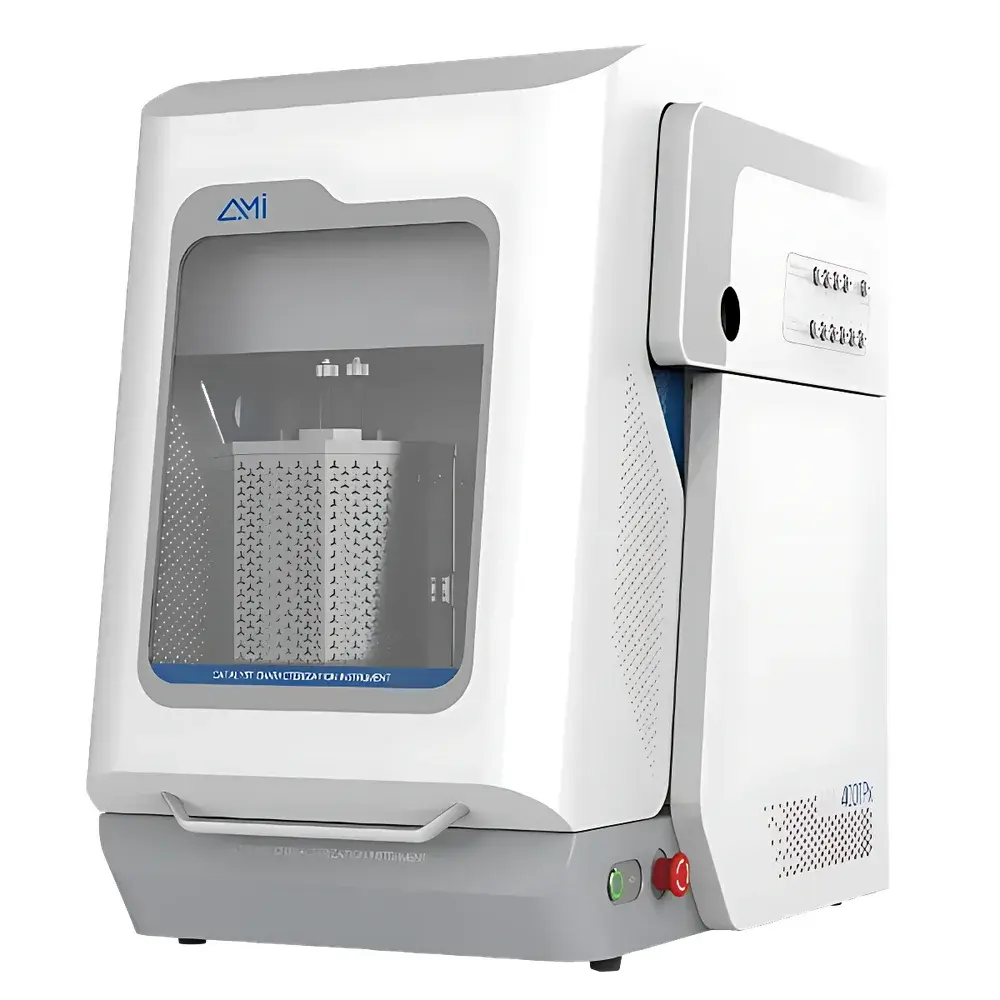
JWGB AMI 400TPx Automated Temperature-Programmed Chemisorption Analyzer
| Brand | JWGB |
|---|---|
| Origin | Beijing, China |
| Manufacturer Type | Direct Manufacturer |
| Model | AMI 400TPx |
| Pricing | Upon Request |
| Core Functionality | Fully Automated TPD, TPR, TPO, TPSR, Pulse Chemisorption, Single-Point BET, Optional MS/GC/FID/FTIR Coupling |
| Gas Compatibility | Inert, Reducing (H₂), Oxidizing (O₂, NO, CO₂), Corrosive (SO₂, H₂S) |
| Control Architecture | Integrated Pneumatic Valve Manifold with Real-Time Flow Path Visualization |
| Software | Proprietary ChemiSoft™ with Live System Status Dashboard, Parameter Logging, and Audit-Trail-Ready Data Export |
Overview
The JWGB AMI 400TPx is a fully automated, benchtop temperature-programmed chemisorption analyzer engineered for quantitative catalytic surface characterization under controlled gas-atmosphere conditions. It operates on the fundamental principle of temperature-programmed desorption (TPD), reduction (TPR), oxidation (TPO), and surface reaction (TPSR), where adsorbed probe molecules (e.g., NH₃, CO, H₂, O₂) are thermally desorbed or reacted across a precisely ramped temperature profile (typically 30–1100 °C), while evolved species are monitored in real time via integrated detection modules. Designed for routine catalyst R&D and QC laboratories, the system integrates high-reproducibility thermal control (±0.5 °C accuracy), mass-flow regulated gas delivery (0.1–100 mL/min, ±1% FS), and modular detector interfaces—enabling kinetic parameter extraction including adsorption capacity, binding energy distribution, active site density, and redox onset temperatures. Its compact footprint (600 × 500 × 450 mm) and simplified pneumatic architecture reflect a design philosophy prioritizing operational robustness, ease of maintenance, and compliance-ready data handling over excessive hardware complexity.
Key Features
- Fully automated sequence execution: Predefined or user-customized methods govern valve switching, gas dosing, temperature ramping (0.1–50 °C/min), hold steps, and detector synchronization without manual intervention.
- Real-time flow-path visualization: Software dashboard renders dynamic color-coded gas pathways; valve positions, port-specific gas assignments, zone temperatures, and detector signals update continuously during operation.
- Modular detection compatibility: Native support for quadrupole mass spectrometry (MS), gas chromatography (GC), flame ionization detection (FID), and Fourier-transform infrared (FTIR) spectroscopy—each interfaced via standardized vacuum/gas ports and TTL-triggered acquisition.
- Corrosive gas-ready configuration: Optional stainless-steel wetted parts, high-temperature ceramic reactors (up to 1100 °C), and chemically resistant seals enable safe handling of SO₂, H₂S, Cl₂, and NH₃ without cross-contamination or degradation.
- Integrated single-point BET capability: Equipped with calibrated thermal conductivity detection (TCD) and N₂/Ar gas manifolds to perform rapid surface area estimation per ISO 9277 and ASTM D3663 standards.
- Thermal stability & repeatability: Dual-zone furnace with independent PID control ensures uniform axial heating profiles; temperature calibration traceable to NIST-certified reference materials.
Sample Compatibility & Compliance
The AMI 400TPx accommodates powdered catalysts (0.05–1.0 g), extrudates, monoliths, and supported metal oxides in standard quartz or ceramic microreactors (ID: 6–8 mm). Sample loading is performed under inert atmosphere to prevent pre-oxidation or moisture uptake. The system meets core requirements for GLP-compliant catalyst testing environments: all method parameters, raw detector outputs, and instrument status logs are timestamped and stored in an immutable binary+CSV dual-format archive. Optional 21 CFR Part 11 compliance packages include electronic signature workflows, role-based access control, and audit-trail generation for regulatory submissions. Method validation protocols align with ISO 18852 (chemisorption), ASTM E1782 (TPD), and IUPAC recommendations for surface area and porosity analysis.
Software & Data Management
ChemiSoft™ v4.2 provides a unified interface for method development, real-time monitoring, and post-run kinetic analysis. Key modules include: (1) Sequence Builder for multi-step TPD/TPR/TPSR workflows with conditional branching; (2) Live Dashboard with animated valve logic maps and signal overlays; (3) Peak Deconvolution Engine using Gaussian-Lorentzian fitting for quantifying overlapping desorption features; (4) Active Site Calculation Toolkit applying stoichiometric models (e.g., H₂ titration for Pt dispersion, NH₃ for acid site density); and (5) Export Manager supporting CSV, PDF reports, and XML metadata compliant with ISA-88/ISA-95 data exchange frameworks. All datasets include embedded metadata: instrument ID, operator ID, calibration dates, gas lot numbers, and environmental ambient logs.
Applications
- Quantification of metal dispersion and particle size in supported noble-metal catalysts (e.g., Pt/Al₂O₃, Pd/C) via H₂ or CO pulse chemisorption.
- Determination of Brønsted vs. Lewis acid site distribution in zeolites and mixed oxides using NH₃-TPD coupled with FTIR confirmation.
- Redox behavior mapping of transition-metal oxides (e.g., Co₃O₄, CeO₂) under H₂/Ar or O₂/N₂ gradients for emission control catalyst development.
- Surface reactivity profiling of sulfided hydrodesulfurization (HDS) catalysts using H₂S-TPD and COS-TPSR protocols.
- Routine QC screening of commercial catalyst batches against reference standards for thermal stability and active phase retention.
- Supporting DOE-funded projects requiring traceable, reproducible surface chemistry data for machine-learning-driven catalyst discovery pipelines.
FAQ
What detection methods are natively supported without third-party integration?
The base system includes a high-sensitivity thermal conductivity detector (TCD) optimized for permanent gases and light hydrocarbons. Mass spectrometry, GC, FID, and FTIR require optional hardware modules and dedicated interface kits.
Can the AMI 400TPx perform simultaneous multi-gas analysis during a single TPD run?
Yes—when equipped with a quadrupole mass spectrometer or FTIR, the system acquires full m/z spectra or spectral stacks synchronized to temperature ramps, enabling deconvolution of co-eluting species such as CO₂, H₂O, and CH₄.
Is calibration traceability documented per ISO/IEC 17025 requirements?
Factory calibration certificates include uncertainty budgets for temperature, flow rate, and detector response, referenced to NIST-traceable standards. On-site recalibration services are available with accredited lab documentation.
How does the system handle gas mixing for reactive atmospheres like 5% H₂/Ar or 10% O₂/N₂?
Precise mass flow controllers (MFCs) with digital setpoint communication enable dynamic blending; gas composition is verified by inline TCD before reactor inlet, with automatic correction loops activated if deviation exceeds ±0.3% FS.
What level of cybersecurity is implemented for network-connected operation?
ChemiSoft™ supports TLS 1.2 encryption for remote access, configurable firewall rules, and periodic vulnerability scanning logs—all aligned with IEC 62443-3-3 industrial security guidelines.
Related Products




