
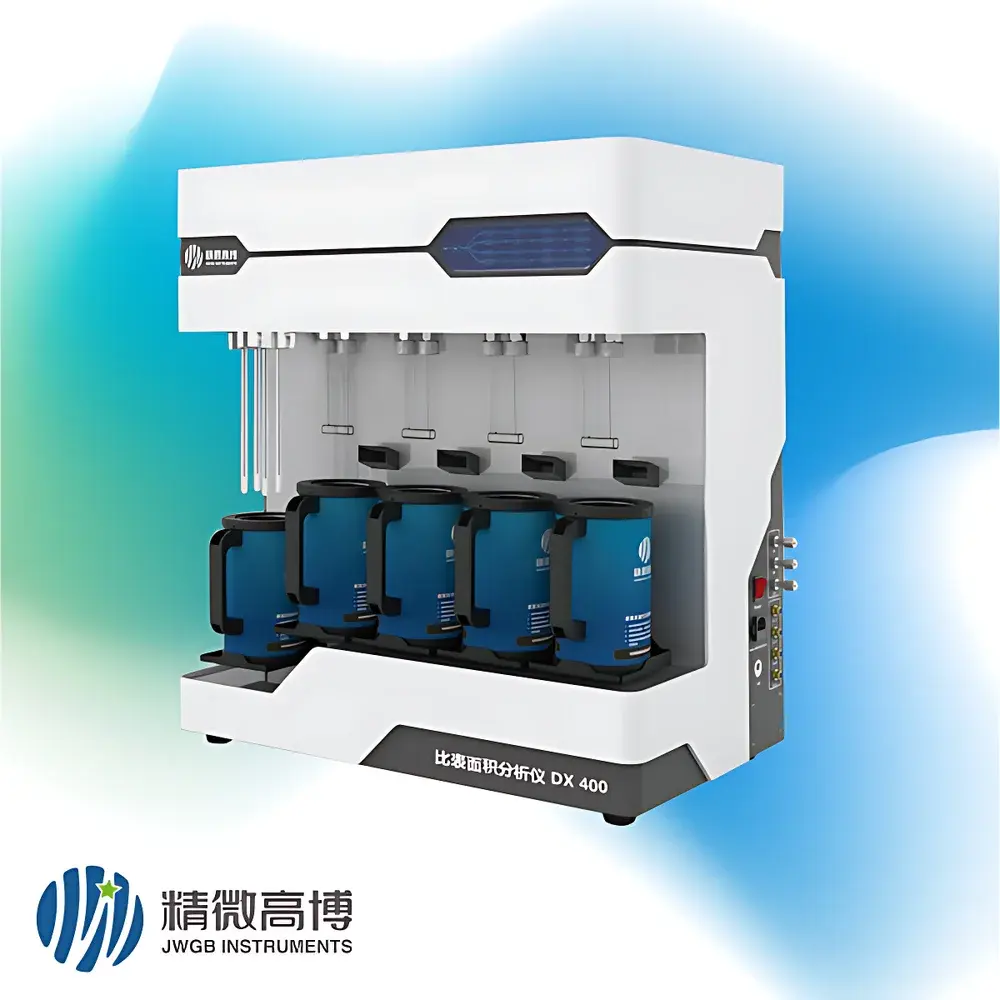
JWGB DX Graphite-Specific Specific Surface Area Analyzer (28 Samples per Hour)
| Brand | JWGB |
|---|---|
| Origin | Beijing, China |
| Manufacturer | Yes |
| Product Type | Domestic |
| Model | DX Graphite-Specific Specific Surface Area Analyzer (28 Samples per Hour) |
| Instrument Category | Specific Surface Area Analyzer |
| Principle | Dynamic Flow Method (Gas Chromatography-Based) |
| Number of Analysis Stations | 4 |
| Measurement Range | 0.01 m²/g to unlimited upper limit |
| Operating Pressure | Ambient pressure |
| Theoretical Basis | Dynamic Chromatographic Method with Thermal Conductivity Detection |
Overview
The JWGB DX Graphite-Specific Specific Surface Area Analyzer is an industrial-grade, high-throughput dynamic flow analyzer engineered for rapid and reproducible specific surface area determination of low-surface-area materials—particularly graphite anodes, NMC/LFP cathode precursors, pharmaceutical excipients, and other micro- to nano-particulate powders where conventional static volumetric (BET) methods face challenges in sensitivity and throughput. Unlike static manometric systems requiring high-vacuum environments and lengthy equilibration, the DX employs a robust ambient-pressure dynamic chromatographic principle: a precisely controlled mixture of nitrogen and helium carrier gas flows continuously over the sample at liquid nitrogen temperature (–196 °C), and surface adsorption events are detected in real time via a high-stability thermal conductivity detector (TCD). The integrated peak area—derived from the transient change in gas-phase thermal conductivity before and after nitrogen adsorption—is directly proportional to the amount of adsorbed nitrogen, enabling quantification using either the single-point direct comparison method or multi-point BET analysis. This architecture eliminates vacuum pump dependency, reduces cycle time, and delivers consistent results under routine QC laboratory conditions.
Key Features
- Four independent analysis stations operating in parallel—enabling true batch processing without cross-contamination or sequential delay.
- Throughput-optimized design: capable of completing 28 standardized samples per hour (based on ASTM D3037-compliant test protocols), making it suitable for high-volume production line monitoring and incoming material inspection.
- Thermal conductivity detection system calibrated against NIST-traceable standards, ensuring long-term signal stability and inter-laboratory comparability.
- Integrated temperature-controlled dewar with automatic liquid nitrogen level monitoring and refill scheduling—minimizing operator intervention and thermal drift.
- Rugged mechanical construction with stainless-steel gas pathways and electropolished TCD cells, compliant with ISO 8573-1 Class 2 compressed air purity requirements for auxiliary gas handling.
- Pre-configured analytical sequences for graphite, silicon-carbon composites, and metal oxide cathode materials—including default desorption ramp profiles and helium purge durations aligned with USP recommendations for solid-state characterization.
Sample Compatibility & Compliance
The DX analyzer accommodates standard 6–8 mm diameter sample tubes (quartz or borosilicate) with mass ranges from 0.1 g to 2.0 g, supporting both loose powders and lightly agglomerated granules. It is validated for use with carbonaceous materials exhibiting surface areas as low as 0.01 m²/g—critical for dense synthetic graphite and coated cathode particles where monolayer formation is limited. All hardware and firmware comply with IEC 61000-6-2 (immunity) and IEC 61000-6-4 (emissions) electromagnetic compatibility standards. Data acquisition and report generation support audit-ready documentation per FDA 21 CFR Part 11 when deployed with optional electronic signature modules and time-stamped audit trails.
Software & Data Management
JWGB’s proprietary SurfacePro™ v4.2 software provides intuitive workflow navigation, automated baseline correction, peak integration validation, and embedded uncertainty estimation per ISO/IEC 17025:2017 Annex A.3 guidelines. Raw chromatograms, calibration logs, and environmental metadata (ambient temperature, LN₂ level, gas flow rate) are stored in vendor-neutral HDF5 format. Export options include CSV, PDF (with embedded digital signatures), and XML files compatible with LIMS platforms such as LabVantage and Thermo Fisher SampleManager. Software validation packages—including IQ/OQ documentation templates—are available upon request for GMP-regulated environments.
Applications
- Quality control of synthetic graphite anode materials in lithium-ion battery manufacturing—monitoring surface oxidation, coating uniformity, and post-milling contamination.
- Rapid screening of precursor powders during cathode active material synthesis (e.g., Ni-rich layered oxides) to correlate calcination parameters with surface reactivity.
- Pharmaceutical solid-state development: assessing specific surface area changes induced by milling, spray drying, or co-processing—directly impacting dissolution rate and content uniformity.
- Carbon black and activated carbon grading in rubber compounding and filtration media production, where surface area correlates strongly with reinforcement efficiency and adsorption capacity.
- Research applications in catalysis and energy storage, including in situ surface area tracking during thermal aging or electrochemical cycling simulations.
FAQ
Is the DX analyzer compatible with non-graphite battery materials such as silicon or lithium titanate?
Yes—the instrument’s dynamic detection range and low-end sensitivity (0.01 m²/g) make it suitable for low-surface-area silicon-based anodes and spinel-structured Li₄Ti₅O₁₂, provided samples are degassed at ≤200 °C under inert gas flow prior to analysis.
Does the system require high-vacuum infrastructure or liquid nitrogen refills during operation?
No high-vacuum pumps are needed; operation occurs at ambient pressure. Liquid nitrogen is required for cryogenic adsorption but is managed via an auto-refill dewar with level sensors—typical consumption is ~3.5 L/hour across four stations.
Can raw chromatographic data be exported for third-party modeling or custom BET fitting?
Yes—SurfacePro™ exports fully time-resolved TCD voltage traces, along with calibrated flow and temperature metadata, in open HDF5 format for external regression or machine learning workflows.
What regulatory documentation is provided for installation qualification (IQ) and operational qualification (OQ)?
JWGB supplies factory-tested IQ/OQ protocols aligned with ASTM E2656 and ISO/IEC 17025, including TCD linearity verification, flowmeter calibration certificates, and system repeatability reports (n ≥ 10, RSD ≤ 2.1% for graphite SRM 1990).



