
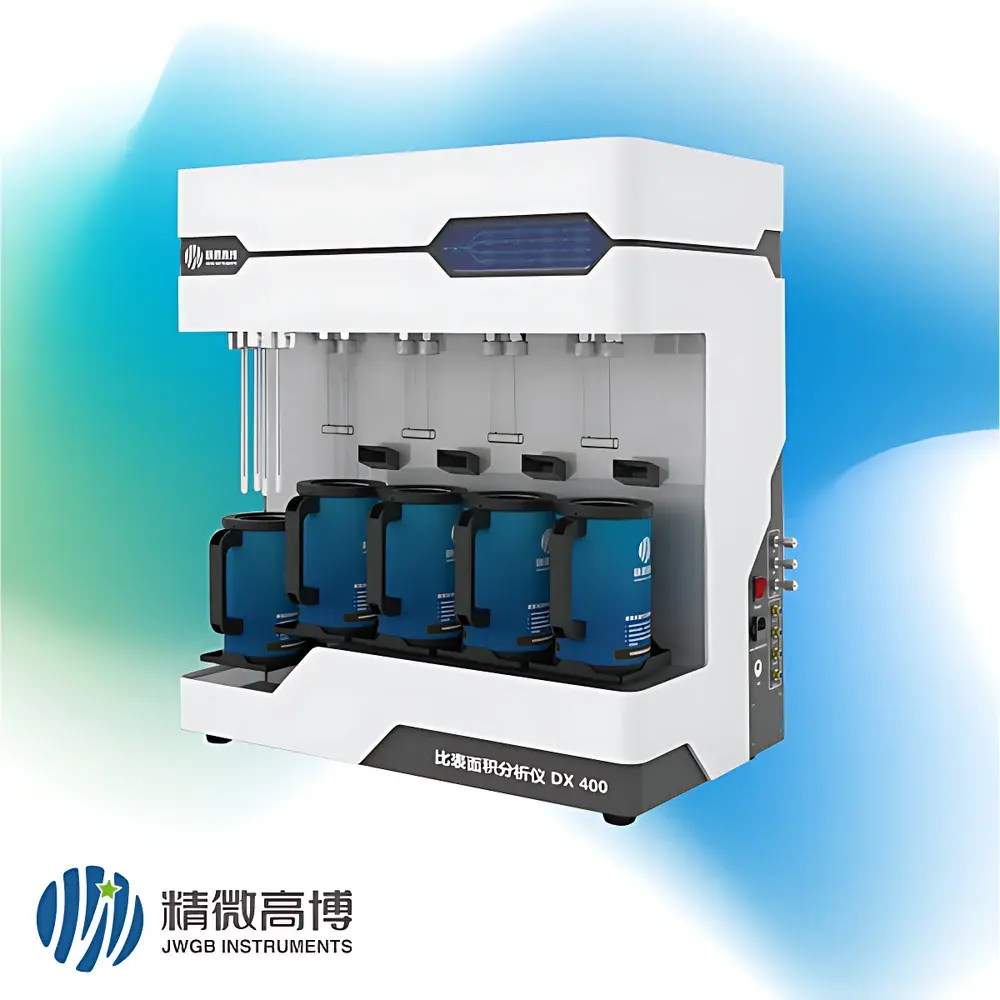
JWGB DX Series Dedicated Specific Surface Area Analyzer for Cathode Materials (28 Samples per Hour)
| Brand | JWGB |
|---|---|
| Origin | Beijing, China |
| Manufacturer Type | Direct Manufacturer |
| Product Category | Domestic Instrument |
| Model | DX Series Dedicated Specific Surface Area Analyzer for Cathode Materials (28 Samples per Hour) |
| Instrument Type | Specific Surface Area Analyzer |
| Operating Principle | Dynamic Flow Method (Carrier Gas Chromatography) |
| Number of Analysis Stations | 4 |
| Measurable Surface Area Range | 0.01 m²/g to unlimited upper limit |
| Operating Pressure | Ambient Pressure |
| Theoretical Basis | Dynamic Chromatographic Adsorption Theory |
Overview
The JWGB DX Series Dedicated Specific Surface Area Analyzer for Cathode Materials is an engineered solution designed explicitly for high-throughput, precision surface area characterization of battery electrode materials—particularly Ni-rich NMC, NCA, LFP, and graphite-based powders. Unlike conventional static volumetric (BET) analyzers that require vacuum evacuation, cryogenic dosing, and multi-point isotherm construction, the DX system implements a dynamic flow method based on carrier gas chromatography. In this configuration, a precisely regulated mixture of nitrogen and helium flows continuously over the sample at ambient pressure and liquid nitrogen temperature (–196 °C). Adsorption-induced changes in thermal conductivity are detected in real time by a high-stability tungsten-rhenium thermistor-based thermal conductivity detector (TCD), generating chromatographic peaks whose integrated areas correlate linearly with adsorbed nitrogen mass. This principle enables rapid, single-point surface area determination without degassing optimization or multi-pressure equilibration—making it uniquely suited for QC/QA labs requiring >20 samples/hour throughput under GLP-aligned operational protocols.
Key Features
- Four independent analysis stations operating in parallel—enabling true batch processing with synchronized thermal conditioning and detection.
- Dedicated hardware and calibration protocols optimized for low-surface-area cathode materials (0.01–5 m²/g), minimizing baseline drift and cross-contamination risks common in generic BET instruments.
- Integrated programmable temperature-controlled sample preparation module with automated purge cycles, ensuring consistent moisture and atmospheric contaminant removal prior to analysis.
- Real-time TCD signal acquisition with 16-bit ADC resolution and <1 nV RMS noise floor, supporting reproducible peak integration across extended run sequences.
- Modular gas delivery system featuring mass flow controllers (MFCs) certified to ISO 6358, with dual-gas capability (N₂/He, Ar/Kr optional) and leak-tight stainless-steel manifolds.
- Compliance-ready firmware architecture supporting audit trails, user-level access control, electronic signatures, and 21 CFR Part 11–compliant data archiving.
Sample Compatibility & Compliance
The DX analyzer accommodates standard 6–8 mm diameter quartz sample tubes (supplied with reusable crimp seals), compatible with free-flowing powders, agglomerated cathode composites, and coated active materials. It meets ASTM D3037–22 (Standard Test Method for Specific Surface Area of Carbon Black by Nitrogen Adsorption) and aligns with ISO 9277:2010 (Determination of specific surface area of solids by gas adsorption using the BET method) for dynamic-mode equivalence validation. All firmware and report generation modules support full traceability per ICH Q5C and USP , with raw chromatograms, calibration logs, and environmental metadata embedded directly into PDF reports. Instrument qualification documentation (DQ/IQ/OQ/PQ templates) is provided as part of the installation package.
Software & Data Management
JWGB’s proprietary SurfaceCalc™ v4.2 software provides intuitive workflow navigation—from method setup and instrument diagnostics to automated peak recognition and surface area calculation via both direct comparison and single-point BET approximation. All datasets are stored in encrypted SQLite databases with SHA-256 hashing; export options include CSV (with uncertainty propagation), XML (for LIMS integration), and PDF/A-2 compliant analytical reports containing digital signatures and timestamped revision history. Remote monitoring is supported via HTTPS-enabled web interface (no third-party cloud dependency), and scheduled backups can be directed to network-attached storage (NAS) or local RAID arrays meeting ISO/IEC 27001 backup integrity requirements.
Applications
- Routine QC screening of LiNi₀.₈Co₀.₁₅Al₀.₀₅O₂ (NCA) and LiNi₀.₆Mn₀.₂Co₀.₂O₂ (NMC622) cathode batches for consistency in surface reactivity and coating uniformity.
- Stability assessment of silicon-graphite anodes after cycling, correlating surface area growth with SEI evolution and capacity fade.
- Pharmaceutical excipient qualification—e.g., microcrystalline cellulose (MCC) and colloidal silicon dioxide—where surface area influences dissolution kinetics and blend homogeneity.
- Quality gate verification for conductive carbon additives (e.g., Super P, Ketjenblack) used in slurry formulation, where excessive surface area may impair rheology or binder distribution.
- Process development support for solvent-free dry electrode manufacturing, where real-time surface area feedback informs calendering pressure and dwell time optimization.
FAQ
Does the DX system require liquid nitrogen refills during continuous operation?
Yes—each analysis station uses a dedicated Dewar flask holding ≥2.5 L LN₂, sufficient for ≥8 hours of uninterrupted testing at 28 samples/hour. Optional auto-refill kits with level sensors and remote alarm outputs are available.
Can the instrument quantify mesopore volume or pore size distribution?
No—the DX platform is purpose-built for rapid, single-point specific surface area determination only. For full porosimetry (including BJH/KJS analysis), JWGB recommends the ASiQ series volumetric analyzers.
Is method transfer possible from a static BET instrument to the DX system?
Yes—JWGB provides documented correlation studies demonstrating R² > 0.995 between DX dynamic results and reference volumetric BET measurements on NIST-traceable silica standards (SRM 1910, SRM 2973).
What maintenance intervals are recommended for the TCD and gas handling system?
TCD filament replacement is recommended every 18 months under normal use; MFC recalibration is required semiannually per ISO/IEC 17025 guidelines. Full preventive maintenance (PM) kits and certified technician dispatch services are included in extended warranty plans.



