
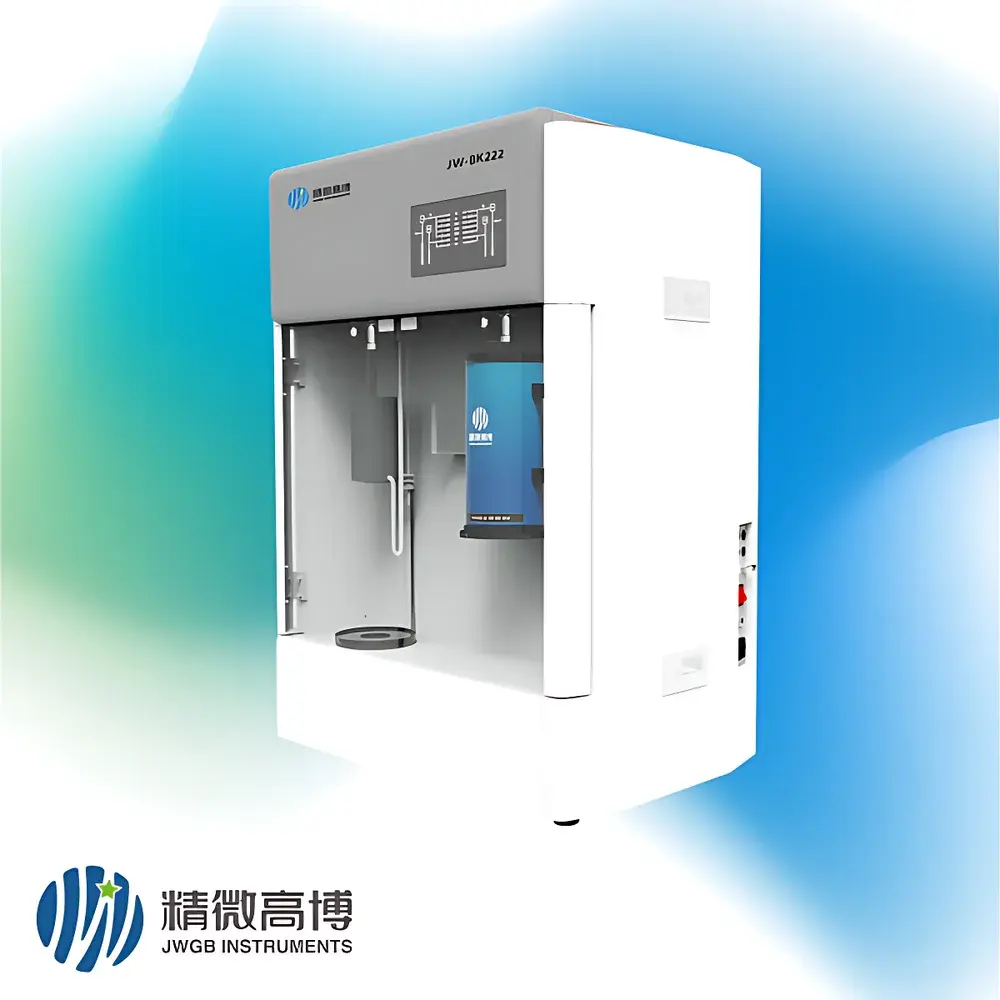
JWGB JW-BK222 Silica Fume-Specific BET Specific Surface Area Analyzer
| Brand | JWGB |
|---|---|
| Origin | Beijing, China |
| Manufacturer Type | Direct Manufacturer |
| Product Category | Domestic |
| Model | JW-BK222 Silica Fume-Specific BET Specific Surface Area Analyzer |
| Instrument Type | Specific Surface Area and Pore Size Analyzer |
| Measurement Principle | Static Volumetric Gas Adsorption Method |
| Number of Analysis Stations | 2 Independent Parallel Stations with In-Situ Degassing Capability |
| Specific Surface Area Range | Down to 0.0005 m²/g |
| Relative Pressure Range (p/p₀) | 1×10⁻⁶ to 0.998 |
| Theoretical Basis | Gas Adsorption Isotherm Analysis via Static Volumetric Technique |
Overview
The JWGB JW-BK222 Silica Fume-Specific BET Specific Surface Area Analyzer is a dual-station, static volumetric gas adsorption instrument engineered for high-precision characterization of specific surface area, pore size distribution, and pore volume in low-surface-area materials—particularly silica fume, precipitated silica, fumed silica, and other ultra-fine, high-density oxide powders used in rubber reinforcement, concrete admixtures, and battery electrode formulations. It operates on the Brunauer–Emmett–Teller (BET) theory and Barrett–Joyner–Halenda (BJH), Dollimore–Heal (DH), and Non-Local Density Functional Theory (NLDFT) models for mesopore/micropore analysis. Unlike dynamic (flow) systems, the static volumetric method ensures thermodynamic equilibrium at each pressure point, delivering superior reproducibility for samples with surface areas as low as 0.0005 m²/g—critical for quality control in silica production where batch-to-batch consistency directly impacts dispersion behavior and reinforcement efficiency.
Key Features
- Dual independent analysis stations operating in parallel—each equipped with dedicated pressure transducers, temperature-controlled sample ports, and isolated vacuum manifolds—to eliminate cross-contamination and enable simultaneous measurement and degassing.
- High-sensitivity pressure detection system: dual-range transducers (1000 torr + 10 torr) enabling accurate p/p₀ resolution from 1×10⁻⁶ up to 0.998, essential for robust micropore (50 nm) quantification.
- In-situ degassing capability: two integrated heating zones (room temperature to 400 °C, ±1 °C stability) with programmable ramp/hold profiles, compatible with vacuum or inert gas purge modes per ASTM D3663 and ISO 9277.
- Multi-gas compatibility: supports N₂, Ar, Kr, H₂, O₂, CO₂, CO, NH₃, and CH₄ (non-corrosive) for tailored isotherm acquisition—Ar at 77 K for microporous carbons, CO₂ at 273 K for narrow micropores, and N₂ at 77 K for routine BET surface area of oxides.
- Robust vacuum architecture: primary two-stage rotary vane pump (ultimate vacuum ≤7×10⁻¹ Pa) augmented by secondary adsorption pump option, achieving base pressures <1×10⁻³ Pa—required for reliable low-p/p₀ data acquisition and reduced outgassing interference.
- Modular hardware design compliant with IEC 61000-6-3 (EMC) and IEC 61010-1 (safety), with sealed stainless-steel manifold, Kalrez® O-rings, and leak-tight fittings certified to ≤1×10⁻⁸ Pa·m³/s He leak rate.
Sample Compatibility & Compliance
The JW-BK222 is optimized for challenging low-surface-area, high-density particulates including silica fume (typically 15–30 m²/g), precipitated silica (≥50 m²/g), and surface-treated fumed silicas with hydrophobic modifiers. Its extended p/p₀ range (1×10⁻⁶–0.998) and sub-microgram mass sensitivity support accurate analysis of industrial-grade batches per ISO 15901-2 (gas adsorption — Part 2: Determination of pore size distribution) and ASTM D4641 (standard practice for calculating BET surface area). All operational logs—including degassing parameters, isotherm acquisition timestamps, and calibration events—are timestamped and user-annotated to satisfy GLP audit requirements. Optional 21 CFR Part 11-compliant software modules provide electronic signatures, audit trails, and role-based access control for regulated QC environments.
Software & Data Management
JWGB’s proprietary SorptionWare™ v5.2 provides full ISO/IEC 17025-aligned data handling: automatic baseline correction, multi-point BET linear regression with user-defined p/p₀ limits (0.05–0.30), t-plot and αs-plot micropore analysis, and NLDFT kernel selection based on material class (e.g., silica, carbon, metal–organic frameworks). Raw isotherm data export is supported in ASTM E2915-compliant CSV and CDF formats. Batch reporting includes RSD calculation per ASTM D6029 (repeatability ≤±1.0% for certified reference materials such as SRM 1990a), uncertainty propagation per GUM (JCGM 100:2008), and PDF certificate generation with digital signature. Local network deployment allows centralized instrument monitoring across multiple labs without cloud dependency.
Applications
- Catalyst supports: surface area verification of γ-Al₂O₃, zeolites, and silica-alumina gels prior to noble metal loading.
- Construction chemistry: QC of silica fume reactivity index via BET surface area correlation with pozzolanic activity (ASTM C1240).
- Battery materials: specific surface area and mesopore volume assessment of SiO₂-coated cathode particles and conductive carbon additives.
- Pharmaceutical excipients: surface heterogeneity mapping of colloidal silicon dioxide (Aerosil® analogs) used in dry powder inhalers.
- Environmental sorbents: pore structure validation of activated silica gels for heavy metal sequestration (EPA Method 9045D).
FAQ
What gases can be used for analysis on the JW-BK222?
N₂, Ar, Kr, H₂, O₂, CO₂, CO, NH₃, and CH₄ are supported—provided they are non-corrosive and compatible with stainless-steel wetted parts and fused silica capillaries.
Is in-situ degassing available for both stations simultaneously?
Yes—both analysis stations feature independent, programmable heating zones (RT–400 °C) and vacuum isolation valves, enabling concurrent degassing and measurement without manual intervention.
How does the instrument ensure accuracy at ultra-low surface areas (e.g., <0.001 m²/g)?
Through high-resolution dual-range pressure transducers, ultra-low base pressure (<1×10⁻³ Pa), rigorous blank subtraction protocols, and adherence to ISO 9277 Annex B for low-surface-area validation using certified reference materials.
Can raw isotherm data be exported for third-party modeling (e.g., SAIEUS, Micromeritics ASiQwin)?
Yes—CSV and CDF exports include absolute adsorbed amount (mmol/g), relative pressure (p/p₀), temperature (K), and instrument metadata required for external DFT/NLDFT fitting.
Does the system comply with FDA 21 CFR Part 11 requirements?
The optional SorptionWare™ Part 11 Edition includes electronic signatures, immutable audit trails, and permission-level controls—validated per IQ/OQ protocols upon installation.



