
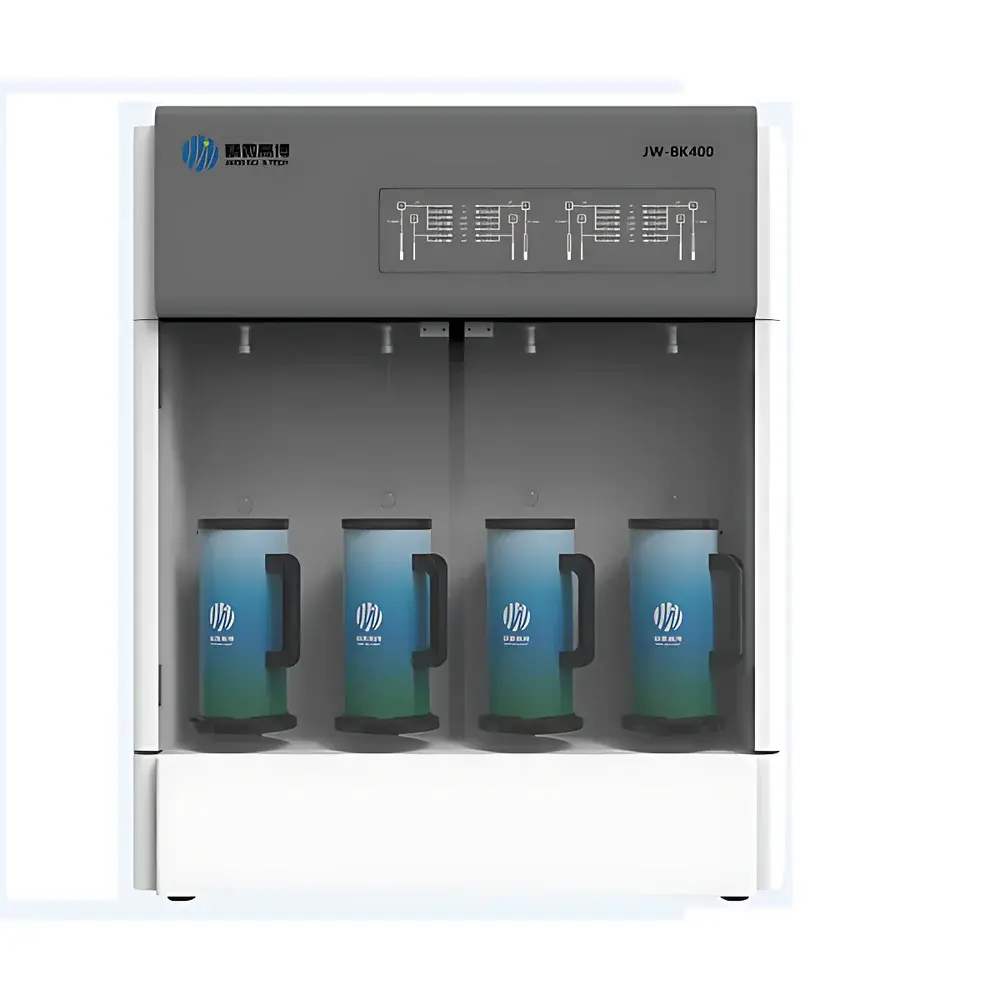
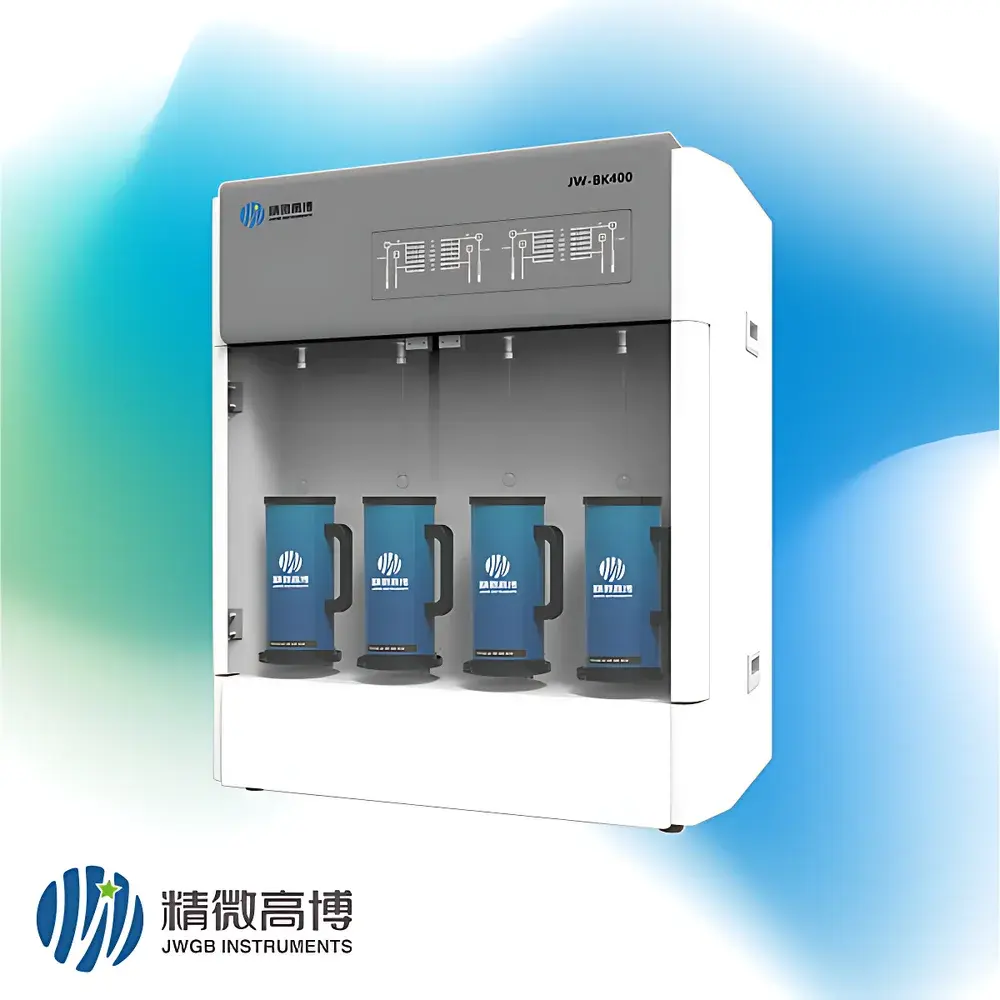
JWGB JW-BK400 Ceramic-Specific Surface Area Analyzer (Static Volumetric Method)
| Brand | JWGB |
|---|---|
| Origin | Beijing, China |
| Manufacturer Type | Direct Manufacturer |
| Instrument Category | Domestic |
| Model | JW-BK400 Ceramic-Specific Surface Area Analyzer (Static Volumetric Method) |
| Instrument Principle | Static Volumetric Gas Adsorption |
| Number of Analysis Stations | 4 |
| Measurement Accuracy | ≤ ±1.0% (specific surface area) |
| Pressure Range | P/P₀ = 10⁻⁴ to 0.998 |
| Theoretical Basis | Static Volumetric Method with Cryogenic Nitrogen Adsorption (or other inert adsorbates) |
Overview
The JWGB JW-BK400 Ceramic-Specific Surface Area Analyzer (Static Volumetric Method) is a high-precision, four-station automated instrument engineered for quantitative determination of specific surface area and micropore/mesopore characteristics of ceramic powders and other inorganic fine particulates. It operates on the fundamental principle of static volumetric gas adsorption—measuring the quantity of adsorptive gas (typically nitrogen at 77 K) reversibly adsorbed onto solid surfaces under controlled equilibrium pressure conditions. This method adheres strictly to the Brunauer–Emmett–Teller (BET) theory for monolayer surface area calculation, Langmuir modeling for chemisorption-prone systems, and t-plot analysis for external surface estimation. Designed specifically for ceramic materials—including alumina, zirconia, yttria-stabilized zirconia, silicon nitride, and silicon carbide—the system integrates thermal stability, vacuum integrity, and pressure resolution optimized for low-surface-area and low-porosity inorganic matrices where conventional dynamic or flow-through analyzers often exhibit reduced sensitivity and reproducibility.
Key Features
- Four fully independent analysis stations with synchronized yet isolated operation—enabling concurrent BET surface area measurement and in-situ degassing without cross-contamination or pressure interference.
- Dual-mode degassing architecture: standard integrated 4-channel in-situ heating modules (0–400 °C, ±1 °C accuracy), each with dedicated PID temperature controller and programmable 10-step ramp profiles; optional external 4-position vacuum degas station available for high-throughput pre-treatment.
- Ultra-stable cryogenic environment: large-capacity double-walled Dewar flask with liquid nitrogen level auto-compensation and anti-volatilization module—supports uninterrupted operation for up to 72 hours.
- High-fidelity pressure control: four imported high-accuracy absolute pressure transducers (≤ ±0.15% full scale), with intelligent equilibrium pressure detection algorithm and adjustable pressure increment steps < 0.1 kPa across the full P/P₀ range (10⁻⁴ to 0.998).
- Robust vacuum architecture: all-stainless-steel multi-port parallel vacuum manifold with patented micro-adjustable pumping speed control (2–200 mL/s), integrated anti-sputter baffle and stepwise particle retention protocol to prevent ultrafine ceramic powder entrainment.
- Ethernet-based real-time data acquisition compatible with Windows 7/10 (32/64-bit); supports remote monitoring, multi-instrument synchronization, and audit-ready logging per GLP/GMP requirements.
Sample Compatibility & Compliance
The JW-BK400 is validated for use with ceramic oxides (Al₂O₃, ZrO₂, Y₂O₃), non-oxides (Si₃N₄, SiC), refractory metals (W, Mo), and composite ceramics exhibiting surface areas from 0.005 m²/g upward. Its static volumetric design ensures minimal error propagation in low-adsorption regimes typical of dense sintered ceramics and nanoparticle agglomerates. The system complies with ISO 9277:2010 (Determination of specific surface area by gas adsorption using the BET method), ASTM D3037-17 (Standard Test Methods for Surface Area of Catalysts), and supports documentation traceability aligned with FDA 21 CFR Part 11 for electronic records and signatures when configured with appropriate software permissions and audit trail settings.
Software & Data Management
The embedded analytical software provides guided workflow navigation—from sample registration and degas parameter definition to isotherm acquisition, BET linear regression, C-constant evaluation, and t-plot derivation. All raw pressure–volume data are timestamped and stored with metadata including ambient temperature, dew point, vacuum level, and valve actuation history. Export formats include CSV, PDF reports (with calibration certificates), and XML for LIMS integration. Optional upgrade paths support DFT/NLDFT pore size distribution modeling and Barrett–Joyner–Halenda (BJH) mesopore analysis—extending utility beyond surface area into structural characterization of hierarchical ceramic architectures.
Applications
- Ceramic powder quality control in advanced manufacturing: sintering aid dispersion assessment, green body density correlation, and batch-to-batch consistency verification.
- Battery ceramics: surface area quantification of Li-ion cathode coatings (e.g., LiCoO₂ surface-modified layers), solid electrolyte interphase (SEI) precursor reactivity screening, and anode additive (e.g., TiO₂, Nb₂O₅) surface functionalization validation.
- Thermal barrier coatings (TBCs): porosity–surface area interdependence modeling for plasma-sprayed YSZ microstructures.
- Catalyst supports: alumina- and ceria-based ceramic carriers for automotive exhaust aftertreatment systems.
- Nuclear-grade ceramics: UO₂, ThO₂, and SiC TRISO fuel particle surface characterization under QA/QC protocols.
- Bioceramics: hydroxyapatite and β-tricalcium phosphate surface hydration state mapping via controlled relative humidity degassing protocols.
FAQ
What adsorption gases are supported, and how does gas selection affect ceramic analysis?
Nitrogen (77 K) is standard for most ceramics; argon (87 K) or krypton (77 K) may be substituted for ultra-microporous systems (< 0.7 nm) where N₂ kinetic diameter limits accessibility.
Can the JW-BK400 perform pore size distribution analysis out of the box?
Basic BET/Langmuir/t-plot surface area and total pore volume are included; DFT/NLDFT or BJH pore size distribution requires optional software module activation and additional isotherm data points below P/P₀ = 0.01.
Is in-situ degassing mandatory for ceramic samples?
Yes—ceramic powders often retain atmospheric moisture and surface carbonates; in-situ vacuum heating (150–300 °C, 2–6 h) is recommended prior to analysis to ensure surface cleanliness and measurement repeatability.
How does the system handle low-surface-area ceramics (e.g., >10 µm grain size sintered bodies)?
The static volumetric method’s high-pressure resolution and low dead-volume manifold minimize signal-to-noise degradation, enabling reliable measurements down to 0.005 m²/g—validated against SRM 1990a (silica gel) and NIST-traceable reference materials.
Does the instrument meet regulatory requirements for pharmaceutical or medical device manufacturing environments?
When deployed with validated software configuration, electronic signature controls, and full audit trail enabled, it satisfies key elements of ISO 13485, ICH Q5C, and USP for surface area testing of ceramic excipients and implantable device components.



