
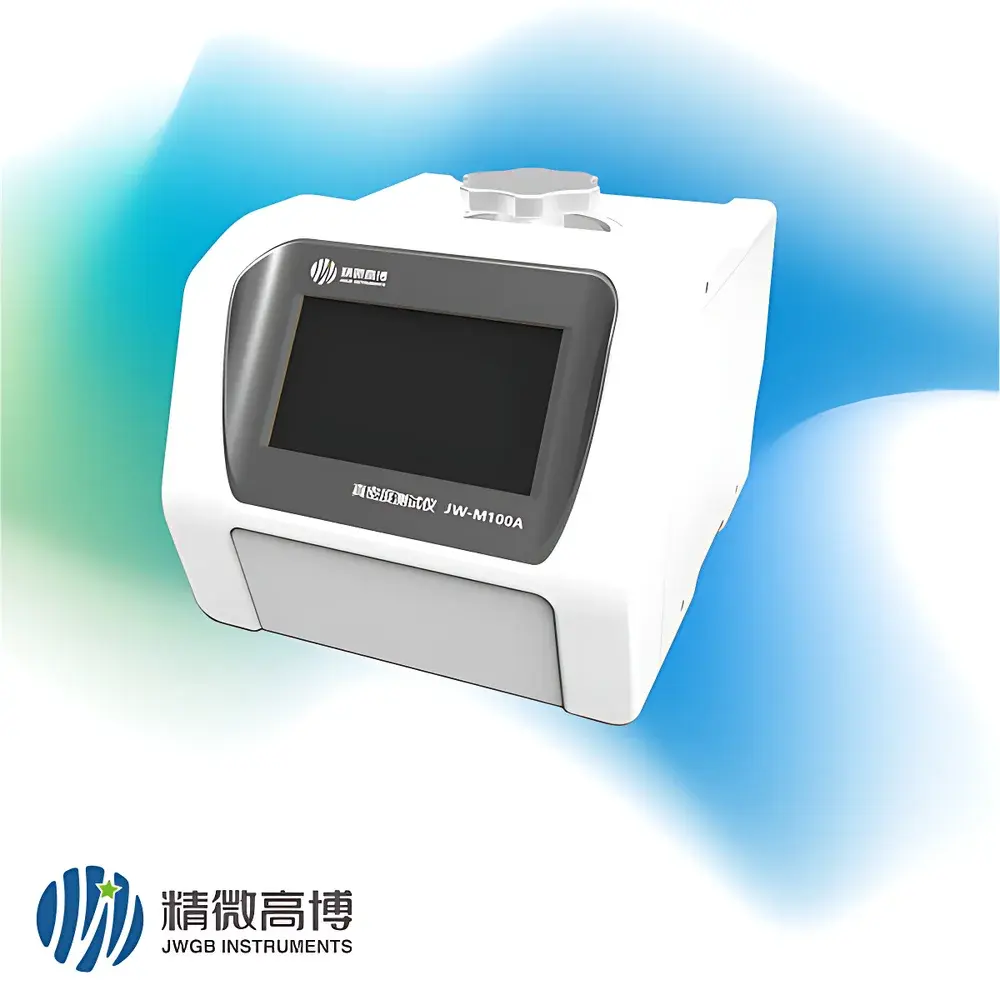
JWGB JW-M100A True Density Analyzer for Ceramic Proppants and Quartz Sand
| Brand | JWGB |
|---|---|
| Origin | Beijing, China |
| Manufacturer Type | Direct Manufacturer |
| Product Category | Domestic |
| Model | JW-M100A True Density Analyzer for Ceramic Proppants and Quartz Sand |
| Instrument Type | True Density Analyzer |
| Form Factor | Benchtop Laboratory Instrument |
| Sample Type | Solid Materials |
| Density Measurement Range | 0 g/mL — No Upper Limit |
| Density Accuracy | ≤ 0.03% (RSD) |
| Resolution | 0.00001 g/mL |
| Temperature Control Range | 0–50 °C |
| Measurement Principle | Gas Displacement (Helium/Nitrogen/Air) |
| Analysis Stations | 1 |
| Vacuum System | Integrated Oil-Free Diaphragm Pump |
| Pressure Sensor | Imported High-Stability Sensor, ±0.04% FS Accuracy, Long-Term Drift ≤ 0.025% FS |
| Thermal Management | Integrated Precision Isothermal Module for Sample & Reference Chambers |
| Sample Chamber Volume Options | 10–120 mL (6 Standard Aluminum Cells Supplied) |
| Data Interface | Full-Touch LCD Console + USB Export |
| Compliance | CE Certified |
| Calibration | Includes Certified Reference Standards |
| Testing Time per Sample | ≤ 2 Minutes |
| Porosity Modes | Open-Cell & Closed-Cell Porosity Calculation |
| Software | Embedded Firmware with Audit-Trail Capable Data Logging (GLP-Compatible) |
Overview
The JWGB JW-M100A True Density Analyzer is a benchtop gas displacement pycnometer engineered for high-precision determination of true (skeletal) density and geometric volume of solid particulates—including ceramic proppants, quartz sand, powders, granules, and porous solids. It operates on the fundamental principle of gas displacement volumetry, compliant with ASTM D5550, ISO 12154, and USP , where helium—due to its small atomic radius and non-adsorptive behavior—is the preferred inert probe gas for accessing interstitial voids without surface interaction artifacts. The instrument employs a dual-chamber static volumetric method: a precisely calibrated reference chamber and a sample chamber of known geometry are equilibrated under controlled isothermal conditions; pressure differentials before and after gas expansion into the sample chamber are measured via high-stability digital transducers, enabling calculation of inaccessible pore-free volume. This methodology delivers absolute density values independent of particle shape, surface roughness, or closed porosity—critical for quality control in oilfield proppant manufacturing, abrasive media grading, and mineral processing.
Key Features
- Integrated isothermal architecture: Patented aluminum monoblock module housing both sample and reference chambers ensures thermal equilibrium (<±0.1 °C) across all operational temperatures (0–50 °C), eliminating thermal drift-induced measurement variance.
- High-fidelity pressure metrology: Imported pressure sensors with ±0.04% full-scale accuracy and long-term stability of ≤0.025% FS guarantee reproducible gas law calculations over extended calibration intervals.
- Leak-tight fluidic control: Specially designed low-heat electromagnetic valves eliminate reverse leakage—a common source of systematic error in conventional pycnometers—enabling precise, repeatable gas dosing cycles.
- Modular sample handling: Six standardized anodized aluminum sample cells (10, 20, 30, 50, 100, and 120 mL) accommodate diverse mass loadings (>5 g typical), enabling optimization of signal-to-noise ratio for fine powders and coarse aggregates alike.
- Self-contained operation: Full-touch 7-inch LCD console with embedded firmware eliminates dependency on external PCs; real-time display of pressure curves, density trends, and statistical summaries supports immediate operator verification.
- Automated workflow: Programmable test sequences include configurable replicate counts (unlimited), auto-zeroing, and pressure ramp profiling—reducing operator intervention while maintaining traceability per ISO/IEC 17025 requirements.
Sample Compatibility & Compliance
The JW-M100A accommodates rigid and semi-rigid solids ranging from dense metal oxides to low-density foams and open-cell ceramics. Its helium-compatible design enables accurate characterization of materials with closed porosity—including sintered proppants, fused quartz grains, catalyst supports, battery electrode coatings, and pharmaceutical excipients. All hardware and software comply with CE marking directives (2014/30/EU EMC, 2014/35/EU LVD). Instrument validation includes NIM (China National Institute of Metrology) certification, and firmware supports audit-trail generation aligned with GLP and GMP data integrity expectations. While not natively 21 CFR Part 11 compliant, raw data export via USB facilitates integration into validated LIMS or ELN environments requiring electronic signature and change control.
Software & Data Management
Embedded firmware provides real-time acquisition, visualization, and post-processing of raw pressure-time datasets. Each analysis session logs timestamp, ambient temperature, chamber pressures, calculated volume, density, and relative standard deviation. Data files are stored internally and exportable as CSV or TXT via USB flash drive—retaining full metadata including operator ID, calibration date, and cell identification. Optional firmware upgrade supports batch reporting templates compatible with laboratory QA documentation workflows. No proprietary software installation is required; exported datasets integrate directly with Excel, MATLAB, or statistical process control platforms.
Applications
This analyzer serves critical QC/QA functions across upstream energy, advanced materials, and regulated manufacturing sectors. In hydraulic fracturing operations, it verifies true density consistency of ceramic proppants—directly correlating with crush resistance and conductivity retention under reservoir stress. For quartz sand suppliers, it discriminates between natural silica polymorphs (α-quartz vs. cristobalite) and detects densification anomalies caused by thermal treatment or contamination. It further supports R&D in battery material synthesis (e.g., LiFePO₄ tap density correlation), catalyst support density optimization, and nanoparticle dispersion stability assessment. Additional use cases span geological core analysis, refractory aggregate specification, and food-grade mineral additive certification.
FAQ
What gases can be used for measurement?
Helium is recommended for highest accuracy due to minimal adsorption and kinetic diameter; nitrogen and dry air are acceptable alternatives for less demanding applications.
Is vacuum degassing integrated?
Yes—the built-in oil-free diaphragm pump achieves ≤10 Pa base pressure prior to gas introduction, removing adsorbed moisture and atmospheric contaminants.
Can the instrument measure open and closed porosity?
Yes—by combining true density with bulk density (measured separately), the system calculates both open-cell and closed-cell porosity fractions using standard volumetric definitions.
How is calibration performed?
Certified stainless-steel reference spheres (supplied) are used for volumetric calibration; gas constant and sensor linearity are verified during factory acceptance testing and documented in the certificate of conformance.
What maintenance is required?
Annual verification of pressure sensor drift and valve response time is recommended; no consumables beyond standard O-rings are required under normal operating conditions.



