
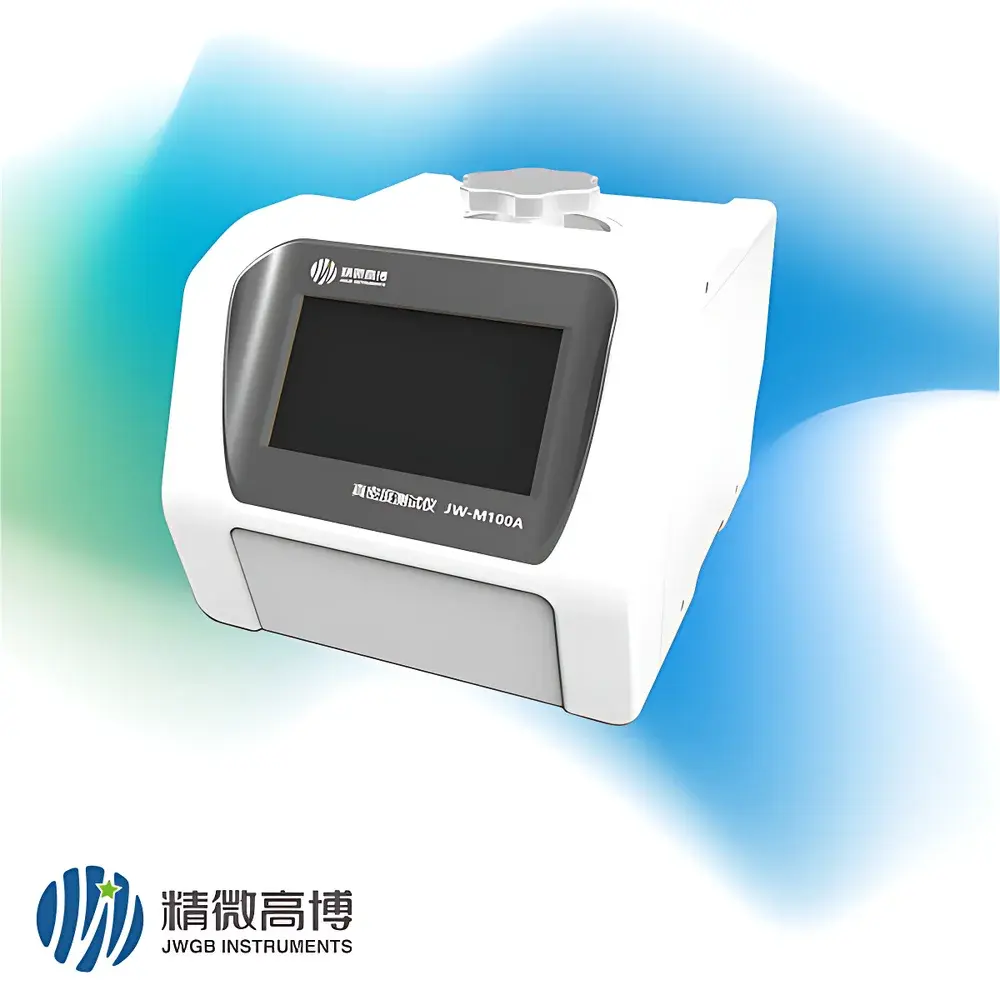
JWGB JW-M100A True Density Analyzer with Open/Closed Cell Porosity Measurement
| Brand | JWGB |
|---|---|
| Origin | Beijing, China |
| Manufacturer Type | Direct Manufacturer |
| Product Category | Domestic |
| Model | JW-M100A True Density Analyzer (Open/Closed Cell Porosity) |
| Instrument Type | True Density Analyzer |
| Form Factor | Benchtop Laboratory Instrument |
| Sample Type | Solid Materials |
| Density Range | 0 g/mL — No Known Upper Limit |
| Density Accuracy | ≤ 0.03% |
| Resolution | 0.00001 g/mL |
| Temperature Control Range | 0–50 °C |
| Measurement Principle | Gas Displacement (Helium/Nitrogen/Air) |
| Analysis Stations | 1 |
| Vacuum System | Integrated Oil-Free Diaphragm Pump |
| Pressure Sensor | Imported High-Stability Sensor, ±0.04% FS Accuracy, Long-Term Drift ≤ 0.025% FS |
| Thermal Management | Integrated Active Temperature Stabilization Module for Sample & Reference Chambers |
| Sample Chamber Volume Options | 10–120 mL (6 Standard Aluminum Cells Supplied) |
| Cycle Time | ≤ 2 Minutes per Measurement |
| Data Interface | Full-Touch LCD Console + USB Export |
| Compliance | CE Certified, CNAS-Validated Calibration Traceability, Meets ISO 12154, ASTM D5550, and USP <699> Requirements for Solid Density Determination |
Overview
The JWGB JW-M100A True Density Analyzer is a benchtop gas displacement instrument engineered for precise determination of true density, skeletal volume, open-cell porosity, and closed-cell porosity in solid and porous materials. It operates on the fundamental principle of gas pycnometry—specifically, helium or nitrogen gas displacement within a calibrated, temperature-stabilized system—where the volume of gas displaced by a solid sample is measured under controlled isothermal conditions. By comparing the pressure change in a known reference volume before and after sample introduction, the instrument calculates the non-porous (skeletal) volume with high reproducibility. This method conforms to internationally recognized standards including ASTM D5550 (Standard Test Method for Density of Solid Plastics), ISO 12154 (Determination of True Density of Solids by Gas Pycnometry), and USP (Density of Solids). The JW-M100A integrates an active thermal stabilization module that ensures uniform temperature distribution across both sample and reference chambers—critical for minimizing thermal drift and achieving ≤0.03% repeatability across repeated measurements.
Key Features
- Integrated oil-free diaphragm vacuum pump eliminates hydrocarbon contamination and enables rapid, quiet evacuation without external infrastructure.
- Imported high-accuracy pressure transducers (±0.04% full-scale accuracy, long-term stability ≤0.025% FS) ensure traceable, low-drift pressure acquisition essential for sub-milligram volumetric resolution.
- Modular aluminum sample chamber assembly—corrosion-resistant, thermally conductive, and chemically inert—optimized for consistent heat transfer and minimal adsorption artifacts.
- Six standard aluminum sample cells (10 mL, 20 mL, 30 mL, 50 mL, 100 mL, 120 mL) allow optimal volume matching for diverse sample geometries—from fine powders (>5 g recommended mass) to rigid monoliths and low-density foams.
- Self-contained full-touch LCD console with embedded firmware eliminates dependency on external PCs; all calibration, measurement protocols, and data logging are executed onboard.
- Automated multi-cycle testing with user-defined repetition count supports statistical validation per GLP/GMP requirements; raw pressure-time datasets are retained with timestamped audit trails.
- USB interface enables secure export of CSV-formatted results—including density, volume, porosity %, and pressure decay profiles—for integration into LIMS or statistical analysis platforms.
Sample Compatibility & Compliance
The JW-M100A accommodates a broad spectrum of solid-phase materials: inorganic powders (e.g., metal oxides, catalysts, battery electrode materials), polymeric foams, ceramic monoliths, carbon-based sorbents, pharmaceutical excipients, geological aggregates, and composite laminates. Its dual-porosity calculation algorithm differentiates between interconnected (open-cell) and isolated (closed-cell) void structures using sequential purge-and-fill cycles under inert gas—enabling compliance with ASTM D2854 (apparent density of activated carbon) and ISO 4590 (cellular plastics—determination of apparent density). All instruments ship with NIST-traceable certified reference materials and undergo factory verification per ISO/IEC 17025 guidelines. CE marking confirms conformity with EU Machinery Directive 2006/42/EC and Electromagnetic Compatibility Directive 2014/30/EU. Calibration documentation includes uncertainty budgets aligned with GUM (Guide to the Expression of Uncertainty in Measurement).
Software & Data Management
The embedded operating system provides intuitive workflow navigation via capacitive touchscreen, supporting method-driven operation (e.g., “Quick Density”, “Porosity Mode”, “Multi-Cycle Validation”). Each test record stores full metadata: ambient temperature/humidity, cell ID, purge gas type, number of equilibration steps, pressure stabilization thresholds, and real-time pressure decay curves. Audit logs capture operator ID (if configured), timestamp, firmware version, and calibration status—meeting FDA 21 CFR Part 11 requirements for electronic records when paired with institutional access controls. Data export preserves column headers and units in SI-compliant format (g/mL, mL/g, %), facilitating direct import into Excel, MATLAB, or quality management systems. Optional firmware updates are delivered via encrypted USB key with SHA-256 signature verification.
Applications
This analyzer serves R&D and QC laboratories across advanced materials development, where accurate skeletal density directly informs critical performance parameters: electrode compaction in lithium-ion batteries (LiCoO₂, graphite anodes), pore network characterization in heterogeneous catalysts (zeolites, Pt/Al₂O₃), density-driven sintering optimization in technical ceramics (Al₂O₃, SiC), and batch release testing of pharmaceutical granules per USP . It is routinely deployed for quality control of rubber fillers (carbon black, silica), food-grade absorbents (bentonite, activated clay), magnetic powders (Fe₃O₄), and nanomaterials (CNTs, nano-Ag), where deviations >0.03% signal process drift in synthesis or milling. In geotechnical and environmental labs, it quantifies bulk vs. particle density in soils and sediments to derive porosity indices used in permeability modeling.
FAQ
What gases can be used for measurement?
Helium is recommended for highest accuracy due to its small molecular size and inertness; nitrogen and dry air are acceptable alternatives for less demanding applications.
Is external PC hardware required for operation?
No—the instrument is fully self-contained with integrated touchscreen control, data storage, and USB export functionality.
How is temperature stability maintained during analysis?
An integrated Peltier-assisted thermal module actively regulates both sample and reference chamber temperatures to ±0.1°C, ensuring isothermal conditions throughout the gas expansion cycle.
Can the instrument differentiate between open and closed porosity in foam materials?
Yes—using sequential helium infiltration and purge cycles, it computes open-cell fraction based on accessible void volume and closed-cell fraction from total skeletal volume deficit.
Does the system support automated calibration verification?
Yes—pre-loaded calibration routines use certified reference spheres (supplied) to validate pressure sensor linearity, valve timing, and thermal equilibrium response prior to sample analysis.



