
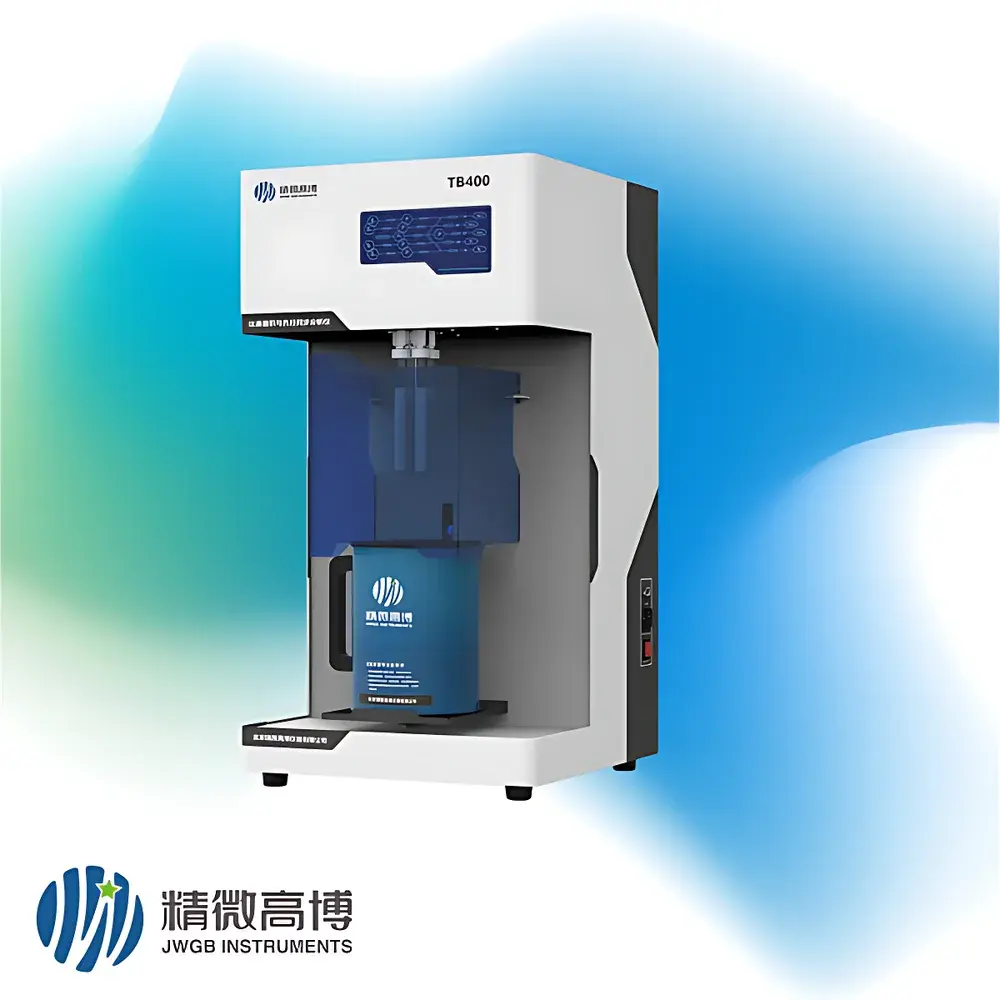
JWGB JW-TB400 Pharmaceutical Excipient-Specific Specific Surface Area and Pore Size Analyzer
| Brand | JWGB |
|---|---|
| Origin | Beijing, China |
| Manufacturer Type | Direct Manufacturer |
| Instrument Category | Domestic |
| Model | JW-TB400 Pharmaceutical Excipient-Specific Specific Surface Area and Pore Size Analyzer |
| Instrument Type | Specific Surface Area and Pore Size Analyzer |
| Principle | Static Volumetric Gas Adsorption Method |
| Number of Analysis Stations | 4 |
| Specific Surface Area Range | >0.0005 m²/g |
| Pressure Range | 1×10⁻⁵ to 0.998 atm |
| Theoretical Basis | Static Volumetric Adsorption Method |
Overview
The JWGB JW-TB400 Pharmaceutical Excipient-Specific Specific Surface Area and Pore Size Analyzer is a high-precision, multi-station gas adsorption instrument engineered for rigorous physical characterization of pharmaceutical excipients, active pharmaceutical ingredients (APIs), and other fine particulate materials used in solid dosage form development. It operates on the well-established static volumetric gas adsorption principle—where controlled doses of nitrogen (or other probe gases such as argon or CO₂) are introduced into calibrated sample cells under ultra-high vacuum conditions, and equilibrium pressures are measured with high-stability capacitance manometers. This method enables quantitative determination of surface area, pore volume, and pore size distribution across microporous (50 nm) regimes. Designed specifically for the pharmaceutical industry, the JW-TB400 integrates hardware and software features that address regulatory requirements for method robustness, data traceability, and inter-laboratory reproducibility—critical for QbD (Quality by Design) workflows and ICH Q5A/Q5C compliance.
Key Features
- Four independent analysis stations sharing a single, temperature-stabilized liquid nitrogen Dewar and centralized gas manifold—minimizing thermal drift and ensuring cross-station measurement consistency.
- Ultra-high vacuum system with ultimate pressure ≤1×10⁻⁵ atm, supported by dual-stage turbomolecular pumping and integrated leak-check diagnostics.
- High-accuracy pressure transducers (capacitance-based) covering a full dynamic range from 1×10⁻⁵ to 0.998 atm with <±0.1% full-scale repeatability.
- Dedicated excipient calibration protocols—including pre-treatment sequences compliant with USP & Ph. Eur. guidelines for residual solvent removal and surface dehydration.
- Modular sample preparation station with programmable heating/de-gassing up to 400 °C under vacuum or inert gas flow, with real-time mass loss monitoring via optional microbalance integration.
- Rugged, CE-compliant industrial enclosure with ESD-safe internal architecture and fail-safe gas handling valves meeting ISO 13849-1 functional safety standards.
Sample Compatibility & Compliance
The JW-TB400 accommodates standard 6–10 mm glass sample tubes and supports powders, granules, pellets, and lyophilized matrices with minimal sample mass requirements (typically 50–500 mg, depending on expected surface area). Its design aligns with key regulatory expectations for pharmaceutical material characterization: all raw pressure–volume isotherm data are time-stamped and stored with full audit trail metadata; software enforces user role-based access control (RBAC); and electronic records comply with FDA 21 CFR Part 11 requirements when deployed with validated IQ/OQ/PQ documentation packages. The instrument supports ASTM D3663 (Standard Test Method for Surface Area of Catalysts), ISO 9277 (Characterization of Powders — Determination of Specific Surface Area), and IUPAC-recommended evaluation methods including BET, Langmuir, BJH, t-plot, NLDFT, and HK formalisms.
Software & Data Management
JWGB’s proprietary JWinPro v5.x software provides a validated, Windows-based platform for instrument control, real-time isotherm visualization, and advanced data reduction. It includes automated quality checks—such as monolayer convergence validation, hysteresis loop symmetry assessment, and relative pressure step consistency scoring—to flag potential artifacts before report generation. All calculations support customizable uncertainty propagation per GUM (Guide to the Expression of Uncertainty in Measurement). Export formats include ASTM E1447-compliant .csv, ISO/IEC 17025-aligned PDF analytical reports, and .xml files compatible with LIMS integration. Audit logs record every parameter change, user login/logout, calibration event, and report revision—fully traceable for GLP/GMP audits.
Applications
- Quantification of specific surface area (SSA) of microcrystalline cellulose, lactose monohydrate, crospovidone, and other excipients to correlate with dissolution rate and tablet compaction behavior.
- Pore structure mapping of silica-based glidants and mesoporous calcium silicates used in direct compression formulations.
- Batch-to-batch comparability studies for biosimilar drug product development per ICH Q5A.
- Stability-indicating characterization of amorphous solid dispersions following accelerated storage conditions (e.g., 40 °C/75% RH).
- Supporting regulatory submissions (e.g., ANDA, MAA) with fully documented, repeatable surface metrics aligned with Ph. Eur. 2.9.33 and USP <1217>.
FAQ
What probe gases are supported for pharmaceutical applications?
Standard operation uses high-purity nitrogen (99.999%) at 77 K; argon (87 K) and CO₂ (273 K) are available for low-temperature or supercritical analysis of microporous excipients.
Can the JW-TB400 perform degassing under controlled humidity?
Yes—optional vapor-saturated purge gas modules enable controlled relative humidity (RH) degassing between 10–90% RH for hygroscopic excipient conditioning prior to analysis.
Is NLDFT kernel selection validated for pharmaceutical polymers?
The software includes IUPAC-recommended NLDFT models for carbon, silica, and alumina; custom kernels for HPMC, PVP, and other polymer surfaces can be imported via certified third-party libraries.
How does the system ensure inter-station equivalence during multi-sample runs?
All four stations share identical thermal mass (common Dewar), identical pressure sensor calibration history, and synchronized dosing sequences—validated annually per ISO/IEC 17025 internal protocol.
Does the instrument support 21 CFR Part 11 compliance out-of-the-box?
Yes—when installed with JWinPro v5.x in validated configuration (including digital signatures, electronic audit trails, and password-protected method locking), it meets baseline Part 11 requirements for electronic records and signatures.



