
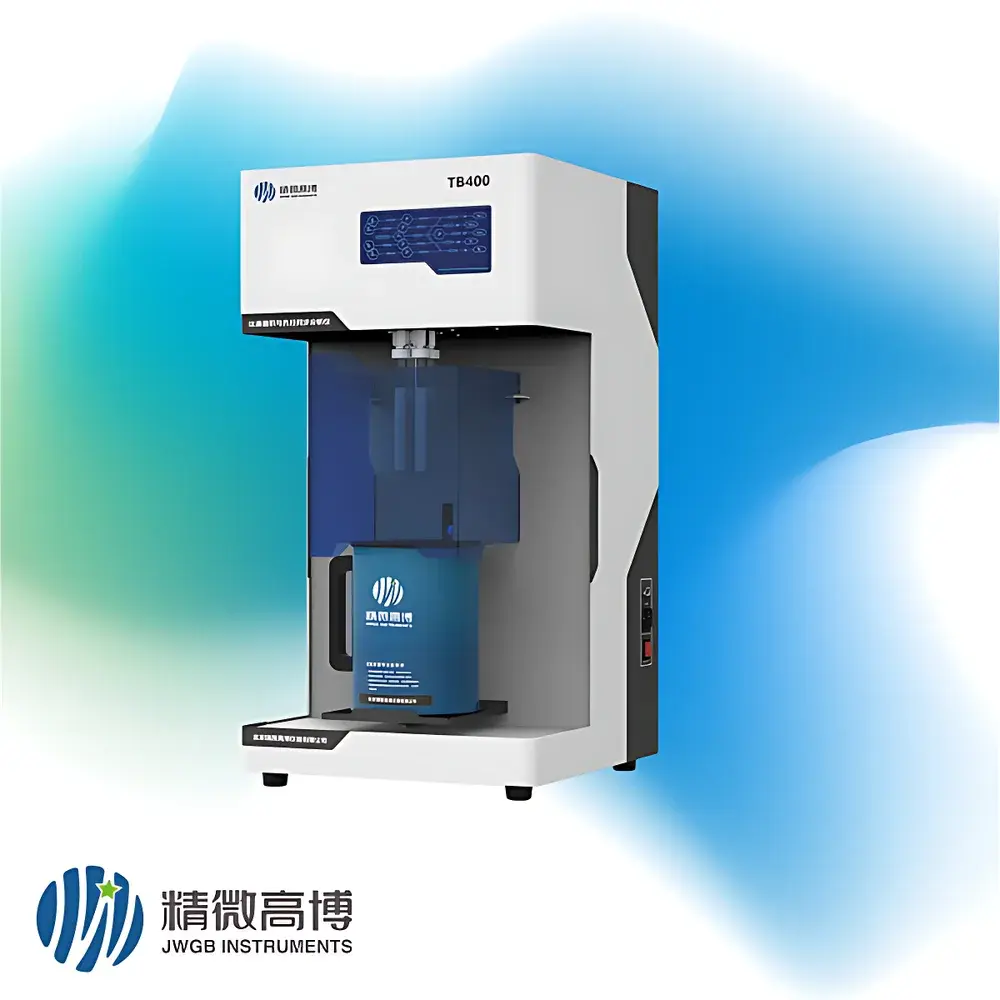
JWGB JW-TB400 Rubber-Specific Specific Surface Area Analyzer
| Brand | JWGB |
|---|---|
| Origin | Beijing, China |
| Manufacturer Type | Direct Manufacturer |
| Instrument Category | Domestic |
| Model | JW-TB400 Rubber-Specific Specific Surface Area Analyzer |
| Instrument Type | Specific Surface Area and Pore Size Analyzer |
| Measurement Principle | Static Volumetric Gas Adsorption Method |
| Number of Analysis Stations | 4 |
| Specific Surface Area Range | >0.0005 m²/g |
| Pressure Range | 10⁻⁵–0.998 P/P₀ |
| Analytical Theory | Static Volumetric Adsorption |
Overview
The JWGB JW-TB400 Rubber-Specific Specific Surface Area Analyzer is a high-precision, multi-station gas adsorption instrument engineered for the quantitative characterization of surface area, pore size distribution, and adsorption behavior in elastomeric and carbon-black–reinforced rubber compounds. It operates on the well-established static volumetric (manometric) gas adsorption principle—where controlled doses of nitrogen (or other inert adsorbates such as argon or CO₂) are introduced into evacuated sample cells at precisely regulated equilibrium pressures. By measuring the quantity of gas adsorbed at each pressure step, the instrument constructs full adsorption–desorption isotherms (Type I–IV per IUPAC classification), enabling rigorous physical and chemical interpretation of surface and porous architecture. Designed specifically for rubber industry applications—including silica- and carbon-black–filled compounds—the JW-TB400 integrates hardware and software optimizations to minimize thermal drift, mitigate competitive adsorption artifacts from residual volatiles, and ensure stable baseline performance during extended low-pressure measurements (down to 10⁻⁵ P/P₀).
Key Features
- Four independent analysis stations sharing a single cryogenic Dewar and centralized gas manifold—ensuring identical thermal history, pressure calibration, and gas purity across all samples, thereby eliminating inter-station variability and enhancing inter-laboratory reproducibility.
- High-resolution pressure transducers with dual-range capability (ultra-high vacuum to near-atmospheric) calibrated traceably to NIST standards, supporting accurate measurement across the full 10⁻⁵–0.998 P/P₀ range.
- Dedicated sample preparation module with programmable degassing protocols (temperature, time, vacuum level) optimized for thermally sensitive elastomer composites and vulcanized rubber powders.
- Integrated temperature-controlled sample ports and low-thermal-mass sample tubes to minimize condensation artifacts and improve signal-to-noise ratio during sub-monolayer adsorption quantification.
- Robust mechanical architecture with electromagnetic valve arrays and leak-tight stainless-steel fluidic pathways, validated to <1×10⁻⁸ mbar·L/s helium leak rate per station.
Sample Compatibility & Compliance
The JW-TB400 accommodates powdered, granular, and cured rubber specimens—including natural rubber (NR), styrene–butadiene rubber (SBR), ethylene propylene diene monomer (EPDM), and carbon-black– or precipitated silica–filled formulations—within standard 6–10 mm OD quartz sample tubes. Sample mass range: 0.05–2.0 g, adjustable based on expected surface area and porosity. The system supports ASTM D3037 (Standard Test Method for Surface Area of Carbon Black by Nitrogen Adsorption), ISO 9277 (Determination of Specific Surface Area of Solids by Gas Adsorption Using the BET Method), and USP (Surface Area Determination). Data acquisition and reporting comply with GLP and GMP documentation requirements, including full audit trails, electronic signatures, and user-access controls aligned with FDA 21 CFR Part 11 readiness.
Software & Data Management
JWGB’s proprietary “JW-Analyzer” software provides a modular, ISO/IEC 17025–aligned data processing environment. It includes fully configurable isotherm acquisition workflows, automated baseline correction, and parallel execution of up to 12 independent analytical models—including BET (single-point and multi-point), Langmuir, t-plot, BJH (adsorption/desorption), DH, DR, DA, HK, SF, and NLDFT kernel-based pore size distribution. All calculations generate traceable metadata: raw pressure–volume files, degassing logs, uncertainty propagation estimates (per GUM guidelines), and ISO-compliant PDF reports with embedded digital signatures. Export formats include CSV, XML, and ASTM E1447–compliant .sas data packages for LIMS integration.
Applications
- Quantitative comparison of carbon black dispersion efficiency in SBR/NR masterbatches via specific surface area shifts and hysteresis loop morphology.
- Correlation of silica surface hydroxyl density (via t-plot micropore volume) with silane coupling agent grafting efficiency.
- Pore network evolution tracking during rubber devulcanization or thermal aging studies.
- QC release testing of reinforcing fillers against batch-to-batch BET surface area specifications (e.g., N115, N220, VN3, etc.).
- Supporting R&D of novel nanostructured elastomers, including graphene oxide– or MXene–reinforced composites.
FAQ
What adsorbate gases are supported, and how is gas selection justified for rubber samples?
Nitrogen at 77 K remains the primary adsorbate for BET surface area and mesopore analysis per ISO 9277; argon at 87 K is recommended for microporous rubber-derived carbons to avoid quadrupole interactions. CO₂ at 273 K may be used for ultra-micropore assessment (<0.7 nm) in activated carbon–filled elastomers.
Does the system support automated degassing under dynamic vacuum or inert purge?
Yes—integrated turbomolecular pumping with programmable ramp rates (0.1–5 °C/min), hold times (up to 24 h), and endpoint criteria (pressure stability <1×10⁻⁴ mbar over 10 min) ensures complete removal of moisture and volatile organics without thermal degradation.
How is cross-contamination prevented between rubber samples with high extractable content?
Each station features dedicated, bakeable stainless-steel valves and a cold trap positioned upstream of the pressure sensor; optional quartz-lined sample tubes further reduce adsorbate carryover.
Can the software generate reports compliant with regulatory submissions (e.g., FDA, EMA)?
Yes—audit-trail-enabled report generation includes operator ID, timestamped method parameters, raw sensor outputs, calculation versioning, and digital signature fields meeting 21 CFR Part 11 Subpart B requirements.



