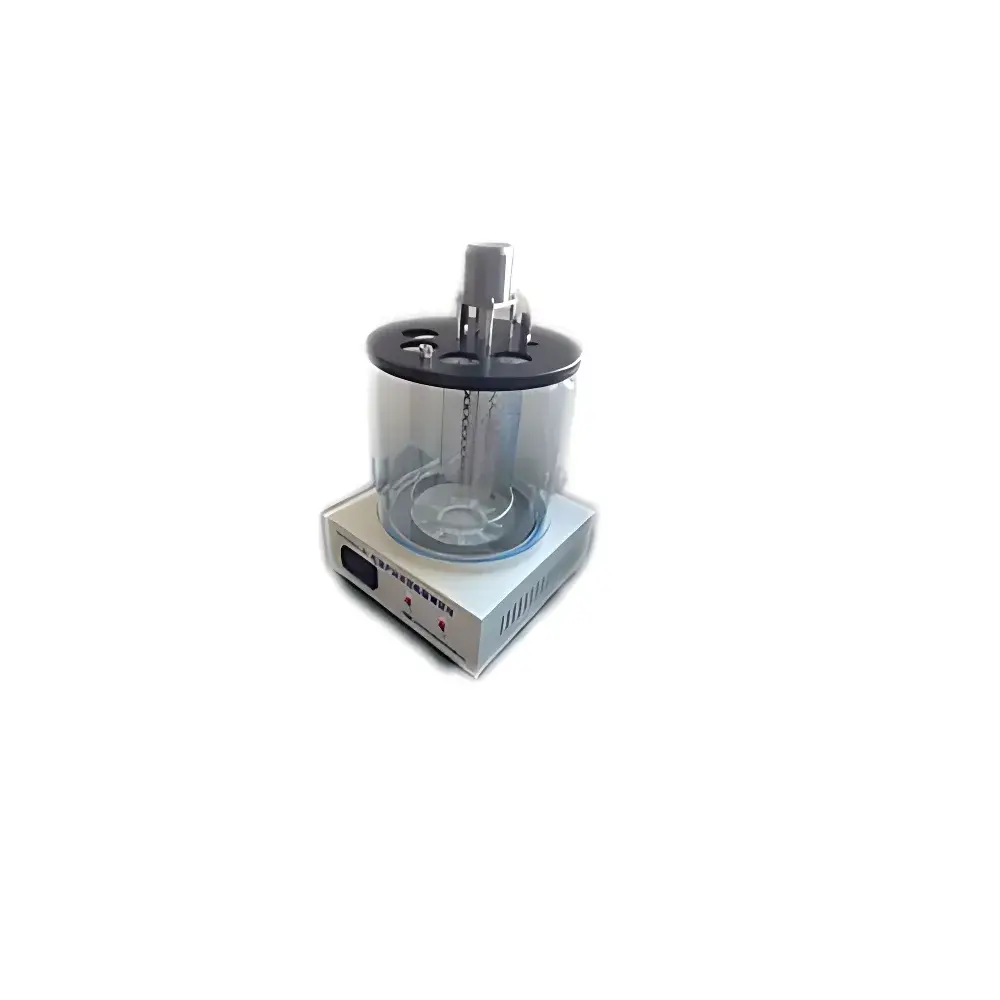
KA-109 Karrie Kinematic Viscosity Tester for Petroleum Products
| Brand | Karrie |
|---|---|
| Model | KA-109 |
| Temperature Control Points | 20°C, 40°C, 50°C, 80°C, 100°C |
| Temperature Stability | ±0.1°C (KA-109), ±0.05°C (KA-109G variant) |
| Stirring Motor Power | 15 W |
| Heating Power | 1.6 kW |
| Power Supply | AC 220 V, 50 Hz |
| Bath Construction | Glass bath vessel, anodized aluminum lid, powder-coated steel housing, acrylic outer shield |
| Integrated Cooling Port | Yes (for external immersion chiller) |
| Configuration Options | Single-bath (KA-109), dual-bath (KA-109C), or calculator-integrated (KA-109A) |
Overview
The Karrie KA-109 Kinematic Viscosity Tester is a precision-engineered laboratory instrument designed specifically for the determination of kinematic viscosity in petroleum products according to ASTM D445 and ISO 3104—international standards harmonized with China’s GB/T 265 “Method for Determination of Kinematic Viscosity of Petroleum Products and Calculation of Dynamic Viscosity.” It operates on the capillary viscometer principle: a fixed-volume sample is drawn into a calibrated glass capillary tube (e.g., Ubbelohde or Cannon-Fenske types), and the time required for the meniscus to pass between two etched marks under gravity is measured. Kinematic viscosity (ν, in mm²/s or cSt) is calculated as ν = C × t, where C is the viscometer constant and t is the efflux time. The KA-109 provides a thermally stable, optically accessible, and mechanically robust environment for this gravimetric timing process—critical for reproducible results across transparent and opaque liquid fuels, lubricants, base oils, and distillates.
Key Features
- Thermostatically controlled glass bath with five preset temperature setpoints (20°C, 40°C, 50°C, 80°C, and 100°C), supporting routine testing across industry-standard conditions including ISO VG classification and ASTM D445 Grade 1–4 requirements.
- High-stability temperature regulation: ±0.1°C for standard KA-109 configuration; ±0.05°C for the enhanced KA-109G variant—achievable via PID-controlled heating combined with low-noise magnetic stirring (15 W motor) and optimized thermal mass distribution.
- Corrosion-resistant fluid path components: stainless-steel stirring shaft, impeller, baffle plate, and heating element ensure long-term dimensional stability and eliminate contamination risks during repeated use with aggressive hydrocarbon solvents or sulfur-containing samples.
- Ergonomic viscometer holder assembly with adjustable clamping mechanism—designed to accommodate capillary viscometers of varying diameters (0.4–1.2 mm bore) while maintaining vertical alignment within ±0.1° tolerance, minimizing flow deviation errors.
- Integrated circumferential fluorescent lighting at the bath base, coupled with a transparent acrylic outer shield, delivers uniform illumination for unambiguous meniscus detection—essential for manual timing or integration with automated optical detection systems.
- Dedicated immersion-chiller port enables active cooling when ambient temperatures exceed 20°C, ensuring rapid thermal equilibration and compliance with ISO 3104 Clause 6.2 (bath temperature must be maintained within ±0.02°C during measurement).
Sample Compatibility & Compliance
The KA-109 supports kinematic viscosity measurement of both transparent (e.g., diesel fuel, kerosene, light naphthas) and opaque (e.g., residual fuel oil, bitumen cutbacks, heavy lubricating oils) petroleum liquids—provided they are sufficiently fluid to permit capillary flow at the selected test temperature. It accommodates standard ASTM D445-compliant viscometers (including Type I, II, and IV Ubbelohde designs) and conforms to calibration traceability requirements outlined in ISO/IEC 17025. When operated with documented SOPs and calibrated reference oils (e.g., NIST SRM 2783 series), the system supports GLP-compliant data generation for refinery QC, third-party certification labs, and regulatory submissions under API RP 2540 or EN 14214 (biodiesel specification).
Software & Data Management
While the base KA-109 model operates as a standalone thermostatic bath for manual timing, optional configurations extend functionality: the KA-109A integrates an embedded microprocessor-based calculator that accepts user-input efflux times and applies preloaded viscometer constants to output kinematic viscosity values directly (in cSt or mm²/s), with automatic unit conversion and basic statistical functions (mean, SD, CV%). All variants support external PC connectivity via RS-232 for time-stamped data logging. When paired with validated LIMS or ELN platforms, the instrument satisfies FDA 21 CFR Part 11 requirements for electronic records—including audit trails, user authentication, and data integrity controls—provided appropriate software validation protocols are implemented by the end user.
Applications
- Quality control of finished petroleum products per ASTM D975 (diesel), D3607 (gasoline), and D2500 (cloud point correlation).
- Viscosity grading of industrial lubricants (ISO VG 32–680) and turbine oils (ASTM D4310).
- Refinery process monitoring: feedstock characterization, distillation cut verification, and blending optimization.
- Research and development of biofuels (FAME, HVO) and synthetic lubricants requiring precise low-shear-rate viscosity profiling.
- Calibration laboratory use as a certified constant-temperature bath for capillary viscometer calibration against primary standards.
FAQ
What capillary viscometers are compatible with the KA-109?
Standard Ubbelohde, Cannon-Fenske, and Ostwald types with nominal bore sizes from 0.4 mm to 1.2 mm—mounted vertically using the adjustable stainless-steel holder.
Does the KA-109 meet ASTM D445 temperature stability requirements?
Yes—the ±0.1°C stability (KA-109) and ±0.05°C (KA-109G) comply with ASTM D445 Section 7.2, which mandates ≤ ±0.02°C deviation during measurement for Grade 1 accuracy; full compliance requires use of certified reference oils and documented bath calibration.
Can the KA-109 be used for high-viscosity samples like asphalt binders?
Not directly—kinematic viscosity measurement above ~50,000 cSt at 60°C typically requires vacuum capillary or rotational methods; however, the KA-109 can condition and stabilize lower-cut asphalt fractions (e.g., flux oils) at elevated temperatures prior to dilution and testing.
Is the bath volume sufficient for simultaneous multi-viscometer operation?
The single-bath KA-109 accommodates one standard viscometer; the KA-109C dual-bath variant supports two independent tests at identical or different temperatures, enabling parallel analysis or reference/sample comparison.
How is temperature calibration verified?
Users perform periodic verification using a NIST-traceable platinum resistance thermometer (PRT) inserted adjacent to the viscometer bulb position, following procedures described in ISO 17025 Clause 6.5 and ASTM E77.