
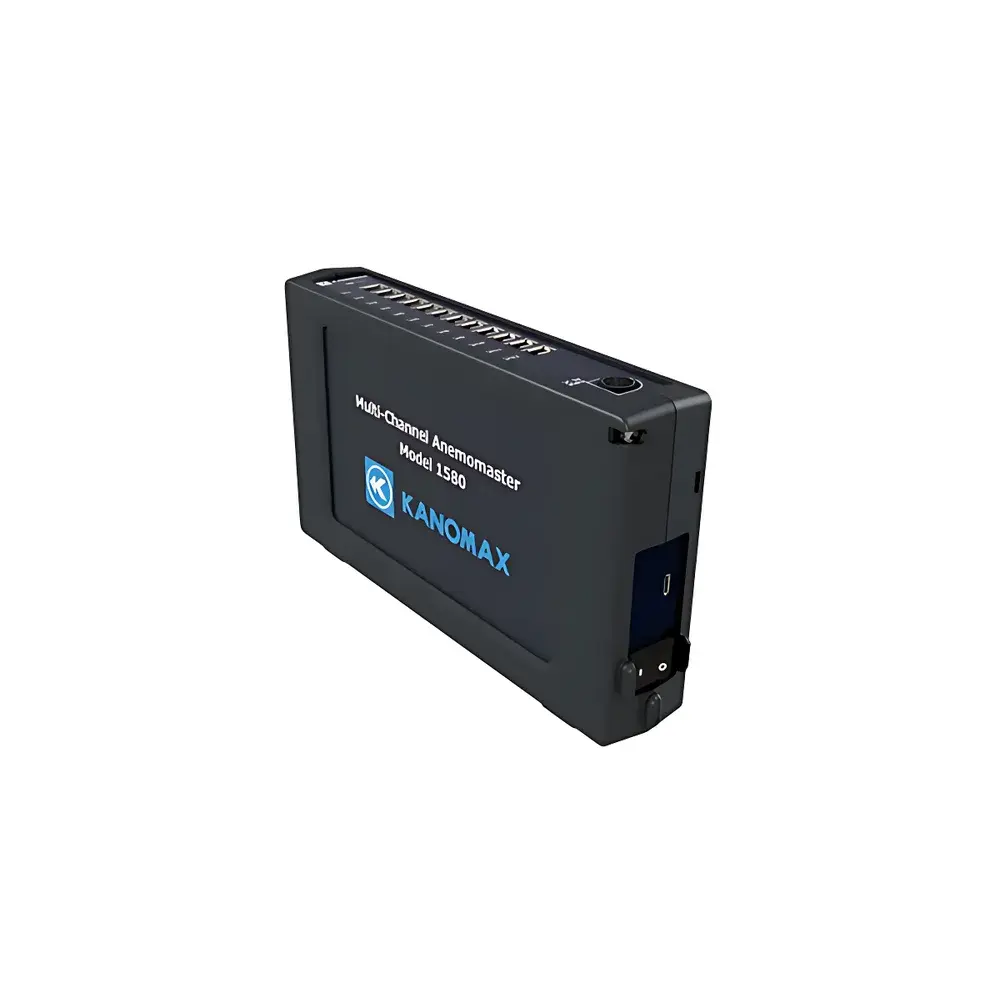
Kanomax 1580-0C 12-Channel Thermal Anemometer System
| Brand | Kanomax |
|---|---|
| Origin | China (Liaoning) |
| Instrument Type | Thermal Anemometer |
| Resolution | 0.01 m/s |
| Measurement Range | 0.01–50.0 m/s |
| Accuracy | ±2% of reading or ±0.02 m/s (whichever is greater) |
| Operating Temperature | 5–40 °C |
| Operating Humidity | 0–85% RH (non-condensing) |
| Power Supply | AC 100–240 V / DC 12–24 V |
| Dimensions (Main Unit) | 220 × 130 × 40 mm |
| Weight (Main Unit) | 0.6 kg |
| Channel Capacity | 12 simultaneous probes |
| Communication | USB Micro-B, RS-485 serial interface |
| Software Compatibility | Windows 10, tri-lingual UI (English, Japanese, Chinese) |
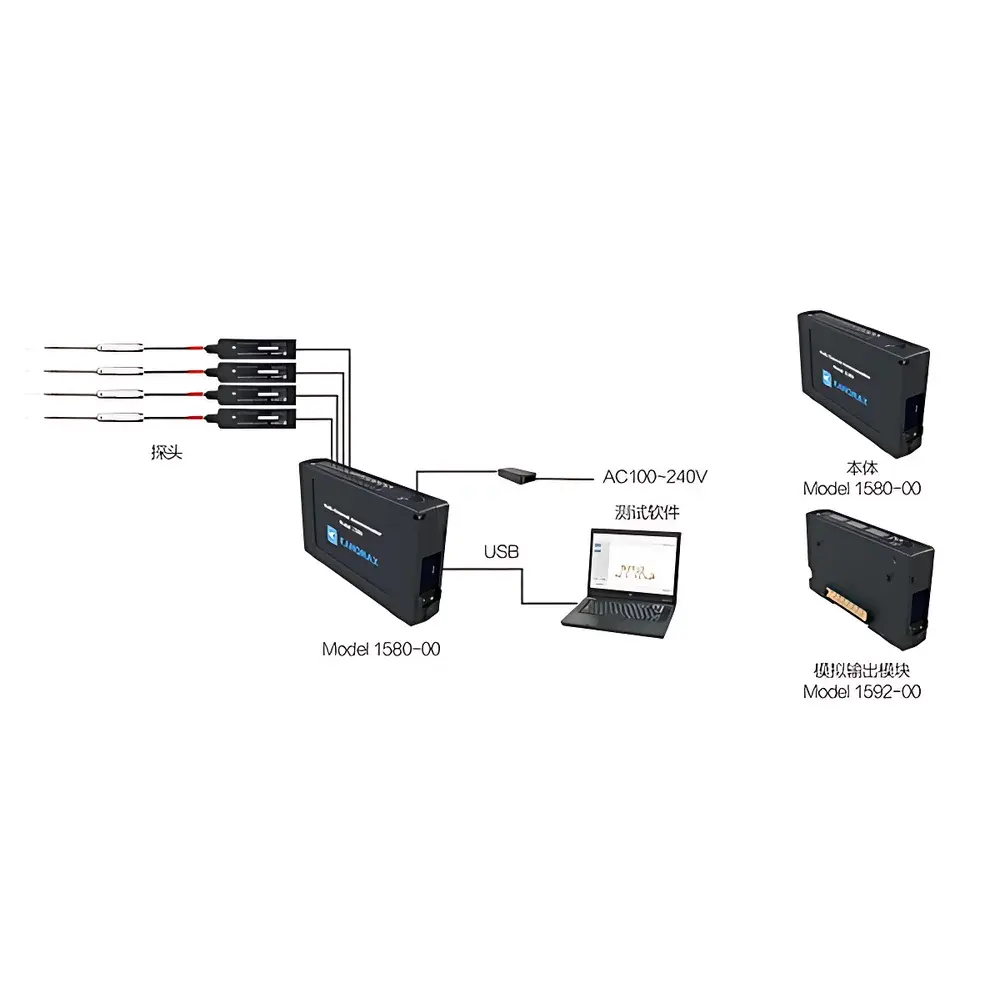
| Max Expandable Channels | 144 (via up to 12 × MODEL 1592-0C analog output modules) |
Overview
The Kanomax MODEL 1580-0C is a modular, high-channel-count thermal anemometry system engineered for precision multi-point airflow characterization in controlled environments, HVAC validation, cleanroom monitoring, and industrial ventilation assessment. Unlike single-point handheld anemometers, the 1580-0C functions as a centralized data acquisition platform that supports up to 12 simultaneously connected thermal probes—each independently configurable for wind speed, temperature, and/or relative humidity measurement. Its operating principle relies on constant-temperature anemometry (CTA), where a heated sensing element’s thermal dissipation correlates linearly with local air velocity under laminar and turbulent flow conditions. This method ensures stable low-end sensitivity down to 0.01 m/s while maintaining repeatability across the full 0.01–50.0 m/s range. The system is designed for integration into permanent or semi-permanent monitoring installations, including mobile test rigs and vehicle-mounted environmental diagnostics setups.
Key Features
- 12-channel synchronized acquisition architecture with hot-wire and hot-film probe compatibility
- Modular probe ecosystem: 15 interchangeable probe models—including directional and omnidirectional variants—with temperature compensation algorithms embedded at the sensor level
- Ultra-compact probe form factors (minimum outer diameter: 1.6 mm) enabling deployment in confined ductwork, laminar flow hoods, and micro-environments
- High-temperature probe options rated for continuous operation up to 120 °C, suitable for exhaust ducts and thermal process validation
- Dual power flexibility: AC mains (100–240 V) or wide-range DC input (12–24 V), supporting both fixed lab and field-deployable configurations
- Integrated analog output expansion via MODEL 1592-0C modules—each supporting 12-channel voltage (0–5 V) or current (4–20 mA) outputs with user-defined scaling per channel
- Robust mechanical design: aluminum alloy chassis, IP20-rated enclosure, and vibration-resistant internal mounting for transportable use cases
Sample Compatibility & Compliance
The 1580-0C system accommodates diverse airflow geometries and environmental conditions through its standardized probe interface and configurable channel mapping. Probes are certified for use in non-hazardous, non-corrosive atmospheres per IEC 61000-6-2 (EMC immunity) and IEC 61000-6-4 (EMC emissions). While not intrinsically safe, the system complies with general-purpose laboratory equipment safety standards (IEC 61010-1). For regulated environments—including pharmaceutical cleanrooms and HVAC commissioning per ISO 14644-3—the system supports audit-ready data logging when used with validated software configurations. All temperature and humidity measurements meet traceability requirements aligned with NIST-traceable calibration practices; probe-specific calibration certificates are available upon request. The system does not inherently satisfy FDA 21 CFR Part 11 requirements but can be deployed in compliant workflows when paired with validated third-party software enforcing electronic signature, audit trail, and data integrity controls.
Software & Data Management
The bundled Windows 10-compatible software provides real-time visualization, configuration management, and export functionality. It supports up to 144 total channels when cascading multiple 1580-0C units with 1592-0C modules. Each probe’s physical attributes—including serial number, calibration date, and sensitivity coefficients—are auto-detected and stored within the session file. Users may define custom averaging intervals (1 s to 60 min), set alarm thresholds per channel, and configure dynamic display modes: instantaneous values, time-weighted averages, min/max tracking, and trend graphs with adjustable time axes. Raw data exports to CSV and Excel (.xlsx) formats preserve timestamp resolution to 100 ms. The software includes built-in unit conversion (m/s, ft/min, knots, °C, °F, %RH), mathematical channel derivation (e.g., volumetric flow calculation from velocity × cross-sectional area), and batch report generation templates compatible with ISO/IEC 17025 documentation frameworks.
Applications
- HVAC system balancing and ASHRAE 111-compliant airflow verification in commercial buildings and laboratories
- Cleanroom ISO Class certification per ISO 14644-3, including uniformity mapping of unidirectional airflow velocity profiles
- Pharmaceutical facility qualification (IQ/OQ/PQ) of laminar airflow workstations, isolators, and gloveboxes
- Automotive cabin ventilation testing, including thermal comfort index derivation using concurrent air velocity and temperature data
- Industrial furnace and kiln exhaust characterization, leveraging high-temperature probe variants
- Academic aerodynamics research requiring spatially resolved boundary layer profiling in wind tunnels or test chambers
- Environmental chamber performance validation, particularly for temperature-humidity-velocity coupling studies
FAQ
What is the minimum measurable air velocity with the 1580-0C system?
The system achieves a lower detection limit of 0.01 m/s using Kanomax’s low-noise thermal probes (e.g., MODEL 0972-00, 0975-00), verified under ISO 16813 ambient conditions.
Can the 1580-0C operate in high-humidity environments?
Yes—operational humidity tolerance extends to 85% RH at temperatures between 5–40 °C, provided no condensation forms on probe surfaces or internal electronics.
Is probe calibration traceable to national standards?
All factory-calibrated probes include NIST-traceable documentation; on-site recalibration services are available through Kanomax-authorized service centers globally.
How many analog output modules can be daisy-chained to one 1580-0C unit?
Up to 12 MODEL 1592-0C modules may be connected via RS-485 serial bus, enabling scalable analog output for up to 144 velocity, 72 velocity+temperature, or 36 velocity+temperature+humidity channels.
Does the system support automated data logging without continuous PC connection?
No—the 1580-0C requires active USB or LAN communication with the host PC for data acquisition; it lacks onboard memory or SD card storage.







