
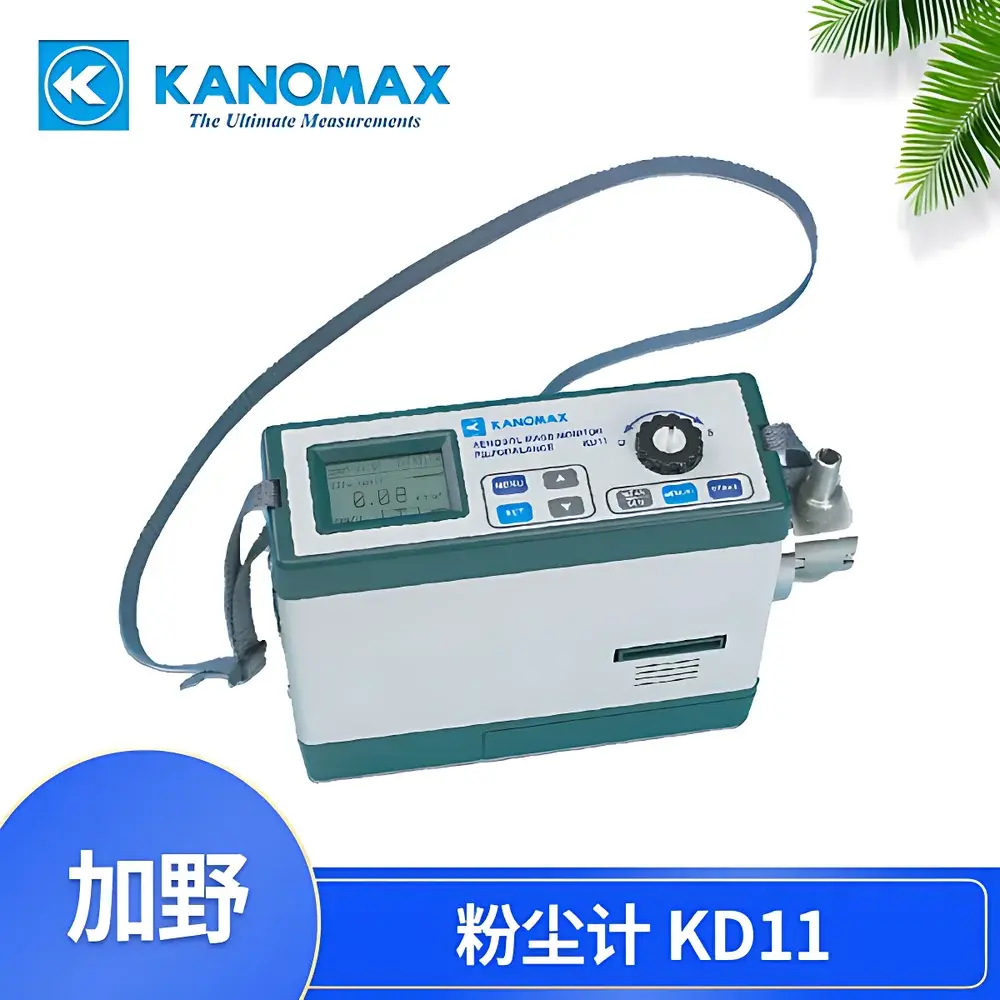
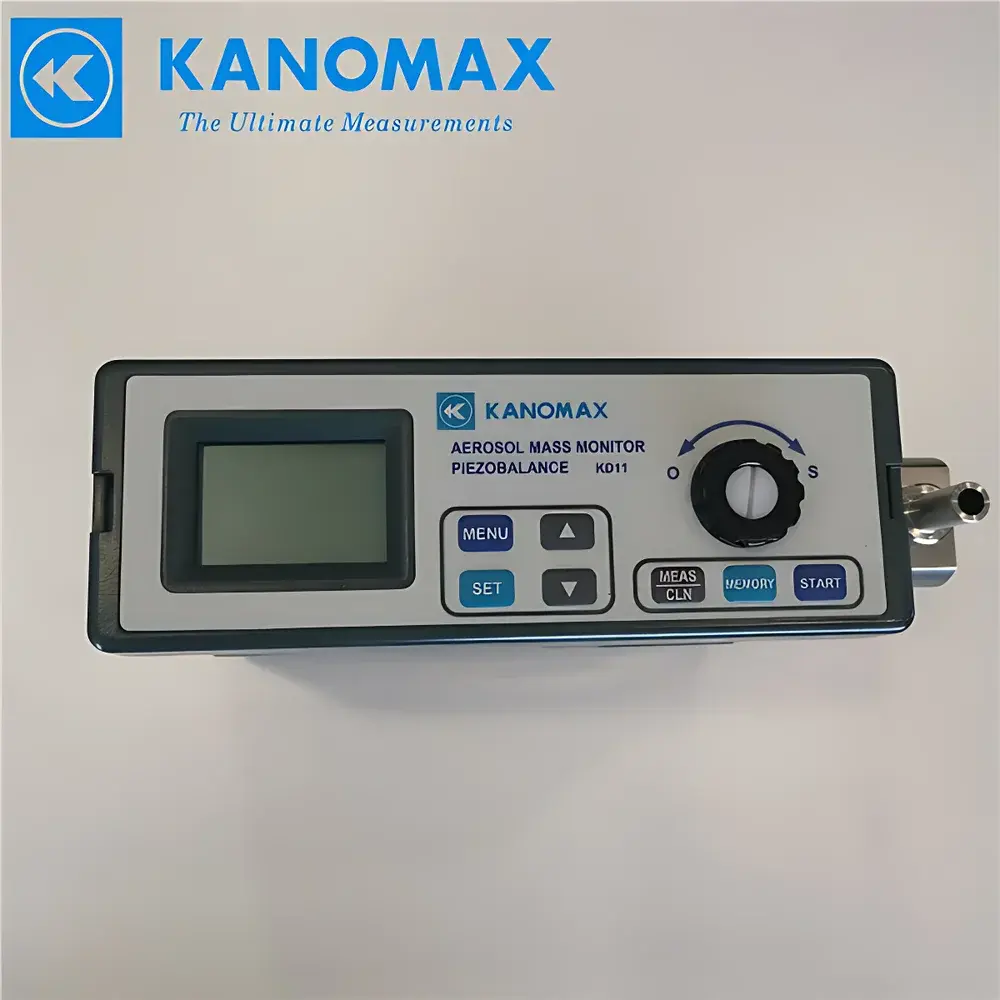
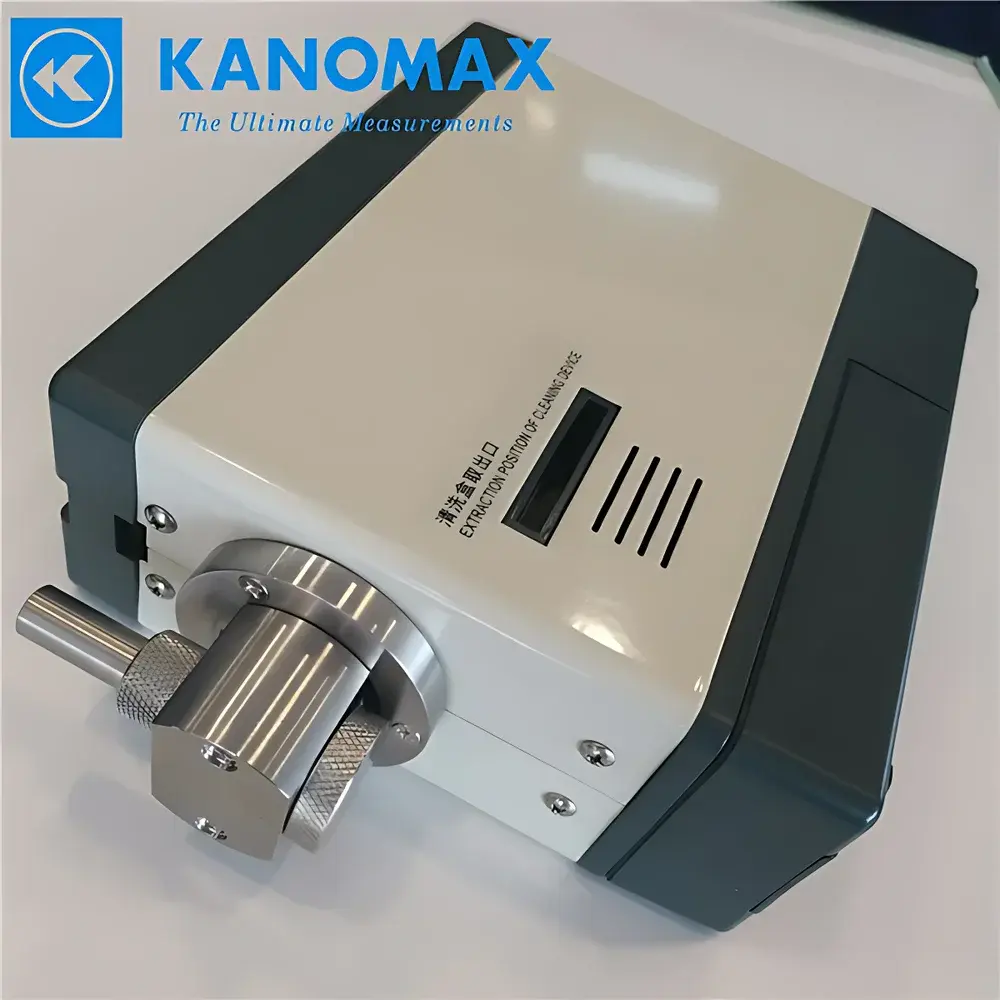
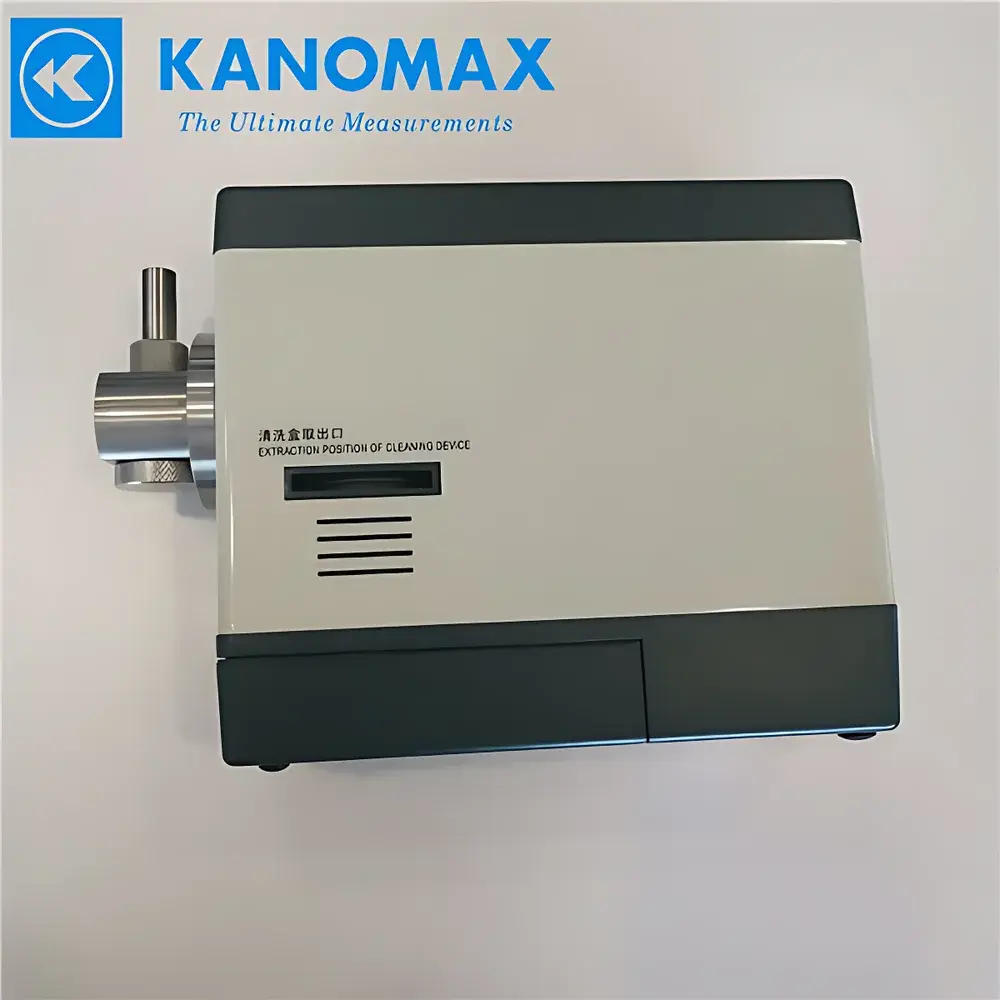
KANOMAX KD11 Piezobalance-Type Dust Monitor
| Brand | KANOMAX |
|---|---|
| Origin | Japan |
| Model | KD11 |
| Measurement Principle | Piezoelectric Microbalance (QCM) |
| Particle Size Range | 0.1–10 µm (PM10), 0.1–2.5 µm (PM2.5) |
| Concentration Range | 0.01–10.00 mg/m³ |
| Flow Rate | 1.0 L/min |
| Data Storage Capacity | 500 measurement records |
| Sampling Duration | Fixed modes (24 s, 120 s) or user-defined (10–3600 s) |
| Communication Interface | RS-232C |
| Power Supply | Rechargeable Ni-MH battery / AC adapter (100–240 V AC) |
| Battery Life | ~4.5 h continuous operation |
| Charging Time | 5–8 h |
| Dimensions (W×L×H) | 65 × 182 × 150 mm |
| Weight | ~1.75 kg |
| Auto-Cleaning Alert | Yes (triggered upon crystal mass loading threshold exceedance) |
Overview
The KANOMAX KD11 Piezobalance-Type Dust Monitor is a precision environmental monitoring instrument engineered for real-time, gravimetric quantification of airborne particulate matter concentrations—specifically PM10 and PM2.5. It operates on the quartz crystal microbalance (QCM) principle: dust particles are drawn onto a pre-calibrated piezoelectric quartz crystal sensor at a constant volumetric flow rate of 1.0 L/min; mass accumulation induces a measurable frequency shift proportional to deposited particle mass, enabling direct calculation of mass concentration (mg/m³) without reliance on optical scattering assumptions or calibration drift-prone photometric proxies. This method delivers inherently stable, traceable, and metrologically robust measurements aligned with gravimetric reference standards used in regulatory ambient air monitoring networks.
Key Features
- Real-time, direct-mass measurement via piezoelectric microbalance technology—eliminates dependence on particle optical properties or density assumptions.
- Dual-range particle size selectivity: configurable inlet cyclones enable simultaneous or sequential assessment of PM10 (0.1–10 µm) and PM2.5 (0.1–2.5 µm) fractions per ISO 7708 and EN 481 definitions.
- Wide dynamic concentration range: 0.01 to 10.00 mg/m³ with resolution of 0.01 mg/m³—suitable for occupational hygiene surveys, indoor air quality audits, and fugitive emission screening.
- Flexible sampling protocols: preset durations (24 s, 120 s) or fully programmable acquisition intervals from 10 to 3600 seconds—enabling time-resolved profiling across variable exposure scenarios.
- Integrated auto-alert system triggers visual/audible notification when crystal mass loading approaches the sensor’s operational limit—ensuring measurement integrity and guiding timely crystal cleaning per manufacturer-recommended procedures.
- Compact, field-deployable form factor (65 × 182 × 150 mm; ~1.75 kg) with ergonomic handheld design and dual power options: rechargeable Ni-MH battery (~4.5 h runtime) or universal AC adapter (100–240 V).
Sample Compatibility & Compliance
The KD11 is validated for use with ambient, indoor, and workplace air matrices containing non-volatile, non-reactive particulates—including mineral dusts, metal oxides, carbonaceous soot, and fibrous aerosols—provided particles remain adherent to the quartz crystal surface during sampling. It complies with fundamental requirements of ISO 10112 (gravimetric determination of inhalable, thoracic, and respirable dust fractions) and supports methodologies referenced in OSHA Method ID-125G and NIOSH Method 0600. While not certified as a Class I, Division 1 hazardous location device, its sealed electronics and low-power architecture meet IP54 ingress protection for typical industrial indoor/outdoor deployment. Data acquisition and storage adhere to basic ALCOA+ principles (Attributable, Legible, Contemporaneous, Original, Accurate) required under GLP-compliant environmental testing workflows.
Software & Data Management
Data export is facilitated via standard RS-232C serial interface using KANOMAX-supplied communication software (Windows-compatible). The software enables download of all 500 stored measurement records—including timestamp, sampling duration, calculated concentration, and sensor status flags—into CSV or Excel-compatible formats for further statistical analysis, trend visualization, or regulatory reporting. Audit trails are maintained within local PC logs; while the KD11 itself does not embed electronic signature or 21 CFR Part 11 compliance features, its raw data output structure supports integration into validated laboratory information management systems (LIMS) where full electronic record governance is implemented externally.
Applications
- Occupational health & safety: Personal and area monitoring of respirable dust in mining, construction, foundry, and pharmaceutical manufacturing environments.
- Indoor air quality (IAQ) assessment: Quantitative verification of HVAC filtration efficiency, source identification during renovation or remediation, and post-occupancy evaluation in schools, hospitals, and office buildings.
- Environmental site characterization: Screening-level assessment of fugitive dust emissions near stockpiles, unpaved roads, or demolition zones prior to regulatory submission.
- Research & development: Aerosol generation studies, filter media testing, and validation of optical particle counters against gravimetric reference.
- Educational laboratories: Hands-on instruction in aerosol science, mass-based measurement principles, and air sampling protocol design.
FAQ
Does the KD11 require periodic calibration with NIST-traceable dust standards?
Yes—while the QCM sensor exhibits excellent short-term stability, KANOMAX recommends annual recalibration using certified test aerosols (e.g., Arizona Road Dust A2, ISO 12103-1) to maintain accuracy within ±5% of true gravimetric value.
Can the instrument measure volatile or hygroscopic particles accurately?
No—volatile compounds (e.g., ammonium nitrate, certain organics) may evaporate post-collection; hygroscopic particles may absorb ambient moisture, altering apparent mass. KD11 is intended for non-volatile, low-hygroscopicity aerosols.
Is the RS-232C interface compatible with modern USB-equipped computers?
Yes—when used with a certified USB-to-RS232 converter cable and appropriate driver installation, full bidirectional communication is supported.
How frequently must the quartz crystal be cleaned?
Cleaning frequency depends on ambient dust load; the auto-alert typically activates after 2–10 hours of cumulative high-concentration sampling. Cleaning follows KANOMAX’s solvent-based protocol using isopropanol and lint-free wipes.
Does the KD11 support external pump control or flow correction for altitude/temperature variations?
No—the internal diaphragm pump maintains fixed 1.0 L/min flow across operating temperature (5–40°C) and pressure ranges (80–106 kPa); no active flow feedback or compensation is implemented.
Related Products







