
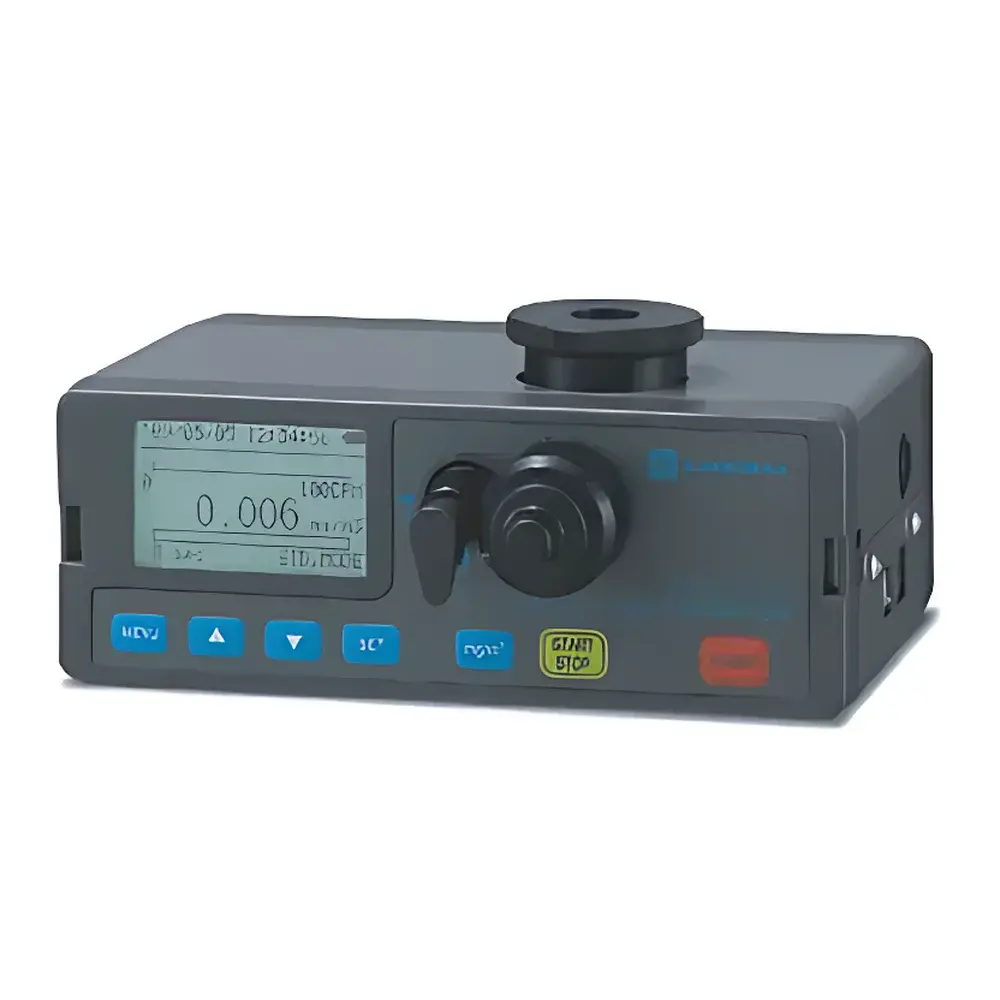
KANOMAX 3443 Optical Scattering Digital Dust Monitor
| Brand | KANOMAX |
|---|---|
| Origin | Japan |
| Model | KANOMAX 3443 |
| Measurement Principle | Optical Light Scattering |
| Particle Size Range | 0.1–10 µm |
| Resolution | 0.01 mg/m³ |
| Accuracy | ±10% |
| Relative Error | ≤±2% |
| Data Storage Capacity | 500 records |
| Sampling Interval | Configurable from 10 to 3600 seconds (default options: 24 s, 120 s) |
| Communication Interface | RS-232C |
| Safety Classification | Non-explosion-proof |
Overview
The KANOMAX 3443 Optical Scattering Digital Dust Monitor is a precision-engineered environmental monitoring instrument designed for real-time quantitative measurement of airborne particulate matter (PM) mass concentration in occupational and ambient air quality applications. Based on the principle of forward-angle optical light scattering—where particles illuminated by a stable semiconductor laser induce scattered light proportional to their surface area and refractive index—the instrument provides rapid, non-destructive assessment of respirable and inhalable dust fractions. It is calibrated and validated for PM10 and PM2.5 equivalent mass concentration reporting in mg/m³, conforming to internationally recognized light-scattering correlation methodologies used in industrial hygiene and regulatory compliance contexts. The device operates under standard atmospheric conditions (20–30 °C, <80% RH, non-condensing), with an internal temperature-compensated photodetector system ensuring stable signal response across typical indoor and outdoor monitoring environments.
Key Features
- Real-time continuous monitoring of PM mass concentration with automatic data logging—up to 500 timestamped measurement records stored internally
- Configurable sampling duration: factory presets at 24 s and 120 s; user-defined intervals from 10 s to 3600 s (1 hr) via front-panel interface
- Optimized optical path design with low-drift laser source and high-sensitivity photodiode detector, engineered for long-term signal reproducibility
- Self-diagnostic function alerts users when optical window contamination exceeds operational threshold—indicating need for cleaning to maintain measurement integrity
- RS-232C serial interface compliant with EIA/TIA-232 standards, enabling bidirectional communication with host PCs for data retrieval, firmware updates, and remote configuration
- Integrated communication software (Windows-compatible) supports CSV export, time-series graphing, and printable report generation with metadata (date/time, sampling duration, unit)
Sample Compatibility & Compliance
The KANOMAX 3443 is intended for use with ambient or workplace air containing solid or liquid aerosols—including mineral dusts, metal fumes, carbonaceous particles, and organic powders—within the 0.1–10 µm aerodynamic diameter range. While not certified to ATEX or IECEx explosion protection standards, its non-explosion-proof classification restricts deployment to non-hazardous locations per IEC 60079-0. The instrument meets Japanese Industrial Standards (JIS B 7990) for optical dust monitors and aligns with ISO 7708:1995 (airborne particles—size-selective sampling criteria) for PM10/PM2.5 surrogate measurement. For occupational exposure assessment, it supports evaluation against OSHA PELs and ACGIH TLVs when used within documented calibration traceability and procedural controls.
Software & Data Management
Data acquisition and management are facilitated through KANOMAX’s proprietary Windows-based communication software, which establishes secure ASCII protocol handshaking over RS-232C. The software implements basic audit trail functionality—including operator ID input, session timestamps, and change logs for configuration parameters—supporting GLP-aligned documentation practices. Exported datasets include raw analog-to-digital counts, calculated concentration values, sampling start/stop times, and instrument status flags (e.g., “cleaning required”). All files adhere to UTF-8 encoding and are compatible with common statistical analysis platforms (e.g., Excel, MATLAB, Python pandas). No cloud connectivity or FDA 21 CFR Part 11 electronic signature capabilities are embedded; users requiring such features must integrate the device into validated third-party LIMS or SCADA systems.
Applications
- Workplace exposure monitoring during grinding, sanding, welding, and bulk material handling operations
- Indoor air quality (IAQ) assessment in offices, schools, hospitals, and cleanroom support zones
- Construction site perimeter monitoring for regulatory PM compliance reporting
- Filter efficiency testing and HVAC system performance verification
- Educational and research laboratories conducting aerosol generation and dispersion studies
FAQ
What particle size range does the KANOMAX 3443 measure?
It responds to airborne particles from 0.1 µm to 10 µm aerodynamic diameter, with calibration optimized for PM10 and PM2.5 mass concentration estimation.
Is the instrument suitable for outdoor long-term unattended operation?
While robust for field use, it lacks weatherproof housing, integrated power backup, or environmental compensation for extreme temperature/humidity—making it best suited for short-term portable surveys or indoor fixed-point monitoring.
How often should the optical chamber be cleaned?
Cleaning frequency depends on ambient dust loading; the unit triggers a visual/audible alert when scattering signal attenuation exceeds 15% baseline—typically every 1–4 weeks in moderate-use environments.
Can the KANOMAX 3443 be calibrated against gravimetric reference methods?
Yes—users may perform field calibration using co-located PM filters (e.g., PVC or PTFE membrane) analyzed per ISO 10175 or EPA Method IO-2, establishing site-specific correction factors for improved accuracy.
Does the device meet ISO/IEC 17025 requirements for accredited testing labs?
The instrument itself is not accredited, but when operated under a documented quality management system—including periodic verification with NIST-traceable aerosol generators and adherence to SOPs—it may support ISO/IEC 17025 clause 5.5.2 (equipment verification).







