
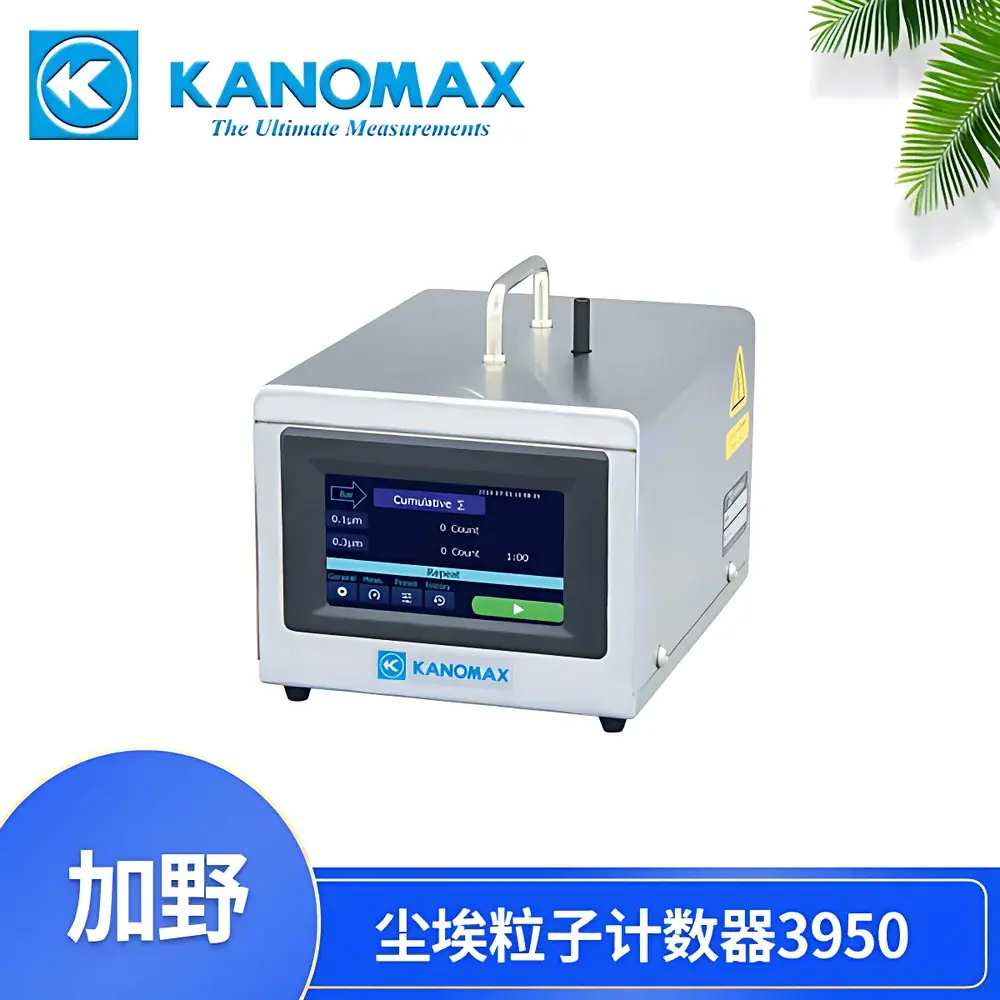
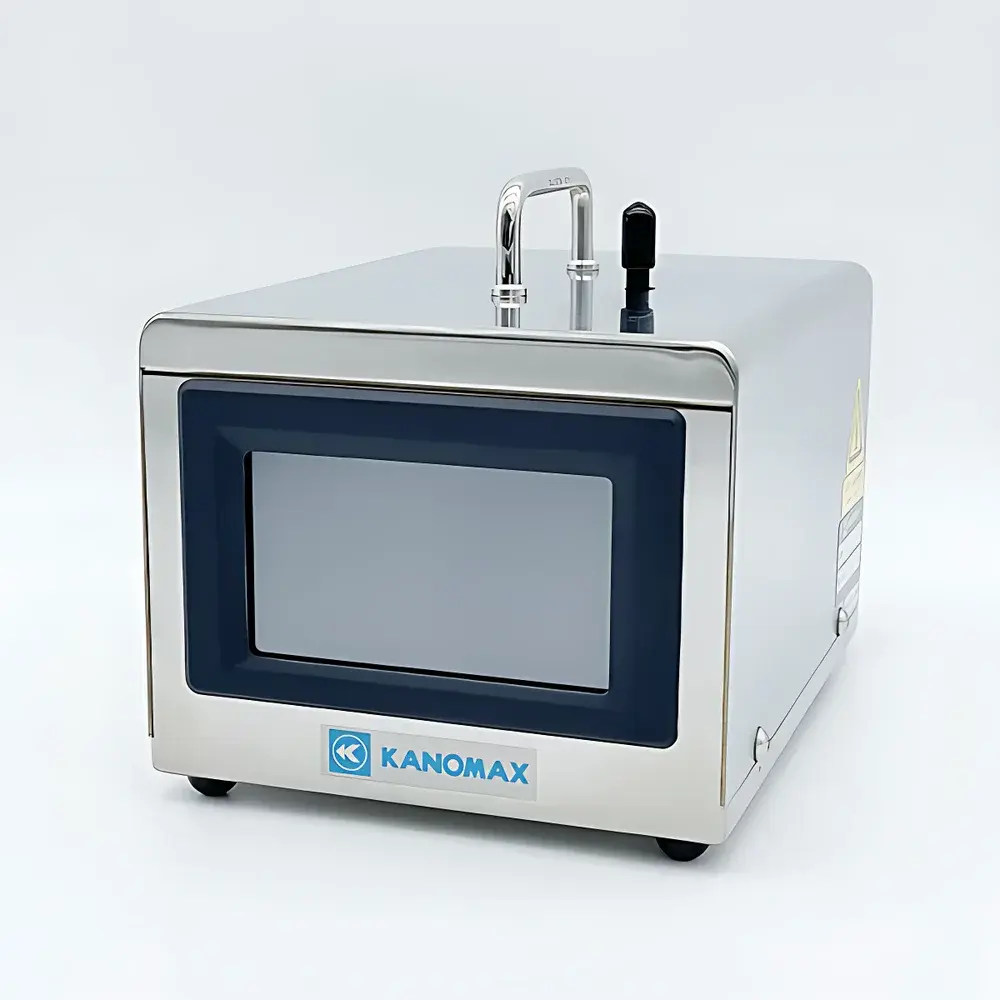
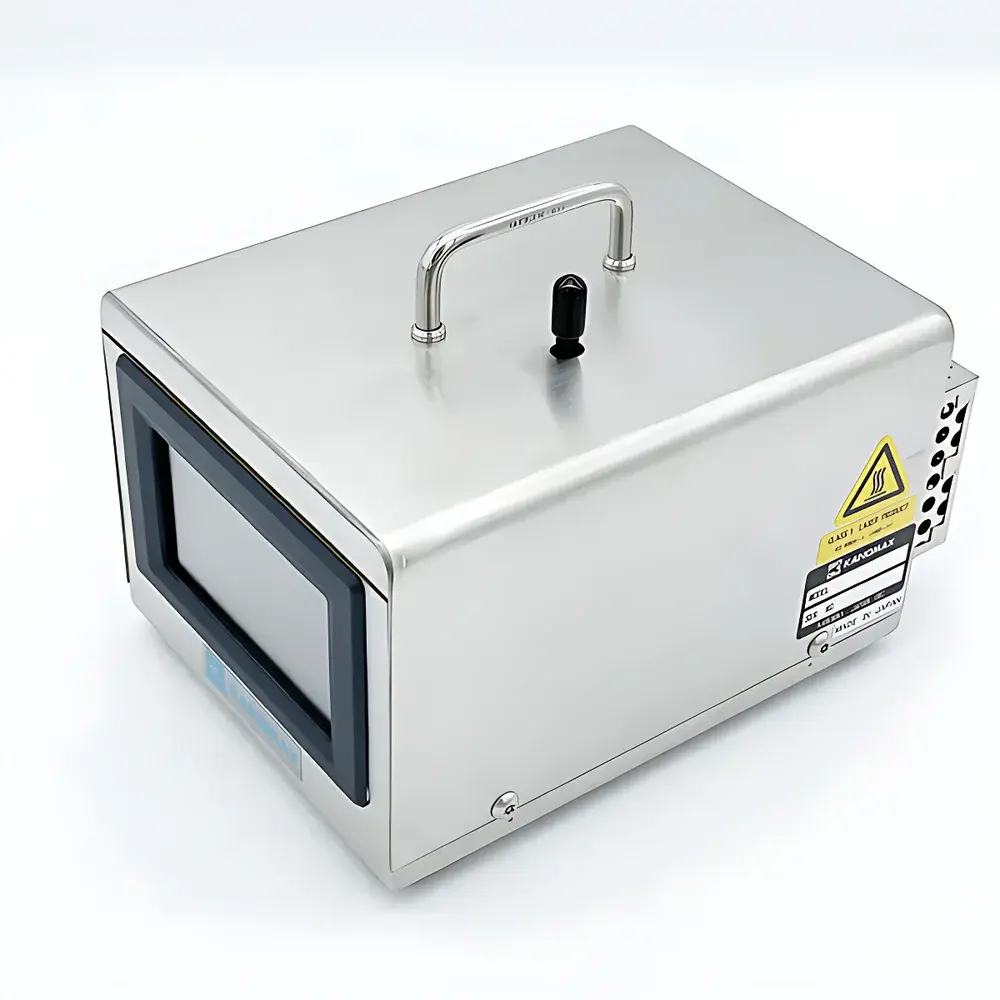
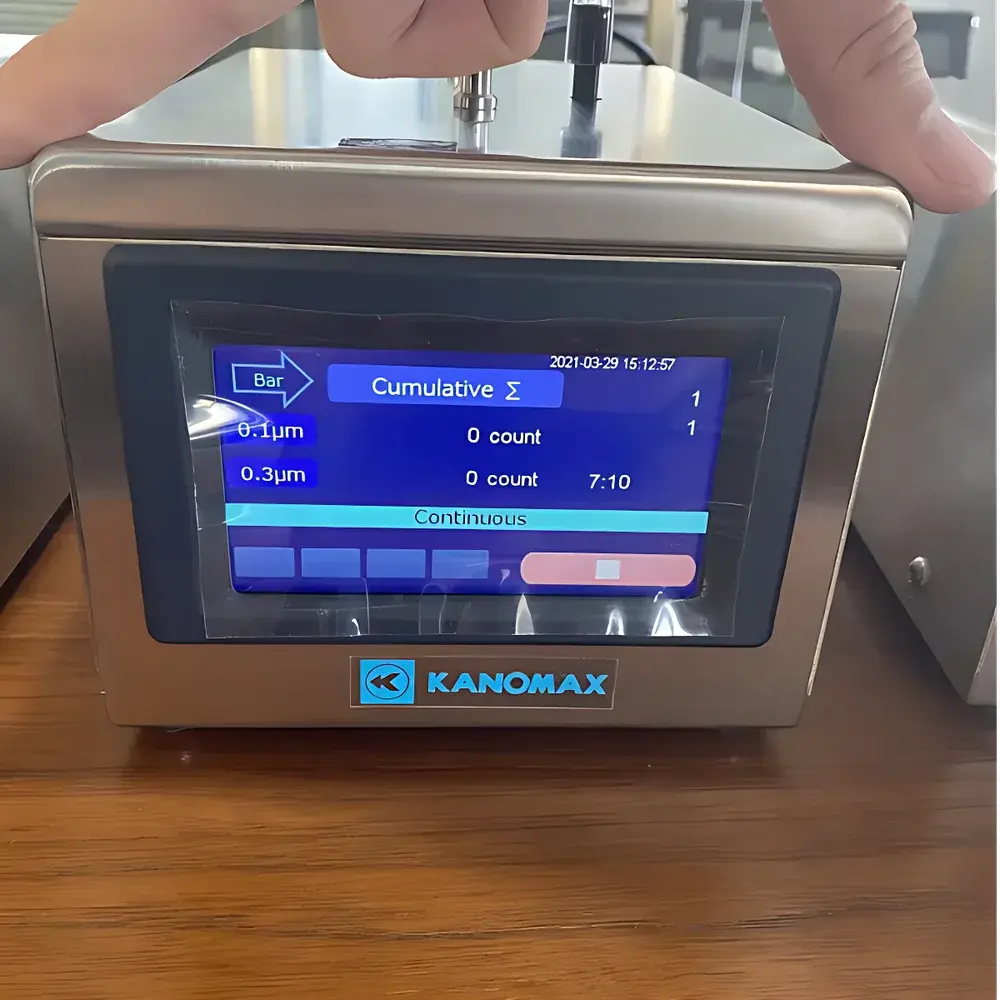
Kanomax 3950-00 Ultra-Sensitive Laser Particle Counter for Semiconductor Cleanroom Monitoring
| Brand | Kanomax |
|---|---|
| Origin | Japan |
| Model | 3950-00 |
| Flow Rate | 2.83 L/min (0.1 CFM) |
| Flow Accuracy | ±5% |
| Timing Accuracy | ±1 s per 6 min |
| Repeatability | ±5% |
| Size Distribution Error | ±15% |
| Indication Error | ±30% |
| Particle Detection Channels | 0.1 μm & 0.3 μm |
| Measurement Principle | Light Scattering |
| Compliance | JIS B9921 & ISO 21501-4 |
| Max Concentration | 10⁷ particles/m³ |
| Counting Efficiency | 50±20% at 0.1 μm (PSL), 100±10% at 0.15–0.2 μm (PSL) |
| False Count Rate | <1 count/35 min |
| Size Resolution | ≤15% (relative to 0.3 μm PSL) |
| Display | 4.3″ color TFT touchscreen |
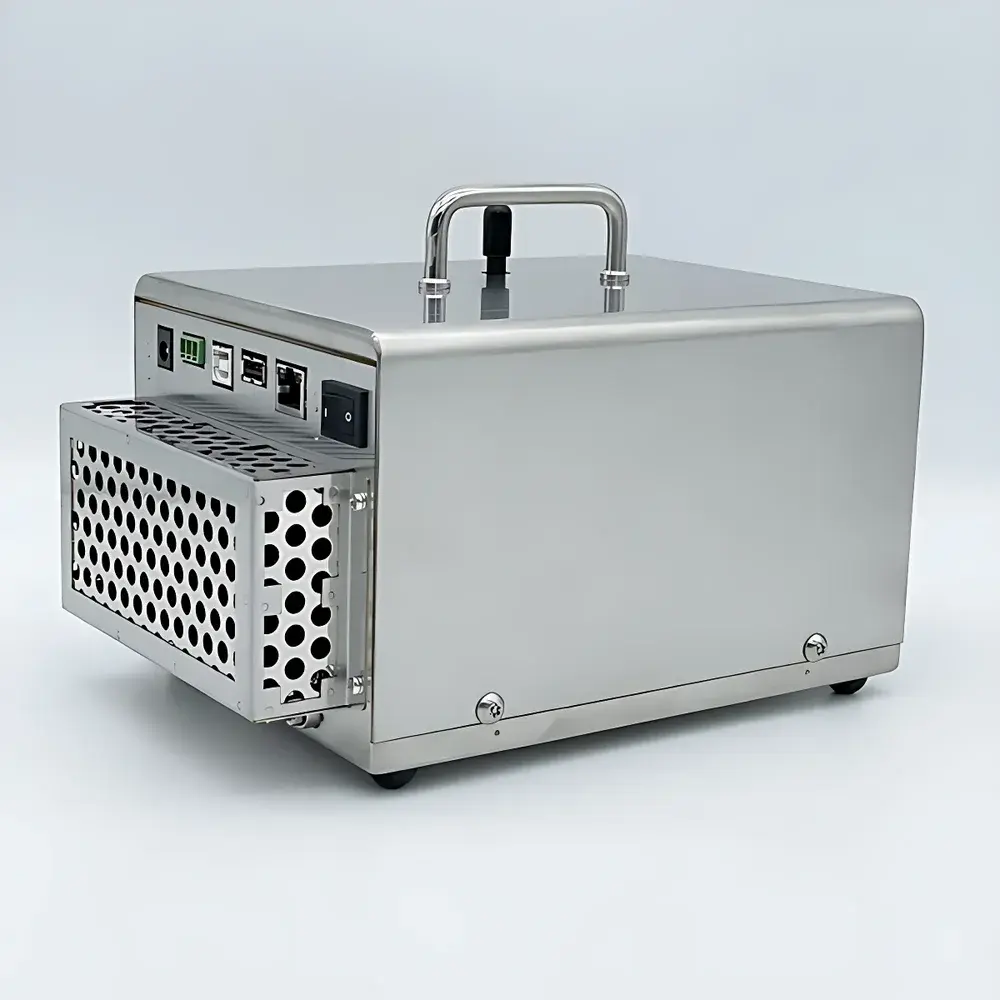
| Interface | USB (Host/Device), Ethernet, RS-485 (9600–38400 baud) |
| Data Storage | 10,000 records (CSV) |
| Operating Environment | 15–35°C, 0–85% RH (non-condensing) |
| Dimensions | 150 × 163 × 228 mm |
| Weight | 3.4 kg |
Overview
The Kanomax 3950-00 is an ultra-compact, high-sensitivity laser particle counter engineered specifically for real-time airborne particulate monitoring in semiconductor fabrication environments. It employs single-particle light scattering detection with dual-channel optical sizing—optimized for the critical 0.1 μm and 0.3 μm thresholds mandated by ISO 14644-1 Class 1–Class 3 cleanrooms and SEMI S2/S8-compliant tool integration. Its 2.83 L/min (0.1 CFM) volumetric flow is precisely regulated via an integrated diaphragm pump, enabling stable sampling under variable backpressure conditions typical of embedded OEM applications. Unlike conventional benchtop counters, the 3950-00 was developed as a modular sensing node: its 3.4 kg mass and 150 × 163 × 228 mm footprint allow direct mechanical integration into lithography steppers, wafer track systems, load ports, and mini-environments without thermal or spatial compromise. The instrument operates on the principle of Mie scattering theory, calibrated against traceable polystyrene latex (PSL) standards per JIS B9921 and ISO 21501-4, ensuring metrological continuity across global fab qualification protocols.
Key Features
- Sub-micron resolution: Certified detection threshold of 0.1 μm with counting efficiency validated at 50±20% (per ISO 21501-4 Annex B), essential for monitoring nucleation-mode particles in EUV lithography tool exhausts and FOUP purge streams.
- OEM-ready architecture: RS-485 Modbus RTU, Ethernet TCP/IP, and dual-role USB (device for PC control; host for direct printer/USB flash logging) support seamless integration into factory automation systems (SECS/GEM, OPC UA).
- Embedded real-time display: 4.3-inch resistive touchscreen with configurable data visualization—simultaneous time-series plots, differential (Δ) and cumulative (∑) histograms, and ISO-class compliance status overlays.
- Robust environmental tolerance: Operational within 15–35°C and 0–85% RH (non-condensing), meeting JEDEC J-STD-033 moisture sensitivity level (MSL) handling requirements for in-line tool-mounted deployment.
- Traceable calibration framework: Built-in audit trail for flow verification, timing synchronization, and channel gain adjustment—supporting GLP-compliant calibration record retention per internal SOPs.
Sample Compatibility & Compliance
The 3950-00 is validated for continuous sampling of compressed dry air (CDA), nitrogen (N₂), and process tool exhaust gases with particulate loading up to 10⁷ particles/m³. It complies with JIS B9921:2010 and ISO 21501-4:2018 for light-scattering particle counters, including rigorous testing for false count rate (<1 count/35 min), size resolution (≤15% CV at 0.3 μm PSL), and counting efficiency linearity. While not intrinsically rated for hazardous area use (e.g., ATEX/IECEx), its low-power design (24 VDC optional via external adapter) and non-sparking enclosure meet SEMI F47 voltage sag immunity and SEMI E10 reliability standards. Data integrity aligns with FDA 21 CFR Part 11 expectations when used with validated software—electronic signatures, audit trails, and user-access controls are implemented at the host system level.
Software & Data Management
Raw measurement data is stored onboard in CSV format (up to 10,000 records), timestamped with millisecond precision and tagged with user-defined location IDs (up to 99 zones). Communication interfaces enable bidirectional data exchange: Ethernet supports DHCP/Static IP configuration and HTTP-based RESTful API polling for SCADA integration; RS-485 enables daisy-chained multi-sensor networks with automatic node addressing. Kanomax’s optional KAN-View software (Windows-based) provides post-processing capabilities—including ISO 14644-1 classification reporting, trend analysis with ±3σ statistical bounds, and automated deviation alerts triggered by programmable concentration thresholds. All exported files retain native metadata (flow calibration date, laser power log, firmware version), satisfying traceability requirements under IATF 16949 and ISO 9001 clause 8.5.2.
Applications
- Real-time contamination monitoring inside photolithography cluster tools, especially at reticle storage cabinets and mask loader interfaces where 0.1 μm particles induce pattern defects.
- In-line validation of ULPA filter performance in point-of-use (POU) gas delivery systems supplying ArF and EUV exposure tools.
- Qualification of mini-environment purge efficacy in advanced packaging lines handling fan-out wafer-level chip-scale packages (FO-WLCSP).
- Root-cause analysis of yield excursions via time-synchronized particle burst detection correlated with tool event logs (e.g., chamber pump-down, robot arm motion).
- Supporting ISO 14644-2 surveillance testing—automated cycle measurements across 99 predefined locations with pass/fail classification per ISO class limits.
FAQ
Does the 3950-00 support remote firmware updates over Ethernet?
Yes—firmware version 2.3.1 and later permit authenticated HTTP PUT uploads via secure network segments. Updates require manual confirmation on the touchscreen and trigger full self-diagnostics before activation.
Can it measure particles below 0.1 μm?
No—the optical design and signal-to-noise architecture are optimized for 0.1 μm as the lower detection limit per ISO 21501-4. Sub-0.1 μm detection requires condensation particle counters (CPCs) or scanning mobility particle sizers (SMPS), which are incompatible with embedded OEM form factors.
Is NIST-traceable calibration documentation included?
Each unit ships with a factory calibration certificate referencing NIST-traceable PSL standards (NIST SRM 1963, 1691a). Full calibration reports—including flow meter verification, timing oscillator drift logs, and channel response curves—are available upon request for IQ/OQ documentation.
What is the recommended maintenance interval for the internal pump and laser diode?
Kanomax specifies 12 months or 5,000 operating hours—whichever occurs first—for preventive maintenance. Pump diaphragm replacement and laser output power verification are performed using Kanomax-certified service centers to preserve ISO 21501-4 conformance.
How does the instrument handle electrostatic discharge (ESD) in semiconductor tool environments?
The chassis meets IEC 61000-4-2 Level 4 (8 kV contact / 15 kV air) ESD immunity. All signal lines incorporate transient voltage suppression (TVS) diodes, and the RS-485 interface includes galvanic isolation rated to 2.5 kV RMS.
Related Products







