
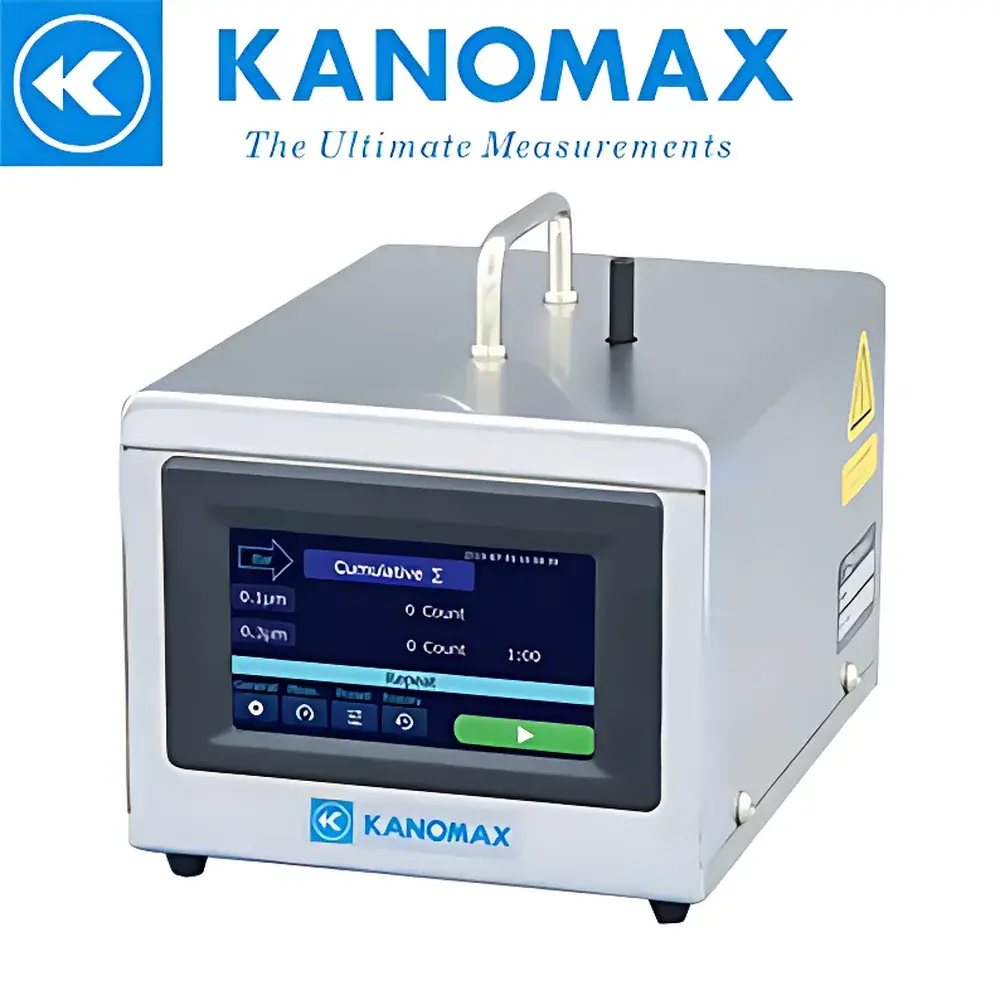
Kanomax 3950 Ultra-Compact Airborne Particle Counter
| Brand | Kanomax |
|---|---|
| Origin | Japan |
| Model | 3950 |
| Flow Rate | 2.83 L/min (0.1 CFM) |
| Flow Accuracy | ±5% |
| Timing Accuracy | ±1 s per 6 min |
| Repeatability | ±5% |
| Size Distribution Error | ±15% |
| Indication Error | ±30% |
| Particle Detection Channels | 0.1 µm, 0.3 µm |
| Counting Efficiency | 50±20% @ 0.1 µm (PSL), 100±10% @ 0.15–0.2 µm (PSL) |
| Maximum Concentration | 10⁷ particles/m³ |
| False Count Rate | <1 count/35 min |
| Size Resolution | ≤15% (relative to 0.3 µm PSL) |
| Display | 4.3″ color TFT touchscreen |
| Communication | USB (Host/Device), Ethernet, RS-485 (9600–38400 baud) |
| Data Storage | up to 10,000 records in CSV format |
| Operating Environment | 15–35 °C, 0–85% RH (non-condensing) |
| Dimensions | 150 × 163 × 228 mm |
| Weight | 3.4 kg |
| Compliance | JIS B9921, ISO 21501-4 |
Overview
The Kanomax 3950 Ultra-Compact Airborne Particle Counter is a high-precision optical particle counter engineered for integration into cleanroom monitoring systems, semiconductor process tools, and controlled-environment equipment. Utilizing the principle of light scattering—where airborne particles passing through a focused laser beam generate scattered photons detected by a photodiode—the instrument delivers real-time quantification of particulate concentration across two calibrated size channels: 0.1 µm and 0.3 µm. Its design adheres strictly to international calibration and performance standards, including JIS B9921 and ISO 21501-4, ensuring traceable measurement integrity for ISO Class 3–5 cleanrooms and critical manufacturing zones. With a nominal sampling flow rate of 2.83 L/min (0.1 CFM), the 3950 achieves high sensitivity at ultra-low particle concentrations while maintaining robust signal-to-noise discrimination—essential for detecting sub-0.2 µm contaminants in advanced lithography tool environments or miniaturized medical device assembly lines.
Key Features
- Ultra-compact footprint (150 × 163 × 228 mm) and lightweight construction (3.4 kg), enabling seamless OEM integration into process chambers, air-handling units, and portable monitoring carts.
- 4.3-inch full-color resistive touchscreen interface with intuitive icon-based navigation—supporting on-device configuration, real-time histogram visualization, and dual-mode display (cumulative ∑ and differential Δ counts).
- Dual-channel optical detection optimized for 0.1 µm and 0.3 µm thresholds, with counting efficiency validated per ISO 21501-4 using polystyrene latex (PSL) reference aerosols.
- Onboard data logging capacity of up to 10,000 measurement records in industry-standard CSV format—retaining timestamp, location ID, channel-specific counts, and operational mode metadata.
- Triple-interface communication architecture: USB (dual-role Host/Device), 10/100BASE-T Ethernet (TCP/IP stack compliant), and isolated RS-485 (configurable baud rates: 9600, 19200, 38400)—facilitating both local peripheral connectivity and centralized SCADA or MES integration.
- Programmable measurement logic supporting six standardized modes: single-shot, repetitive, continuous, calculated average, ISO 14644-1 compliance reporting, and GB/T 16292 (Chinese pharmaceutical cleanroom standard) protocol alignment.
Sample Compatibility & Compliance
The Kanomax 3950 is validated for use with ambient air, compressed dry air (CDA), nitrogen purge streams, and filtered process gases—provided relative humidity remains below 85% RH and no condensation occurs. It is not rated for corrosive, explosive, or oil-laden aerosols. All optical and pneumatic components are constructed from anodized aluminum and chemically inert polymers to ensure long-term stability in Class 10–Class 100 (ISO 4–ISO 5) environments. Calibration traceability is maintained to NIST-traceable PSL standards via factory-certified verification reports. The device meets electromagnetic compatibility requirements per IEC 61326-1 (industrial environment) and safety compliance under IEC 61010-1. While not intrinsically safe, its low-power design (AC 100–240 V, 50/60 Hz) supports operation in GMP-regulated facilities when deployed within validated HVAC monitoring networks.
Software & Data Management
Data export and remote supervision are supported via Kanomax’s proprietary PC application (compatible with Windows 10/11), which enables batch download, time-synchronized multi-instrument trending, and automated report generation in PDF or Excel formats. Raw CSV logs include full audit trail fields: measurement start/stop timestamps, user-defined location tags (up to 99 locations), flow verification flags, and internal temperature/humidity telemetry (if external sensor is connected). The Ethernet interface supports Modbus TCP and HTTP GET/POST endpoints for direct ingestion into LIMS or cloud-based environmental monitoring platforms. For regulated environments, optional firmware upgrade enables GLP/GMP-compliant audit trail logging—including operator ID, parameter change history, and electronic signature capture—aligned with FDA 21 CFR Part 11 principles when paired with validated authentication infrastructure.
Applications
- Real-time contamination monitoring inside semiconductor photolithography steppers, etch tools, and wafer probers—where sub-0.15 µm particles directly impact yield loss.
- OEM integration into isolators, RABS, and filling line environmental sensors for aseptic pharmaceutical manufacturing (compliant with EU Annex 1 and USP ).
- Portable verification of HEPA/ULPA filter integrity during commissioning and periodic requalification (per ISO 14644-3).
- Research-grade nanoparticle exposure assessment in nanomaterial synthesis labs and inhalation toxicology chambers.
- Continuous surveillance of clean-assembled electronics enclosures, aerospace avionics bays, and precision optics coating chambers.
FAQ
Does the Kanomax 3950 require annual recalibration?
Yes. To maintain compliance with ISO 21501-4 and JIS B9921, recalibration against NIST-traceable PSL standards is recommended every 12 months—or after any event involving physical shock, optical contamination, or firmware updates.
Can the 3950 operate continuously for 24/7 monitoring?
Yes. Its thermal management system and solid-state pump support unattended operation for >10,000 hours; however, scheduled maintenance—including inlet filter replacement and optical window cleaning—is required every 6 months under continuous duty.
Is the device compatible with cleanroom monitoring software such as SetraView or TSI LinkPlots?
Native drivers are not provided, but CSV export and Modbus TCP support enable interoperability with third-party platforms via custom middleware or OPC UA gateways.
What is the minimum detectable particle concentration?
The lower limit of quantitation (LoQ) is 1 particle per 2.83 L sample volume—equivalent to ~0.35 particles/L—under optimal background conditions (class 10 or cleaner ambient air).
Does the 3950 meet FDA requirements for use in pharmaceutical manufacturing?
The base unit satisfies instrumentation qualification prerequisites (IQ/OQ); however, full 21 CFR Part 11 compliance requires implementation of validated electronic signatures, audit trails, and access controls—available via optional firmware and documented SOPs.
Related Products







