
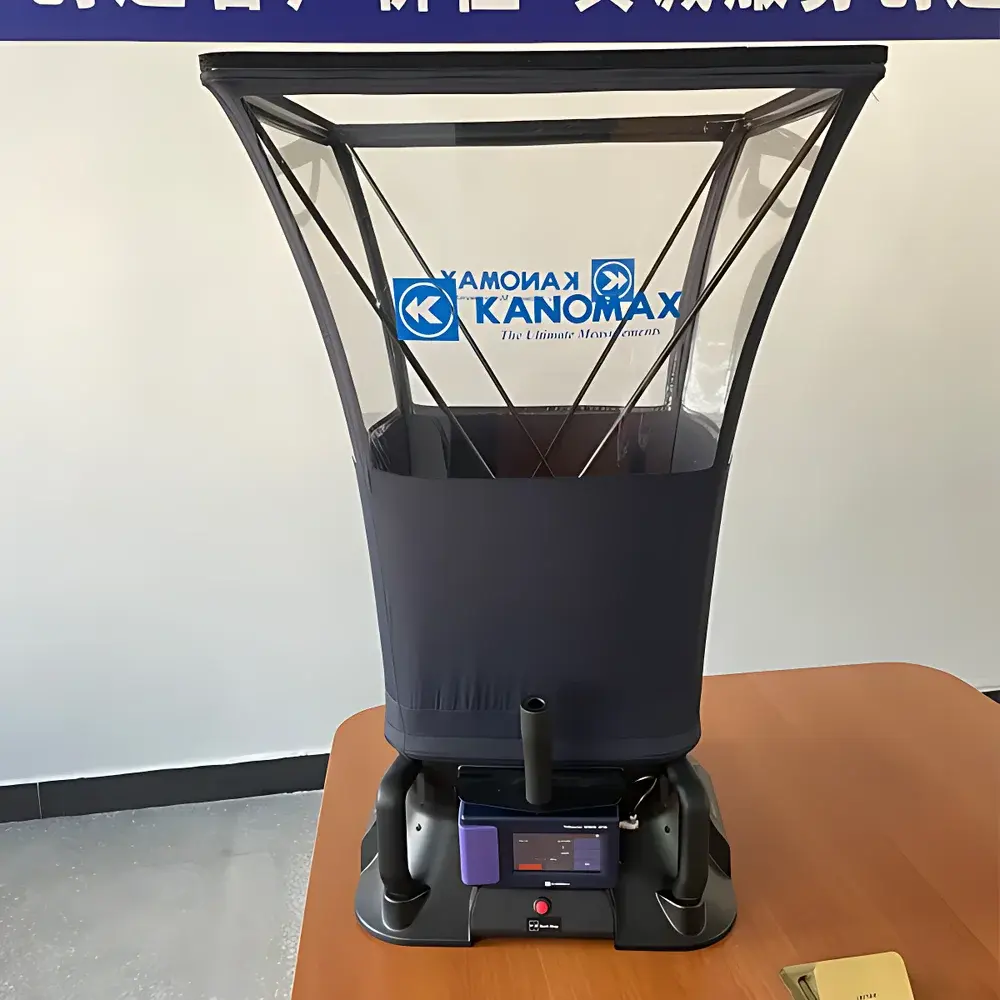
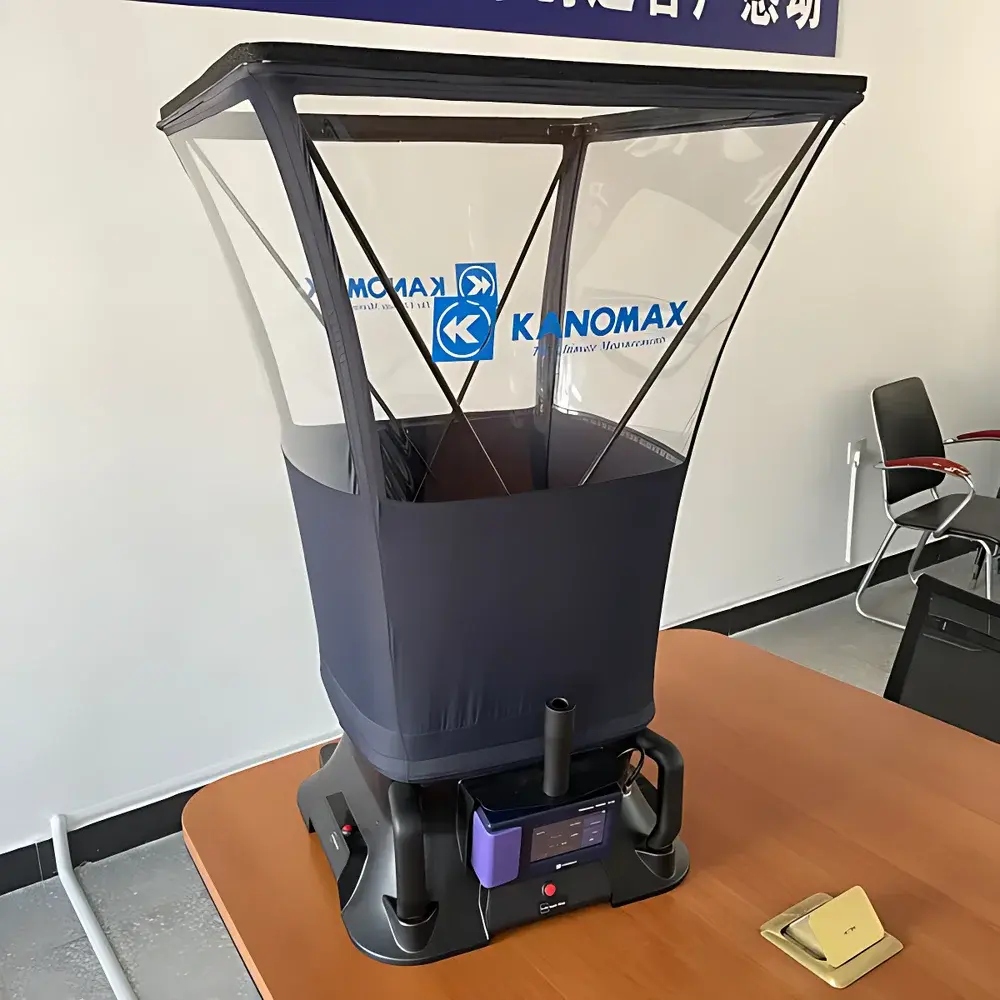
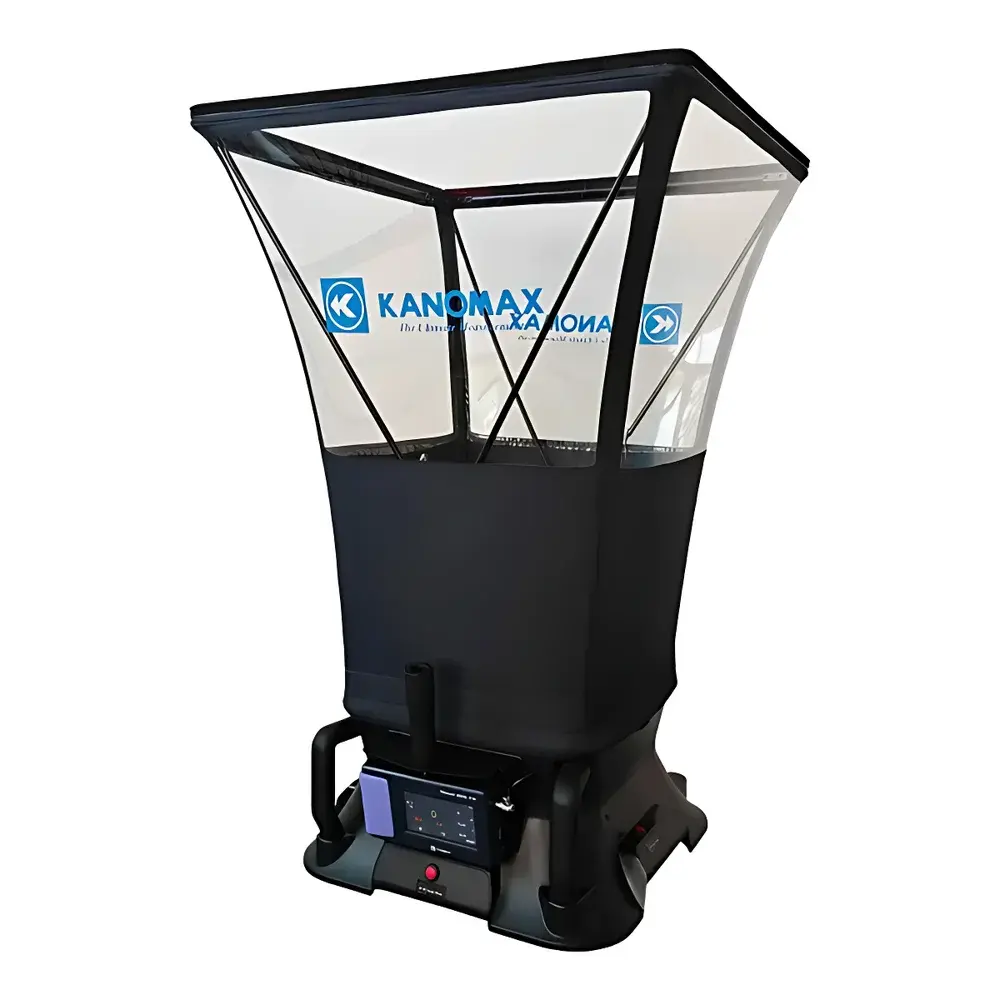
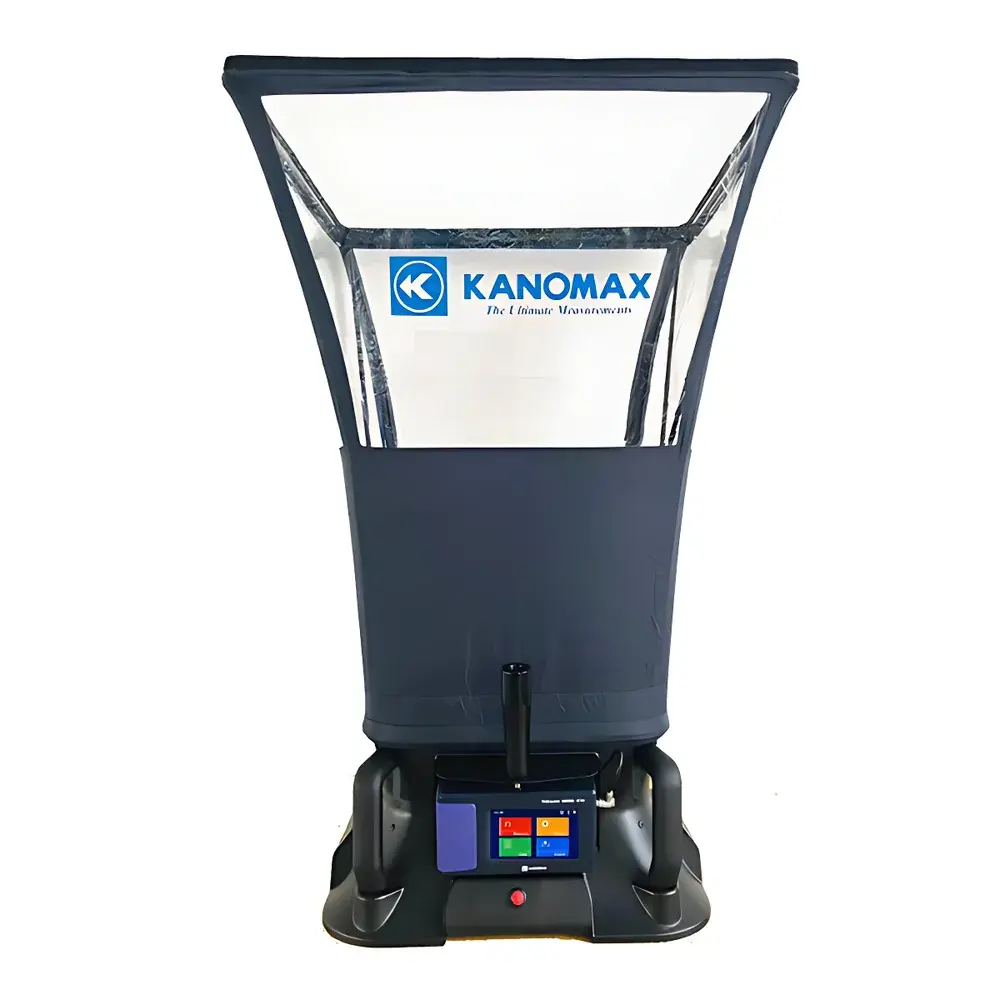
Kanomax 6720 Portable Air Flow Hood with Integrated Multi-Parameter Measurement
| Brand | Kanomax |
|---|---|
| Origin | Japan |
| Model | 6720 |
| Air Flow Range | 40–4300 m³/h |
| Accuracy | ±3% of reading ±8 m³/h |
| Operating Temperature | 0–60 °C |
| Operating Humidity | 0–100 %RH |
| Air Velocity Range (Pitot Tube) | 0.15–40 m/s |
| Air Velocity Range (Matrix Sensor) | 0.15–15 m/s |
| Velocity Accuracy | ±3% of reading ±0.05 m/s |
| Differential Pressure Range | −2500 to +2500 Pa |
| DP Accuracy | ±1.5% of reading ±0.25 Pa |
| Temperature Accuracy | ±0.5 °C |
| Relative Humidity Accuracy | ±3 %RH (10–90 %RH) |
| Display | 4.3-inch full-color touchscreen LCD |
| Data Storage Capacity | 8,000 measurements (host), 10,000 (via Kanomax Mobile App) |
| Power Supply | 4 × AA batteries (≈9 h), DC 5 V adapter |
| Weight | 3.6 kg |
| Standard Hood Size | 610 × 610 mm |
| Optional Hood Sizes | 610 × 1220 mm, 305 × 1220 mm, 500 × 500 mm, 915 × 915 mm, 915 × 610 mm, 800 × 1400 mm |
| Key Functions | Inlet/Exhaust mode detection, backpressure compensation, barometric pressure correction, 16-point differential pressure array, detachable velocity matrix, transparent viewing window, Bluetooth 4.2, USB data export, real-time thermal/hygrometric/differential pressure logging |
Overview
The Kanomax 6720 Portable Air Flow Hood is an integrated, field-deployable instrument engineered for quantitative volumetric air flow measurement in HVAC, cleanroom, and containment system validation. It operates on the principle of multi-point differential pressure sensing across a calibrated orifice grid—combined with real-time temperature and atmospheric pressure correction—to compute volumetric flow rate (m³/h) under varying static pressure conditions. Unlike single-point anemometers, the 6720 employs a 16-hole pressure array distributed across its hood face, enabling simultaneous capture of localized static and total pressure differentials. This architecture supports robust backpressure compensation, critical for accurate readings when measuring airflow at supply diffusers, exhaust grilles, or biological safety cabinets where duct resistance induces measurable system backpressure. The device conforms to industry-standard test methodologies referenced in ISO 14644-3 (cleanroom certification), ASHRAE Guideline 12–2020 (HVAC commissioning), and IEST-RP-CC006.2 (laminar flow hood verification).
Key Features
- Simultaneous measurement of volumetric air flow (40–4300 m³/h), air velocity (0.15–40 m/s via Pitot tube; 0.15–15 m/s via detachable matrix sensor), ambient temperature (0–60 °C), relative humidity (0–100 %RH), and differential pressure (−2500 to +2500 Pa)
- Integrated backpressure compensation algorithm—automatically adjusts flow calculation based on real-time differential pressure profile across 16 calibrated ports
- Barometric pressure and temperature correction applied per ISO 5167-derived density compensation, ensuring traceable volumetric accuracy across variable elevation and climate conditions
- 4.3-inch full-color capacitive touchscreen with intuitive icon-driven interface, supporting multi-language selection (English, Japanese, Chinese, Korean, Spanish, French)
- Detachable velocity matrix and interchangeable hood frames (6 standard sizes, 6 optional configurations) enable adaptation to diverse grille geometries—from compact terminal units to large VAV boxes
- Bluetooth 4.2 module enables wireless pairing with iOS/Android devices running the official Kanomax Mobile App for remote configuration, live data streaming, and on-device statistical analysis (min/max/avg/cumulative values)
- Transparent polycarbonate viewing window allows visual confirmation of hood-to-grille seal integrity prior to measurement initiation—a critical step for GLP-compliant airflow reporting
Sample Compatibility & Compliance
The 6720 is designed for non-intrusive, in-situ measurement of conditioned air streams in commercial, pharmaceutical, and laboratory environments. Its modular hood system accommodates rectangular, square, and irregularly shaped supply/exhaust openings without requiring custom tooling. All sensor subsystems are factory-calibrated against NIST-traceable standards, with calibration certificates available upon request. The instrument meets electromagnetic compatibility requirements per IEC 61326-1:2021 and environmental operating specifications per IEC 60529 (IP42 ingress protection). For regulated facilities, audit trails—including timestamped operator ID, measurement mode (inlet/exhaust), K-factor settings, and environmental metadata—are embedded in each stored record and exportable in CSV or PDF format compliant with FDA 21 CFR Part 11 requirements when used with validated Kanomax software.
Software & Data Management
Data acquisition and post-processing are supported by two complementary platforms: the onboard firmware (with 8,000-measurement internal memory) and the Kanomax Mobile App (10,000-measurement capacity, offline caching). Raw datasets include synchronized timestamps, sensor status flags (e.g., low battery, out-of-range humidity), and user-defined test IDs. Export options include USB mass storage mode (FAT32), Bluetooth printing to compatible thermal printers (e.g., Zebra ZQ520), and encrypted cloud sync via Kanomax Cloud Portal (optional subscription). The desktop companion software—Kanomax Data Manager v3.2—supports batch report generation aligned with ISO/IEC 17025 documentation templates, including uncertainty budgets derived from combined error propagation of flow, temperature, and pressure terms.
Applications
- HVAC system balancing and TAB (Testing, Adjusting, Balancing) per NEBB Procedural Standards
- Cleanroom classification (ISO 14644-1) and recertification, including uniformity assessment of supply air distribution
- Biological safety cabinet (BSC) inflow and downflow velocity verification per NSF/ANSI 49
- Pharmaceutical isolator and RABS airflow mapping during qualification (IQ/OQ)
- Exhaust hood face velocity surveys for laboratory fume hood compliance (ASHRAE 110)
- Energy audit workflows requiring volumetric airflow input for fan power calculations (ASHRAE 90.1 Appendix G)
FAQ
Does the 6720 support regulatory audit requirements for pharmaceutical cleanrooms?
Yes—the device records full environmental context (T, RH, Patm, ΔP), operator ID, and calibration status with each measurement. When paired with Kanomax Data Manager and configured for electronic signatures, it satisfies ALCOA+ principles and supports 21 CFR Part 11 compliance.
Can the same hood frame be used with both Pitot tube and matrix sensor configurations?
No—the Pitot tube is mounted externally via a dedicated port on the hood’s side panel; the matrix sensor integrates directly into the hood face and requires mechanical detachment for cleaning or replacement.
Is atmospheric pressure measured internally or entered manually?
The unit includes a built-in barometric pressure sensor (range: 60–110 kPa), eliminating manual entry and enabling automatic density correction during flow computation.
What is the minimum recommended distance between the hood and the test opening surface?
Zero gap is required: the hood must make full contact with the grille or diffuser face. The transparent window ensures immediate visual verification of seal continuity before initiating measurement.
How frequently does the instrument require recalibration?
Kanomax recommends annual factory recalibration. Field verification using NIST-traceable reference standards (e.g., calibrated rotameter or laminar flow element) is advised before critical certification activities.







