
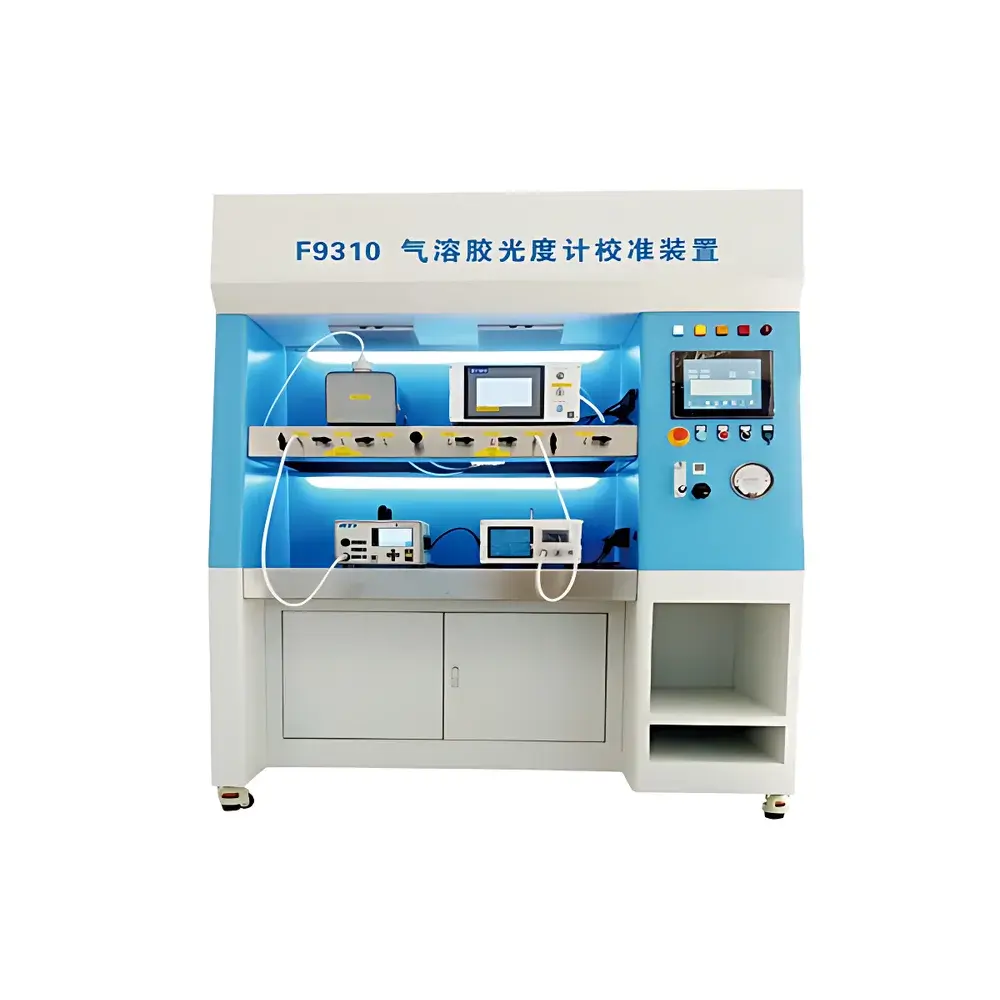
KANOMAX F9310 Aerosol Photometer Calibration System
| Brand | KANOMAX |
|---|---|
| Origin | Liaoning, China |
| Manufacturer Type | Authorized Distributor |
| Country of Origin | China |
| Model | F9310 |
| Pricing | Upon Request |
| Aerosol Generation Range | 0.01–150 µg/L (PAO-4) |
| Diluted Aerosol Range (for mixing) | 0.01–1 µg/L |
| Stability | ≤5% over 4 h (at 0.01–1 µg/L) |
| Reference Photometer Accuracy | ±10% MPE (mass concentration) |
| Reference Flowmeter Range | 0–50 L/min |
| Accuracy | <±1.0% FS |
| Dimensions | 1650 × 1000 × 2500 mm (L×W×H) |
| Operating Temperature | 15–30 °C |
| Relative Humidity | ≤85% RH |
| Power Supply | AC 220 V, 50 Hz |
Overview
The KANOMAX F9310 Aerosol Photometer Calibration System is a fully integrated, metrologically traceable calibration platform engineered for the precise generation, dilution, stabilization, and quantification of polyalphaolefin (PAO-4) aerosol test particles. Designed in accordance with ISO 14644-3, ISO 21501-4, and ASTM E1287–22 standards for cleanroom and containment testing instrumentation, the system implements a dual-traceability architecture—supporting both photometric reference (using a certified primary-standard aerosol photometer) and gravimetric verification (via membrane filtration and microbalance analysis). Its core function is to deliver calibrated aerosol mass concentrations across three orders of magnitude (0.01–150 µg/L), enabling rigorous performance verification of airborne particle counters, filter integrity testers (e.g., DOP/PAO challenge systems), and real-time photometric monitors used in pharmaceutical manufacturing, HVAC validation, and biosafety laboratory certification.
Key Features
- Multi-stage aerosol generation architecture utilizing heated PAO-4 nebulization, thermophoretic condensation, and controlled coagulation to ensure monodisperse-like behavior and high reproducibility across the full concentration range.
- Integrated turbulent mixing chamber with optimized residence time and Reynolds-number-controlled flow dynamics to achieve spatial homogeneity (CV ≤3% across 10 measurement ports).
- Dual-mode concentration verification: real-time photometric referencing against an NIST-traceable primary standard photometer (±10% MPE), plus optional gravimetric cross-validation per ISO 14644-3 Annex B using 47-mm PTFE filters and analytical microbalances (0.1 µg resolution).
- Industrial-grade control system based on embedded IPC with capacitive touchscreen HMI, supporting automated sequence execution—including concentration ramping, dwell timing, stability monitoring, and pass/fail logic per user-defined acceptance criteria.
- Zero-emission exhaust configuration featuring HEPA + activated carbon dual-stage filtration, compliant with OSHA 1910.1200 and local occupational exposure limits for PAO-4 (TLV-TWA: 5 mg/m³).
- Self-diagnostic routines covering pressure differentials, thermal stability of the generator core, photometer zero-drift compensation, and flowmeter linearity verification prior to each calibration cycle.
Sample Compatibility & Compliance
The F9310 supports calibration of all optical particle counters and photometers operating on light-scattering principles (90° or forward-angle detection), including but not limited to devices compliant with ISO 21501-4 (light scattering airborne particle counters), IEST-RP-CC034.2 (filter leak testing), and USP / environmental monitoring requirements. It is compatible with PAO-4 (polyalphaolefin, viscosity 4 cSt) as the designated challenge agent per EN 1822-5 and FDA guidance for HEPA filter integrity testing. All generated aerosols meet ISO 14644-3 Class 5 stability thresholds for calibration duration. The system itself conforms to IEC 61000-6-2 (immunity) and IEC 61000-6-4 (emissions), and its software architecture supports audit trails and electronic signatures aligned with FDA 21 CFR Part 11 and EU Annex 11 requirements when deployed in GMP environments.
Software & Data Management
The embedded calibration management software provides role-based access control (administrator/operator modes), configurable test protocols (single-point, multi-point, linearity sweep), and automated report generation in PDF format compliant with ISO/IEC 17025 clause 7.8. All raw sensor data—including photometer voltage outputs, mass flow readings, temperature/humidity logs, and stability metrics—are timestamped and stored locally with SHA-256 hashing for data integrity. Export options include CSV for third-party statistical analysis (e.g., linear regression per ISO/IEC 17025:2017 Annex A.3) and XML for LIMS integration. Audit trails record user actions, parameter changes, and calibration events with immutable timestamps—retained for ≥10 years per GLP-compliant archiving policy.
Applications
- Periodic calibration and intermediate checks of aerosol photometers used in cleanroom classification (ISO 14644-1), isolator qualification, and glovebox leak testing.
- Validation of filter integrity test systems (e.g., TDA-99M, PortaCount Pro+) under controlled challenge concentrations per EN 1822-5 and IEST RP-CC001.3.
- Development and verification of aerosol dispersion models in containment hood and fume cupboard performance studies.
- Reference standard transfer between metrology labs and end-user facilities via interlaboratory comparison protocols.
- Training and proficiency testing for QA/QC personnel performing ISO 14644-3 Annex D compliance audits.
FAQ
What traceability standards does the F9310 support?
The system enables traceability to NIST SRM 1979 (PAO-4 aerosol standard) via primary photometric reference or to NIST SRM 2877 (microbalance calibration) via gravimetric mode.
Can the F9310 calibrate instruments using alternative challenge agents like DEHS or NaCl?
No—the system is validated exclusively for PAO-4 per manufacturer specifications and international filter testing standards; substitution requires full requalification per ISO/IEC 17025 clause 5.4.2.
Is remote operation or network connectivity supported?
Yes—optional Ethernet/IP interface enables remote monitoring and diagnostic access via secure TLS 1.2 connection; however, calibration execution remains local to prevent unauthorized parameter modification.
What maintenance intervals are recommended for long-term accuracy?
Annual recalibration of the reference photometer and flowmeter by an ISO/IEC 17025-accredited lab is required; generator nozzle cleaning and HEPA filter replacement every 500 operational hours or per visual inspection.
Does the system comply with GMP documentation requirements?
Yes—full 21 CFR Part 11 compliance package available upon request, including electronic signature workflow, audit trail export, and IQ/OQ documentation templates aligned with ASTM E2500-13.
Related Products







