
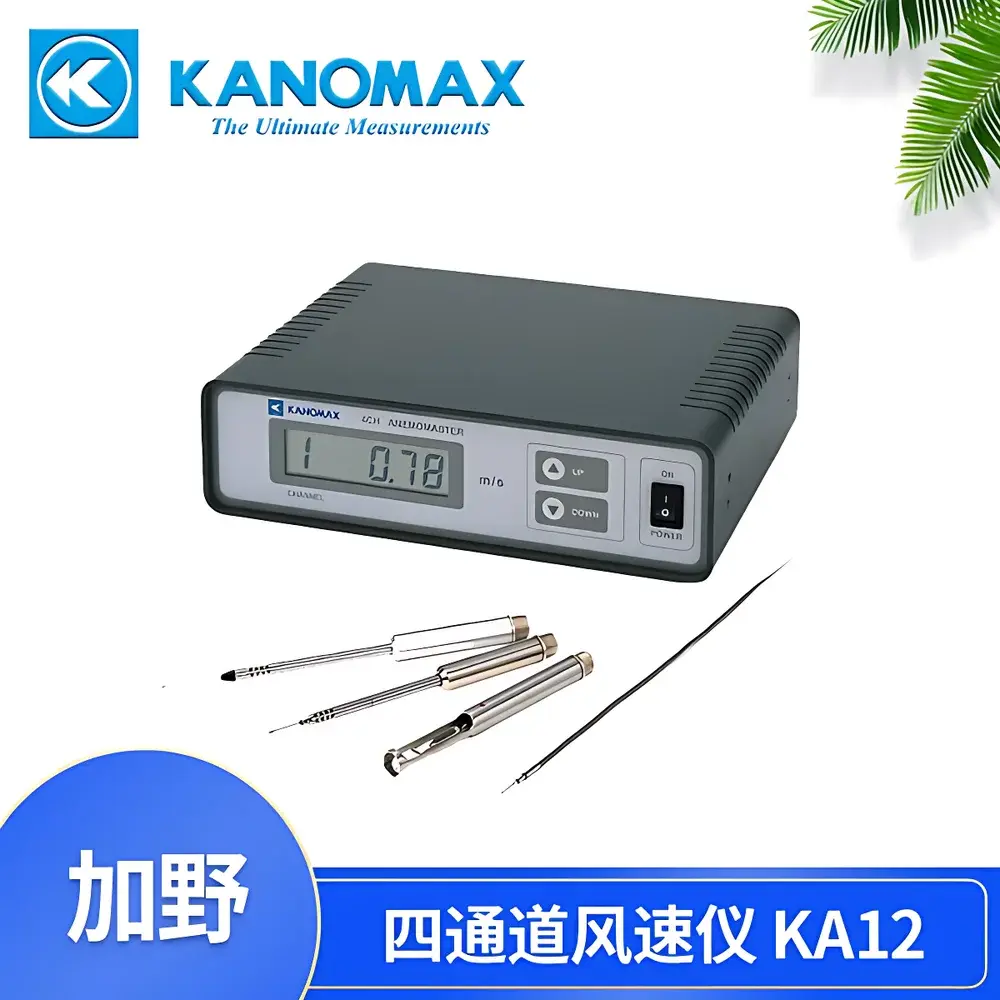
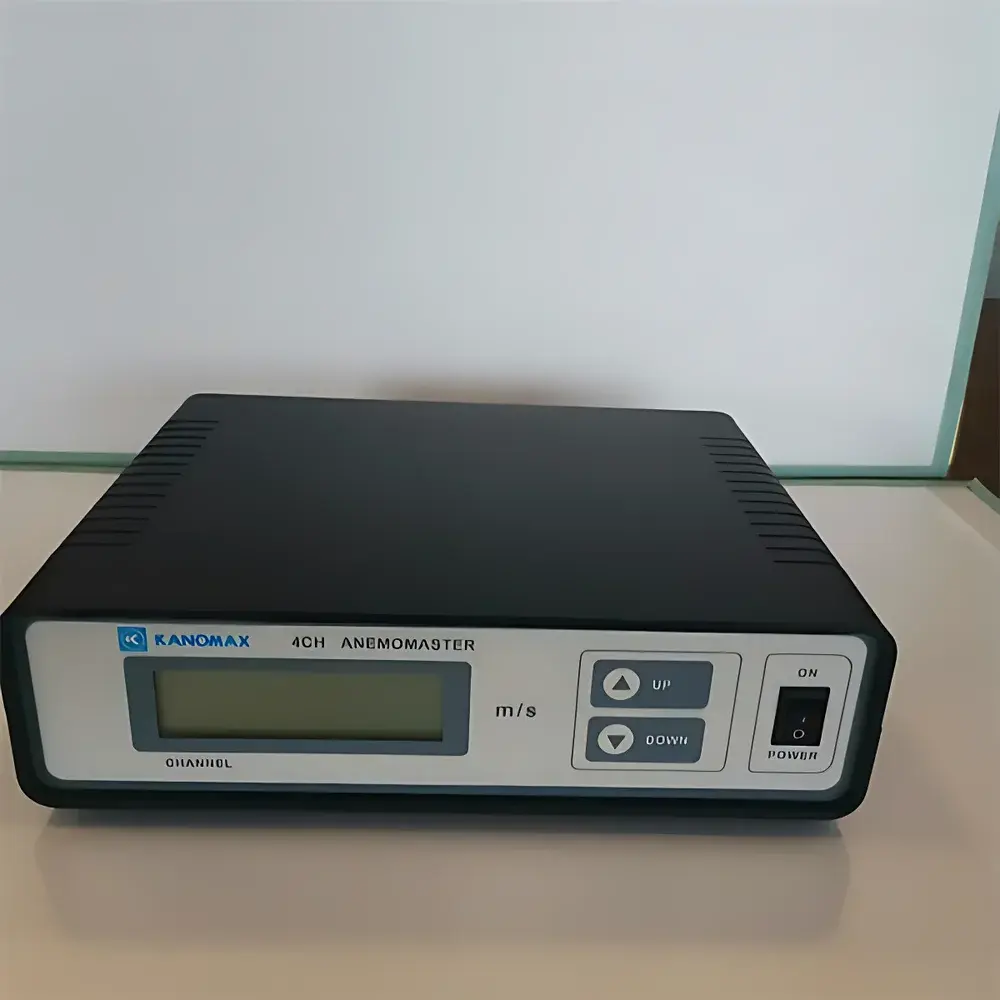
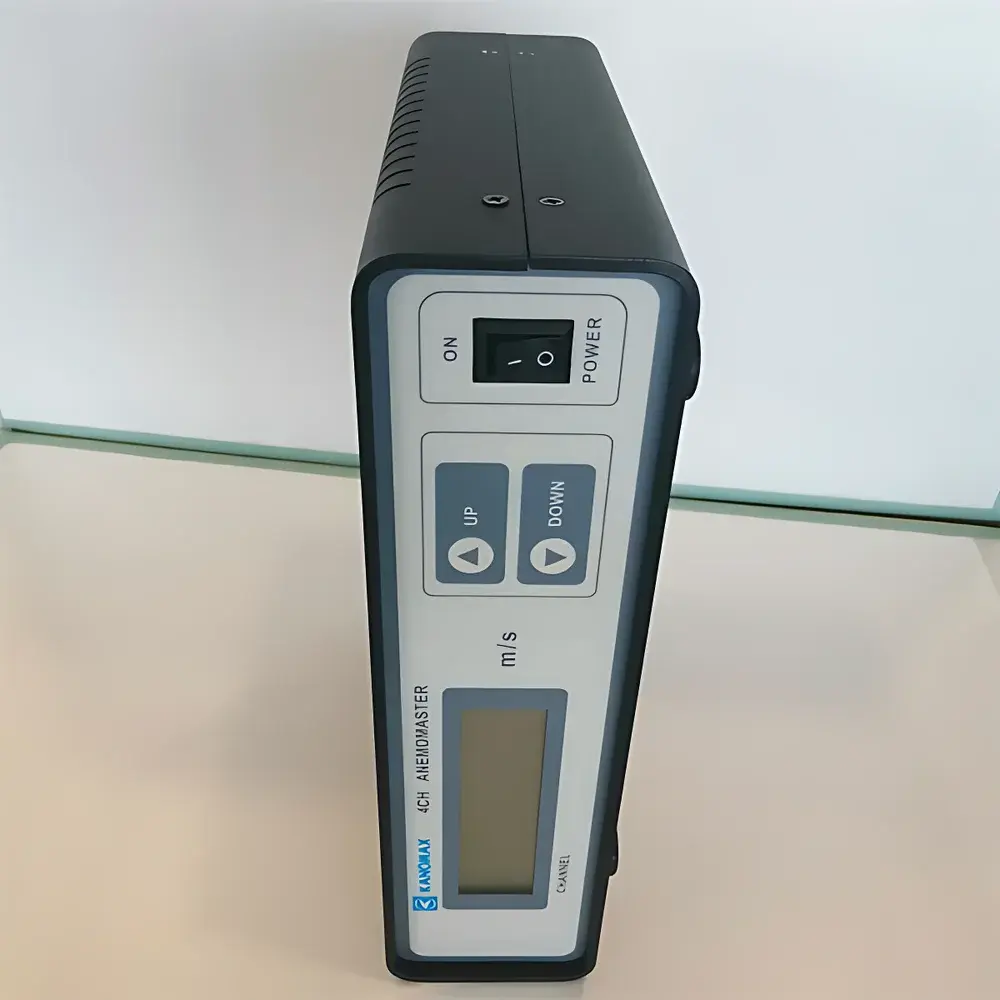
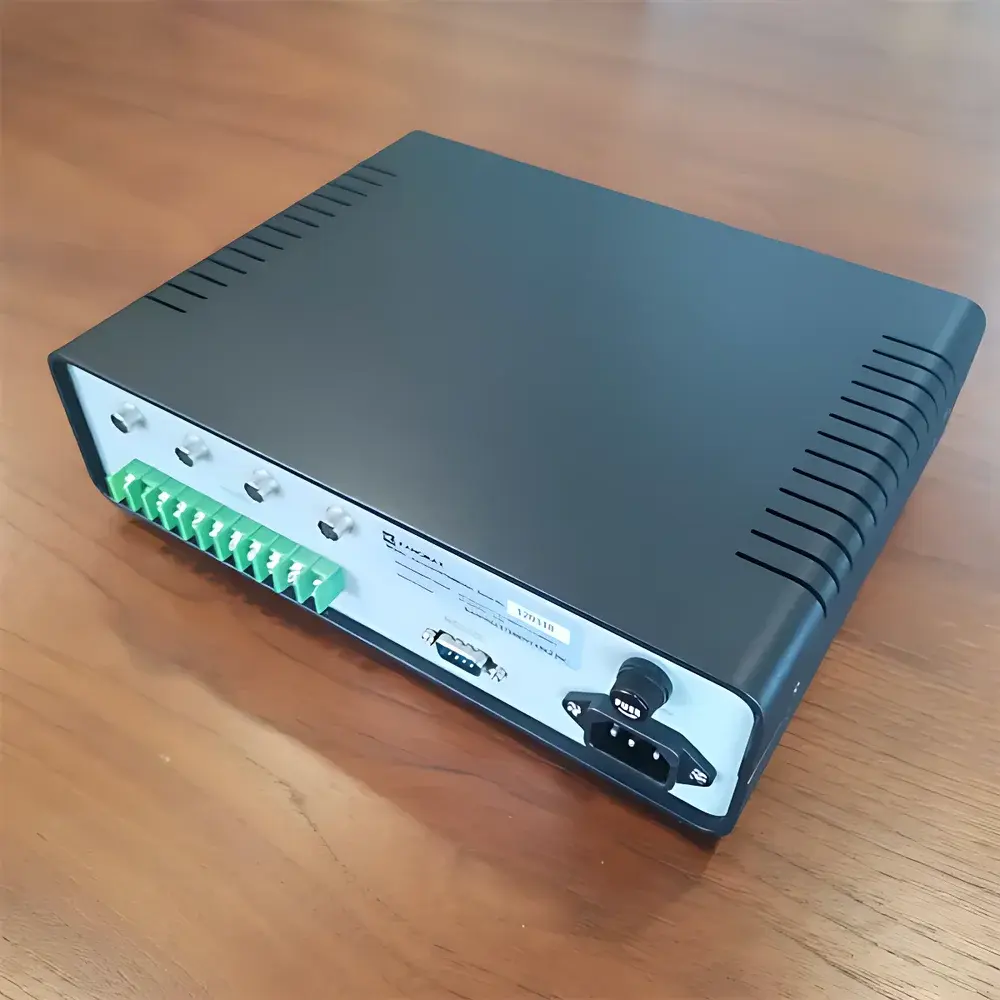
Kanomax KA12 Four-Channel Thermal Anemometer for Cleanroom Environmental Monitoring
| Brand | Kanomax |
|---|---|
| Origin | Japan |
| Model | KA12 |
| Instrument Type | Thermal Anemometer |
| Resolution | 0.01 m/s |
| Accuracy | ±3% of reading |
| Measurement Range | Probe-dependent (e.g., 0.05–30 m/s typical for standard hot-wire probes) |
| Operating Temperature | 0–60 °C |
| Operating Humidity | 0–100% RH |
| Analog Output | 0–5 V or 4–20 mA |
| Communication Interface | RS-232C |
| Power Supply | AC 220 V |
| Dimensions | 200 × 260 × 70 mm |
| Weight | 2.6 kg |
Overview
The Kanomax KA12 is a precision-engineered four-channel thermal anemometer designed specifically for continuous, multi-point airflow verification in regulated clean environments—including ISO Class 5–8 pharmaceutical manufacturing suites, semiconductor fabrication cleanrooms, aseptic processing isolators, and medical device assembly areas. Utilizing constant-temperature anemometry (CTA), the KA12 measures convective heat loss from calibrated hot-wire or hot-film sensor elements to determine local air velocity with high temporal resolution and low thermal inertia. Its quad-channel architecture enables simultaneous, time-synchronized acquisition from up to four independent probes—critical for mapping laminar flow uniformity across HEPA filter banks, validating unidirectional airflow at critical workstations (e.g., filling lines, laminar flow hoods), and performing dynamic airflow balance studies during HVAC commissioning and requalification per ISO 14644-3 and EU GMP Annex 1 requirements.
Key Features
- Four independent analog input channels supporting simultaneous real-time velocity measurement from up to four interchangeable Kanomax thermal probes—including straight, bent, and retractable variants optimized for ducts, diffusers, and confined ISO-classified zones.
- Probe-agnostic calibration architecture: Each channel auto-detects connected probe type and applies corresponding NIST-traceable calibration coefficients stored in probe EEPROM—ensuring metrological continuity across probe swaps without manual recalibration.
- Dual-mode analog output (0–5 V DC or 4–20 mA) configurable per channel for integration into building management systems (BMS), SCADA platforms, or PLC-based environmental monitoring systems (EMS) compliant with FDA 21 CFR Part 11 data integrity expectations.
- RS-232C serial interface enabling bidirectional communication with host PCs for remote configuration, firmware updates, and automated data logging—fully compatible with Kanomax’s proprietary KAN-LOG software suite.
- Rugged industrial enclosure (IP20-rated) with EMI-shielded internal circuitry, designed for stable operation in electrically noisy cleanroom utility corridors and equipment rooms.
Sample Compatibility & Compliance
The KA12 supports ten standardized Kanomax probe models—including the KA0112 (straight 100-mm stem), KA0113 (90° bent tip), and KA0118 (retractable 300-mm probe)—all constructed from stainless steel (SUS316L) and PTFE-insulated sensing wires to withstand repeated alcohol-based disinfection and low-particulate cleaning protocols. All probes comply with IEC 60529 (IP rating), ISO 8573-1 (compressed air purity), and ASTM D1896-20 (air velocity measurement in controlled environments). The instrument itself meets CE marking requirements under the EMC Directive 2014/30/EU and Low Voltage Directive 2014/35/EU. Data acquisition workflows support ALCOA+ principles (Attributable, Legible, Contemporaneous, Original, Accurate, Complete, Consistent, Enduring, Available) when used with validated KAN-LOG software and audit-trail-enabled PC configurations.
Software & Data Management
KAN-LOG software (Windows 10/11 compatible) provides comprehensive post-acquisition analysis including time-series velocity trending, statistical summary (mean, min/max, SD, CV%), iso-velocity contour generation, and pass/fail compliance reporting against user-defined limits (e.g., 0.36–0.54 m/s for Grade A zones per EU GMP Annex 1). Raw data exports in CSV and Excel formats retain full metadata (timestamp, channel ID, probe SN, calibration date). Optional GxP module enables electronic signatures, role-based access control, and 21 CFR Part 11-compliant audit trails—including operator login/logout events, parameter changes, and report generation history—with immutable storage on network-attached storage (NAS) or SQL Server databases.
Applications
- ISO 14644-3 cleanroom certification: Multi-point velocity profiling across filter face, work surface, and return grilles.
- Aseptic process validation: Real-time airflow visualization during media fill simulations and glove port testing.
- HVAC system commissioning: Quantitative verification of supply/return air balance, duct leakage assessment, and room pressurization dynamics.
- Environmental monitoring system (EMS) integration: Continuous feed of velocity data into centralized EMS dashboards for alarm-triggered deviation investigation.
- Pharmaceutical QC lab ventilation verification: Ensuring fume hood face velocity stability per ANSI/AIHA Z9.5 and USP .
FAQ
Does the KA12 require annual recalibration?
Yes—Kanomax recommends traceable recalibration every 12 months using NIST-certified wind tunnel standards (e.g., ISO/IEC 17025-accredited labs) to maintain ±3% accuracy specification.
Can the KA12 measure air velocity in high-humidity cleanrooms (e.g., 95% RH)?
Yes—the probe sensors and electronics are rated for 0–100% RH non-condensing operation; however, prolonged exposure to saturated conditions may affect long-term hot-wire stability and is not covered under warranty.
Is probe interchangeability supported across different KA12 units?
Yes—each probe contains embedded calibration memory; swapping probes between KA12 instruments preserves measurement traceability without manual coefficient entry.
What is the minimum measurable velocity with standard probes?
Typical lower limit is 0.05 m/s using the KA0112 probe; sub-0.1 m/s measurements require low-velocity optimized probes (e.g., KA0120) and laminar flow shielding accessories.
Does the KA12 support Modbus RTU or Ethernet connectivity?
No—native communication is RS-232C only; third-party protocol converters (e.g., RS-232-to-Modbus gateways) may be deployed externally, though such configurations fall outside Kanomax validation scope.







