
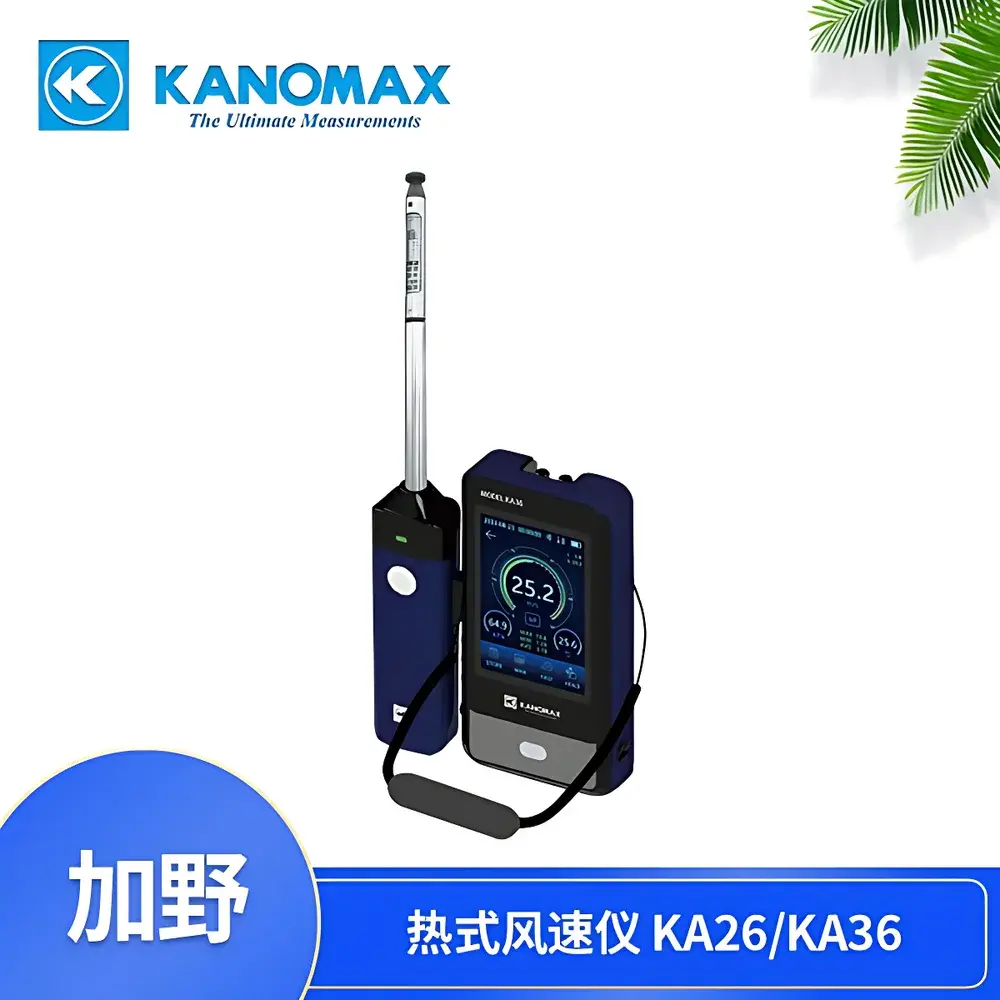
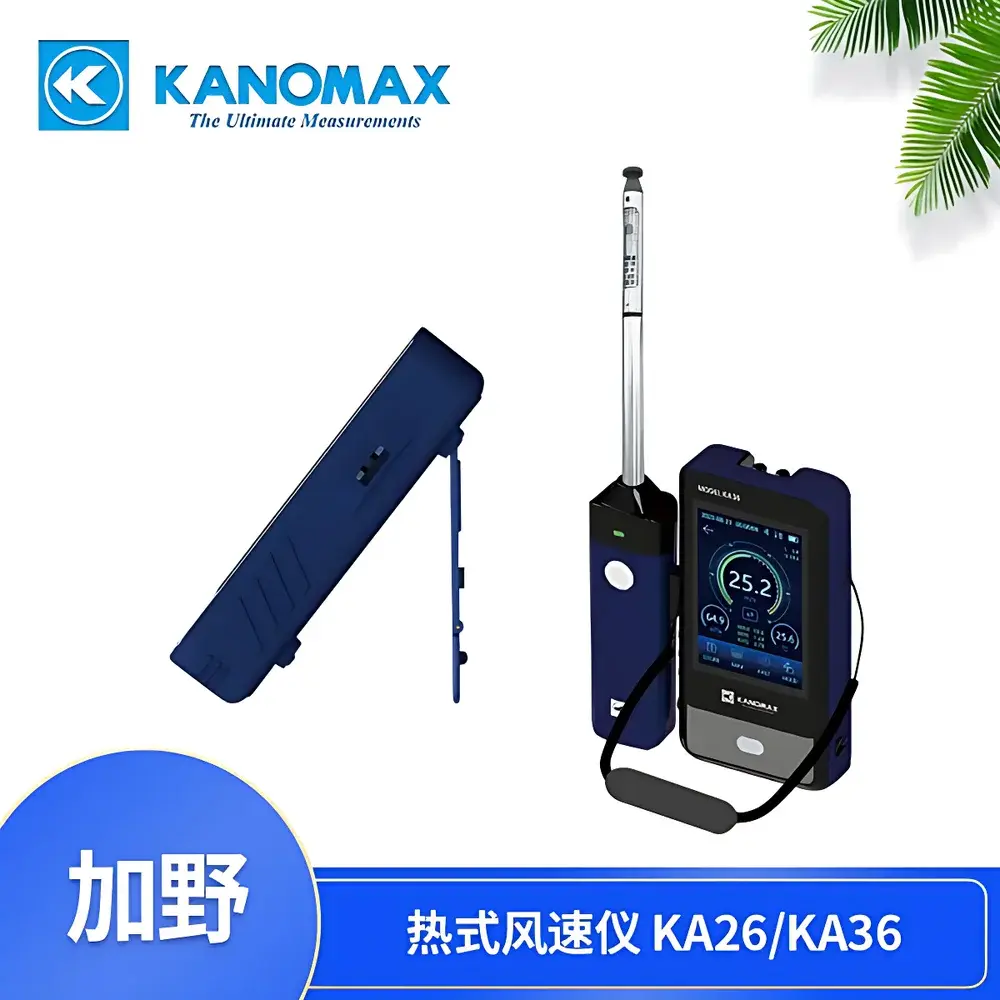
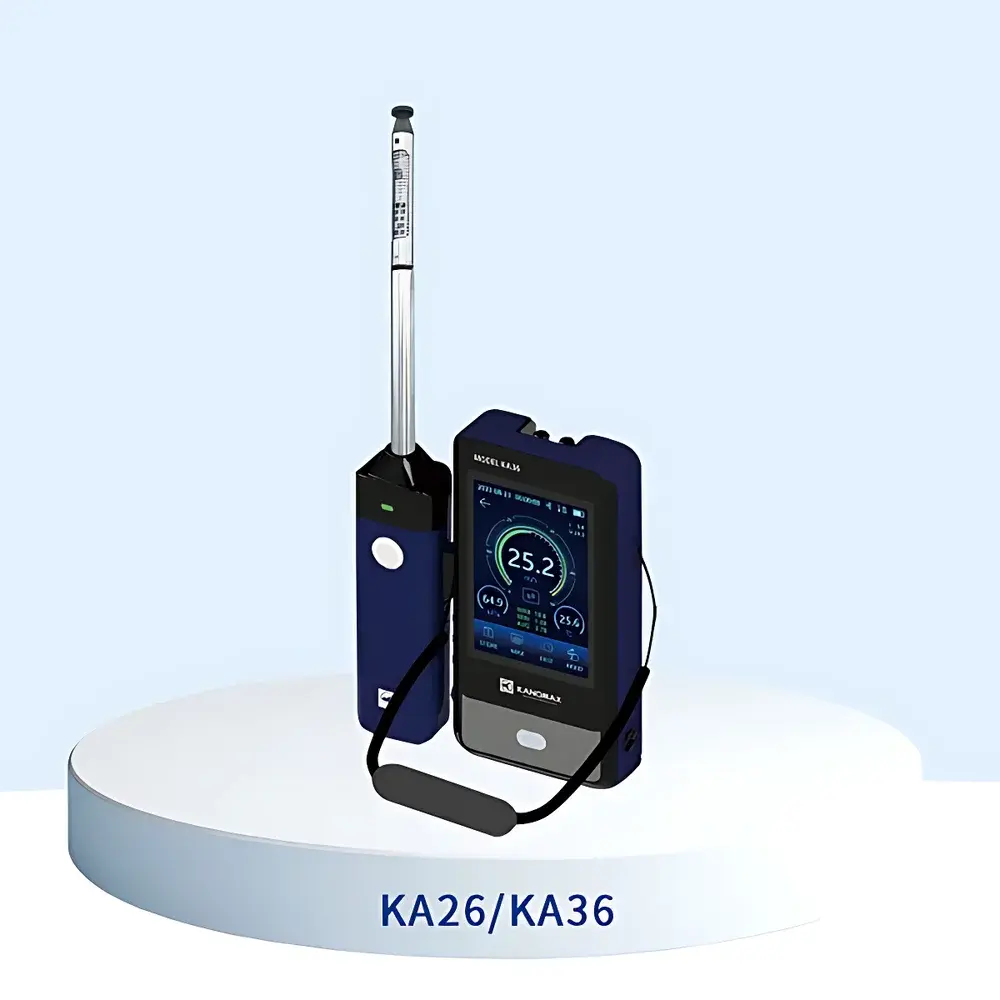
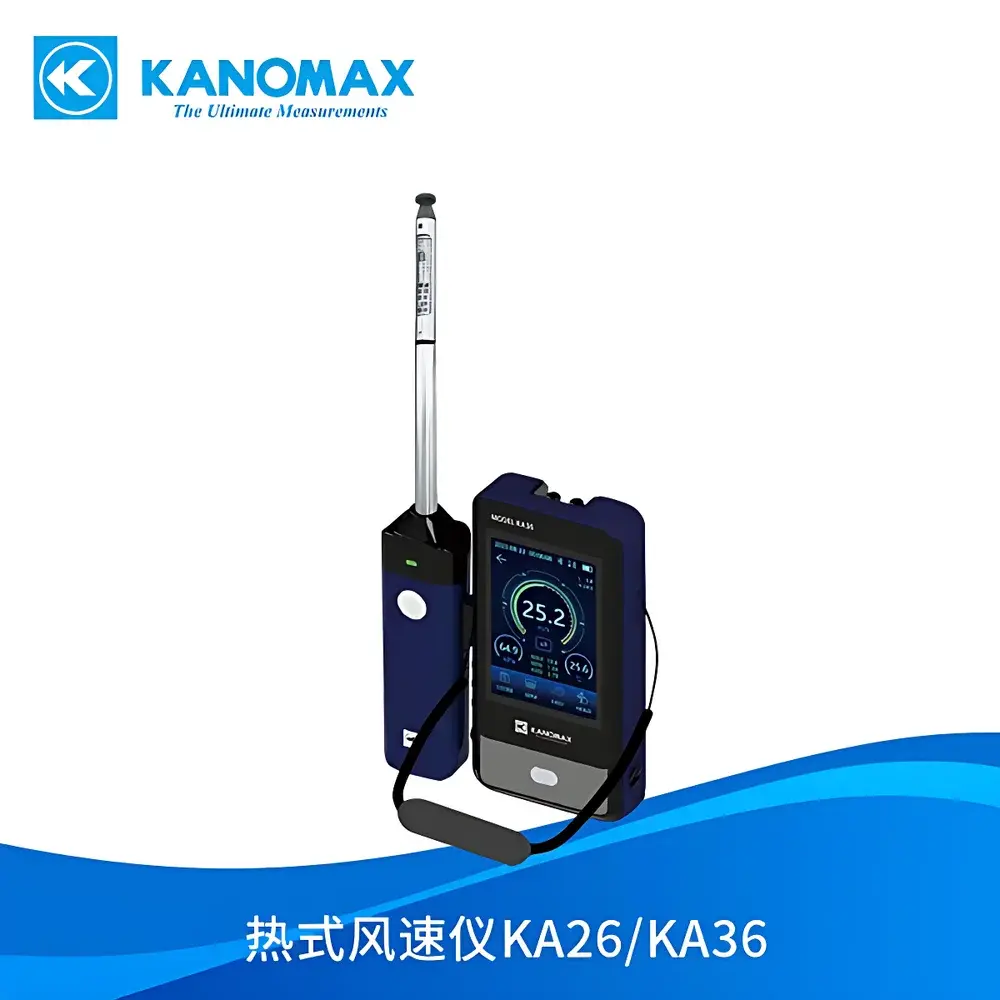
KANOMAX KA26/KA36 Hot-Wire Anemometer for Pharmaceutical Cleanroom Monitoring
| Brand | KANOMAX |
|---|---|
| Origin | Japan |
| Instrument Type | Hot-Wire Anemometer |
| Measurement Range | 0.00–50.0 m/s (wind speed), −20.0–100.0 °C (temperature), −5.00–+5.00 kPa (differential pressure) |
| Resolution | 0.01 m/s (0.00–9.99 m/s), 0.1 m/s (10.0–50.0 m/s), 0.1 °C, 0.01 kPa |
| Accuracy | ±max(3% of reading, 0.015 m/s) for wind speed |
| ±0.3 °C (−20.0–0.0 °C and 60.0–100.0 °C | ±0.5 °C) |
| Response Time | ~1 s (wind speed & pressure), ~30 s (temperature) |
| Display | 3.5-inch resistive touchscreen |
| Data Storage | 5,000 records |
| Communication | Bluetooth 5.0, USB-C |
| Battery Life | ~10 hours (typical cleanroom operating conditions) |
| Operating Temperature (Body) | 5–40 °C |
| (Probe) | −20–100 °C |
| Storage | −30–60 °C |
| Weight | ~600 g (body only) |
| Probe Reach | Adjustable up to 1240 mm with extension rod |
Overview
The KANOMAX KA26/KA36 Hot-Wire Anemometer is an ISO-compliant environmental monitoring instrument engineered for precise, real-time characterization of airflow dynamics in regulated pharmaceutical cleanrooms (ISO 14644-1 Class 5–8), controlled environments, and HVAC validation zones. Utilizing constant-temperature anemometry (CTA), the device measures convective heat transfer from a heated platinum sensor wire immersed in airflow—enabling high-sensitivity detection of low-velocity laminar flow (<0.1 m/s) critical for unidirectional airflow verification per EU GMP Annex 1 and FDA Aseptic Processing Guidance. Unlike cup or vane anemometers, its thermal sensing architecture eliminates mechanical inertia, delivering sub-second response time and immunity to orientation-dependent error. The dual-channel capability (KA36 model) supports simultaneous measurement of velocity, temperature, and differential pressure—essential for calculating volumetric flow rate (Q = A × v) and assessing air change rates (ACH) across HEPA filter banks, supply grilles, and return ducts.
Key Features
- Triple-parameter real-time acquisition: wind speed (0.00–50.0 m/s), temperature (−20.0–100.0 °C), and differential pressure (±5.00 kPa) — all traceable to JIS Z 8000 and NIST-traceable calibration standards.
- 3.5-inch resistive touchscreen with dual-view display: numeric readout + dynamic analog bar graph — enabling immediate visual assessment of parameter stability and transient excursions during smoke studies or airflow mapping.
- Bluetooth 5.0 wireless probe-body communication: eliminates cable constraints during testing of high-mounted diffusers, ceiling-mounted FFUs, or deep ductwork — supporting ASTM E2656-compliant point sampling protocols.
- Modular, bendable probe system with 1240 mm maximum reach: interchangeable sensor heads (Φ10 mm active element) mount directly to ergonomic handle or extend via telescoping rods — no auxiliary fixtures required for ISO 14644-3 scan-path compliance.
- On-device statistical engine: computes min/max/average values over user-defined intervals (1–999 s), with data hold, auto-zero, and rate-of-change alerts — supporting continuous monitoring mode per ICH Q5A and WHO TRS 977 Annex 2 requirements.
- Embedded audit-ready functionality: timestamped measurements with battery level, signal strength, and Bluetooth status indicators — facilitating GLP/GMP-aligned recordkeeping without external software dependency.
Sample Compatibility & Compliance
The KA26/KA36 is validated for use with clean, dry, non-corrosive air streams typical of ISO Class 5–8 pharmaceutical environments. Its platinum-wire sensor is inert to common cleanroom disinfectants (e.g., vaporized hydrogen peroxide, isopropyl alcohol) and resistant to particulate loading up to ISO 16890 ePM1 50% efficiency thresholds. The instrument complies with electromagnetic compatibility (EMC) per IEC 61326-1:2020 and safety standards IEC 61010-1:2010. All factory calibrations are performed against NMIJ/JCSS-certified reference standards, with optional UKAS-accredited calibration certificates available. Device firmware supports 21 CFR Part 11-compliant electronic signatures when paired with KANOMAX’s optional PC software suite (KA-Link Pro), including full audit trail logging, user access control, and electronic record export in CSV/PDF formats.
Software & Data Management
While fully functional as a standalone field instrument, the KA26/KA36 integrates seamlessly with KANOMAX KA-Link Pro software via Bluetooth or USB-C. This Windows-based application enables automated report generation compliant with ISO/IEC 17025:2017 documentation requirements—including calibration history, uncertainty budgets, and measurement traceability chains. Raw datasets retain native timestamps, probe ID, and environmental metadata (e.g., operator ID, location tag, test protocol version). Export formats include ANSI X12-compliant CSV for LIMS ingestion and PDF/A-1b for archival submission to regulatory reviewers. The embedded 5,000-record memory buffer ensures uninterrupted capture during extended qualification runs—even during temporary Bluetooth disconnection.
Applications
- Aseptic processing line certification: uniformity testing of laminar airflow velocity profiles at working height (15–30 cm above work surface) per EU GMP Annex 1 §4.37.
- HEPA filter integrity verification: upstream/downstream differential pressure trending to detect filter degradation or seal failure.
- HVAC system commissioning: air change rate calculation across classified zones using multi-point traverse methodology (ASTM D1821).
- Environmental monitoring program (EMP) support: periodic verification of room pressurization gradients between adjacent cleanroom classifications.
- Investigation of particle dispersion pathways: correlation of localized airflow reversals with viable/non-viable particle counts during root cause analysis.
- IQ/OQ/PQ protocol execution: integration into validation master plans for HVAC, isolators, and RABS systems under FDA 21 CFR Part 211 and PIC/S PI 007-6.
FAQ
Is the KA26/KA36 suitable for ISO 14644-3 airborne particle counter correlation studies?
Yes — its sub-second wind speed response and ±0.015 m/s low-end accuracy enable synchronized measurement with particle counters during dynamic airflow mapping, ensuring temporal alignment of velocity and concentration data.
Can the device be calibrated in-house per GMP requirements?
Field calibration is not supported; however, the instrument accepts third-party accredited calibration services traceable to national metrology institutes. KANOMAX provides calibration certificate templates compliant with ISO/IEC 17025.
What is the recommended recalibration interval for pharmaceutical QC use?
Annual recalibration is standard practice; however, risk-based assessment per ICH Q9 may justify shorter intervals in high-use or critical applications (e.g., Grade A zone monitoring).
Does the KA36 model support simultaneous pressure and temperature compensation during velocity calculation?
Yes — density-compensated velocity output is automatically computed using real-time T and P inputs, satisfying ISO 14644-3 Annex B requirements for volumetric flow correction.
How does the device handle condensation or high-humidity environments?
The probe housing meets IP54 ingress protection; however, prolonged exposure to saturated air (>95% RH) may affect thermal sensor stability. Use is restricted to dew point-controlled cleanrooms per ISO 14644-1:2015 Clause 6.2.
Related Products







