
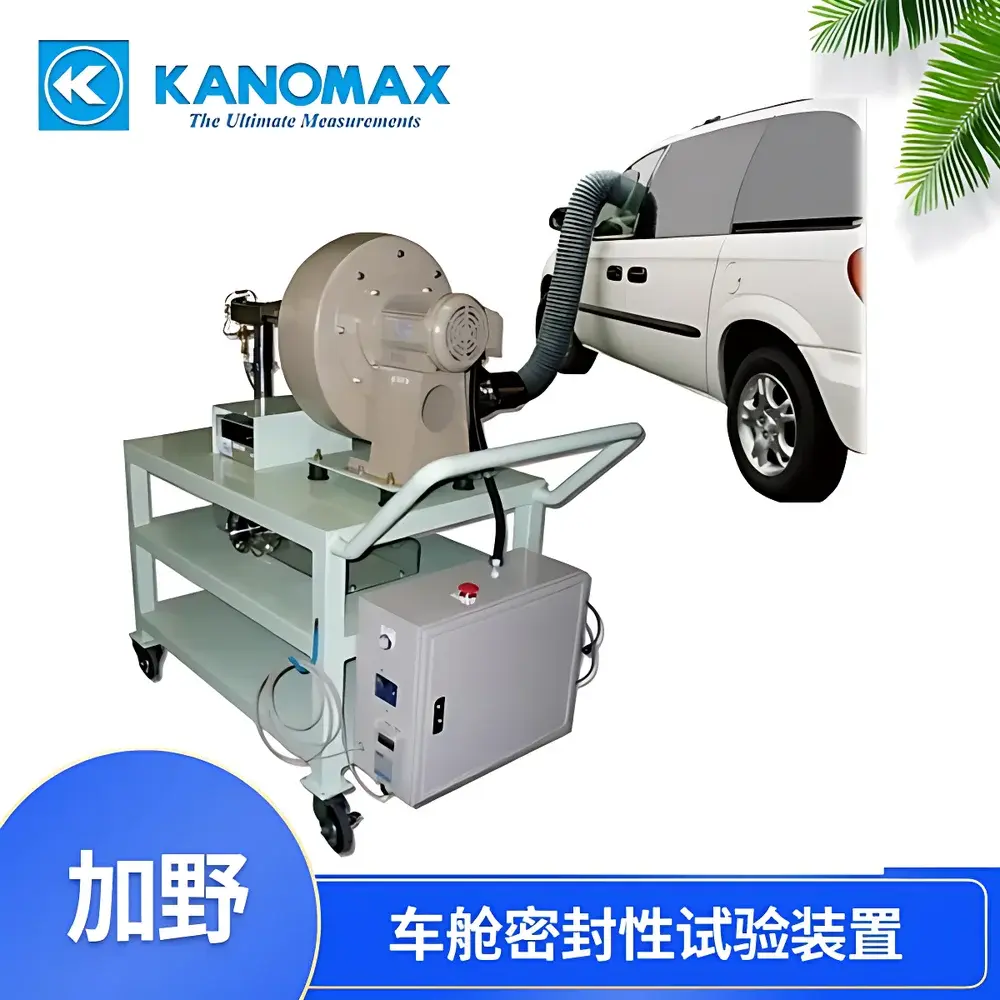
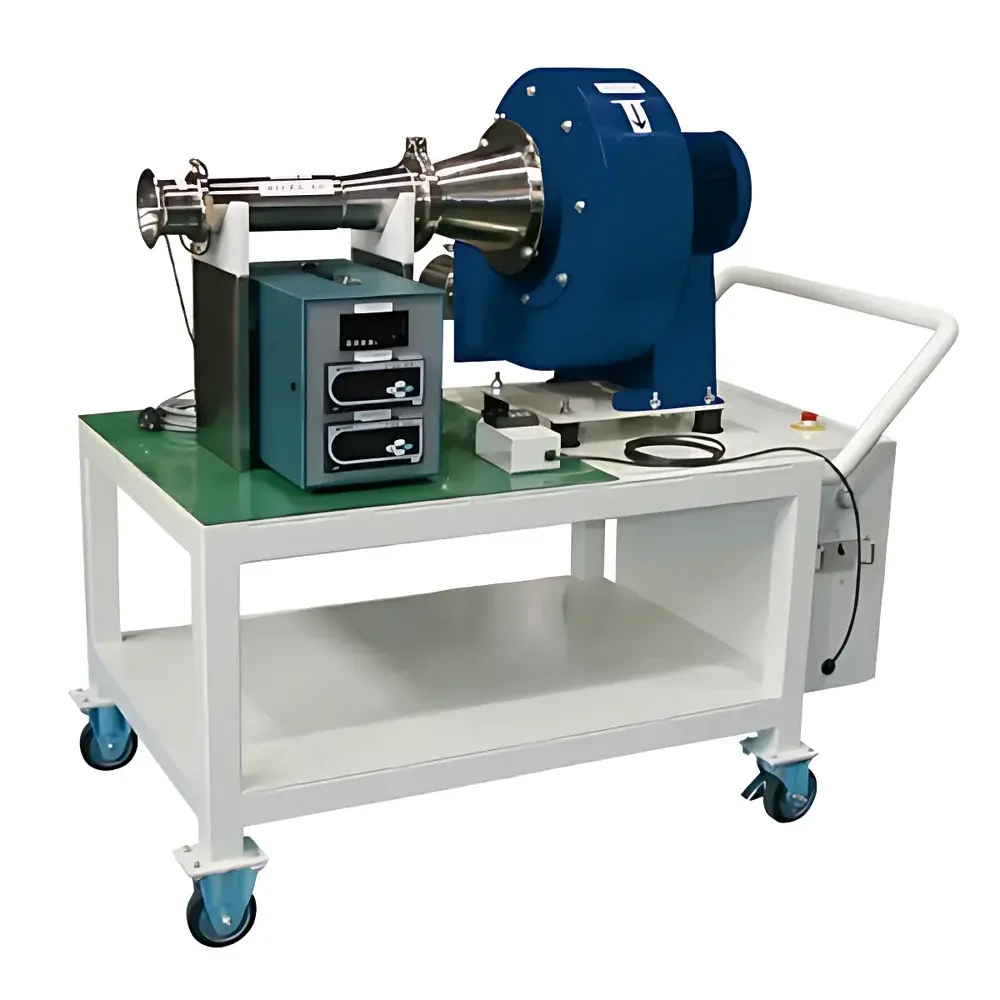
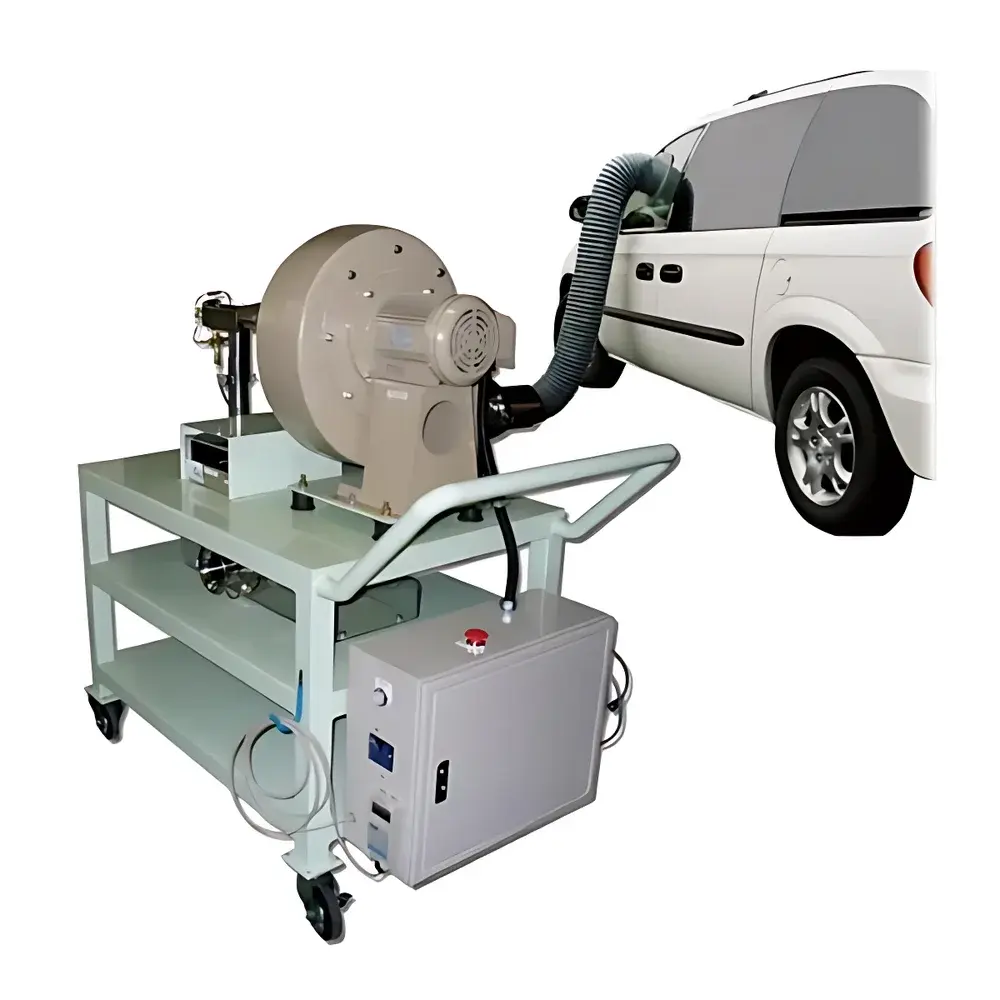
Kanomax KAN-7000 Automotive Cabin Air Tightness Test System
| Brand | Kanomax |
|---|---|
| Origin | Japan |
| Model | KAN-7000 |
| Airflow Range | 100–500 m³/hr |
| Max. Cabin Static Pressure | ±2500 Pa (adjustable) |
| Standard Nozzle Diameters | Φ41 mm and Φ39 mm |
| Compliance | JIS D 1622, JIS B 8330 |
| Pressure Measurement Port | Integrated static pressure tap on flange-mounted flexible duct |
| Control Method | Inverter-driven variable-speed blower with real-time feedback loop for pressure or leakage rate setpoint control |
Overview
The Kanomax KAN-7000 Automotive Cabin Air Tightness Test System is an engineered solution for quantitative evaluation of air leakage characteristics in passenger vehicle cabins under controlled pressurization conditions. Based on the principle of forced-air differential pressure testing—where a calibrated, variable-frequency blower supplies conditioned airflow through a flexible duct connected via flanged interface to vehicle windows—the system measures the volumetric flow rate required to maintain a user-defined static pressure differential between the cabin interior and ambient environment. This enables precise determination of total cabin leakage, as well as component-specific leakage rates (e.g., doors, sunroof, trunk lid) when combined with sequential sealing protocols. The measurement methodology aligns with JIS D 1622 (Automotive Ventilation Performance Testing) and JIS B 8330 (Fan Testing and Certification), ensuring metrological traceability and regulatory relevance for OEM validation labs and Tier-1 suppliers operating under Japanese and global automotive quality frameworks.
Key Features
- High-stability inverter-controlled centrifugal blower delivering continuous, stepless airflow regulation from 100 to 500 m³/hr
- Dual-standard nozzle configuration (Φ41 mm and Φ39 mm) enabling optimized flow coupling across varying cabin inlet geometries and pressure drop profiles
- Integrated static pressure port on the flange-mounted flexible duct assembly, compatible with standard digital manometers or data acquisition systems for real-time cabin pressure monitoring
- Real-time closed-loop control architecture supporting either pressure-setpoint mode (±2500 Pa range) or leakage-rate-setpoint mode, with automatic fan speed adjustment to compensate for thermal drift or seal relaxation during extended tests
- Modular duct interface design facilitates rapid reconfiguration for sedans, SUVs, and light commercial vehicles without mechanical modification
- Robust aluminum-alloy frame with vibration-damped mounting and IP54-rated electrical enclosure for workshop durability
Sample Compatibility & Compliance
The KAN-7000 is validated for use with production-intent passenger vehicles meeting ISO 16750-4 (Environmental Conditions and Testing for Electrical and Electronic Equipment – Climatic Loads) and JASO M302 (Automotive Interior Air Leakage Test Procedure). Its flange-to-window coupling method accommodates standard OEM window opening dimensions (up to 800 × 500 mm), while the flexible duct’s torsional compliance prevents unintended loading on glazing assemblies. All pressure and flow measurements adhere to the uncertainty budget requirements defined in ISO/IEC 17025 for accredited calibration laboratories. The system supports audit-ready documentation per IATF 16949 clause 8.5.1.2 (Validation of Special Processes – Leak Testing) and is routinely deployed in GLP-compliant R&D environments requiring full traceability of test parameters, operator inputs, and environmental conditions.
Software & Data Management
While the KAN-7000 operates as a hardware-integrated benchtop instrument with analog pressure output and digital RS-485 interface, it is fully compatible with third-party SCADA and LIMS platforms via Modbus RTU protocol. Raw pressure and blower RPM signals can be logged at ≥10 Hz sampling rate using standard DAQ hardware. For standalone operation, users may connect external USB data loggers compliant with NIST-traceable calibration standards. All test records—including date/time stamp, vehicle VIN (manually entered), test type (total cabin / door-specific), setpoint value, achieved steady-state deviation (<±2 Pa over 60 s), and pass/fail flag per JIS D 1622 acceptance criteria—are exportable in CSV or XML format. Optional integration with Kanomax’s KAN-Link software suite provides automated report generation aligned with AIAG CQI-15 guidelines for leak test documentation.
Applications
- Pre-production validation of door seal compression force distribution and gasket material aging effects on long-term air retention
- Comparative benchmarking of HVAC housing integrity across platform variants (e.g., EV vs. ICE chassis)
- Root-cause analysis of wind noise sources by correlating localized leakage paths (identified via smoke visualization + KAN-7000 quantification) with acoustic intensity maps
- Verification of after-market accessory installation (e.g., roof racks, window tints) on cabin pressure decay behavior per SAE J1211
- Supporting thermal management system development by quantifying parasitic air infiltration affecting cabin cooling load calculations
- Supplier qualification audits where Tier-2 gasket manufacturers must demonstrate batch-level consistency against OEM air-tightness specifications (e.g., ≤15 m³/hr @ 100 Pa)
FAQ
Does the KAN-7000 comply with ISO 5801 for fan performance certification?
Yes—the blower module is factory-calibrated per ISO 5801 Annex E (Nozzle Flow Measurement), and its certified performance curve is supplied with each unit.
Can the system measure negative pressure (suction) conditions?
Yes—it supports bidirectional pressure control from –2500 Pa to +2500 Pa relative to ambient, enabling both pressurization and depressurization test modes.
Is on-site calibration support available outside Japan?
Kanomax-certified service engineers provide annual verification services in North America, Europe, and China under contract; calibration certificates include uncertainty statements per ISO/IEC 17025.
What is the typical warm-up time before stable readings are achieved?
Less than 90 seconds after power-on, assuming ambient temperature stability within ±2°C; built-in thermal compensation algorithms minimize drift during extended testing.
Are replacement nozzles and duct components available as spare parts?
Yes—standardized Φ41 mm and Φ39 mm nozzles, 3-meter reinforced silicone ducts, and window flange kits are stocked globally with lead times under 10 business days.
Related Products







