
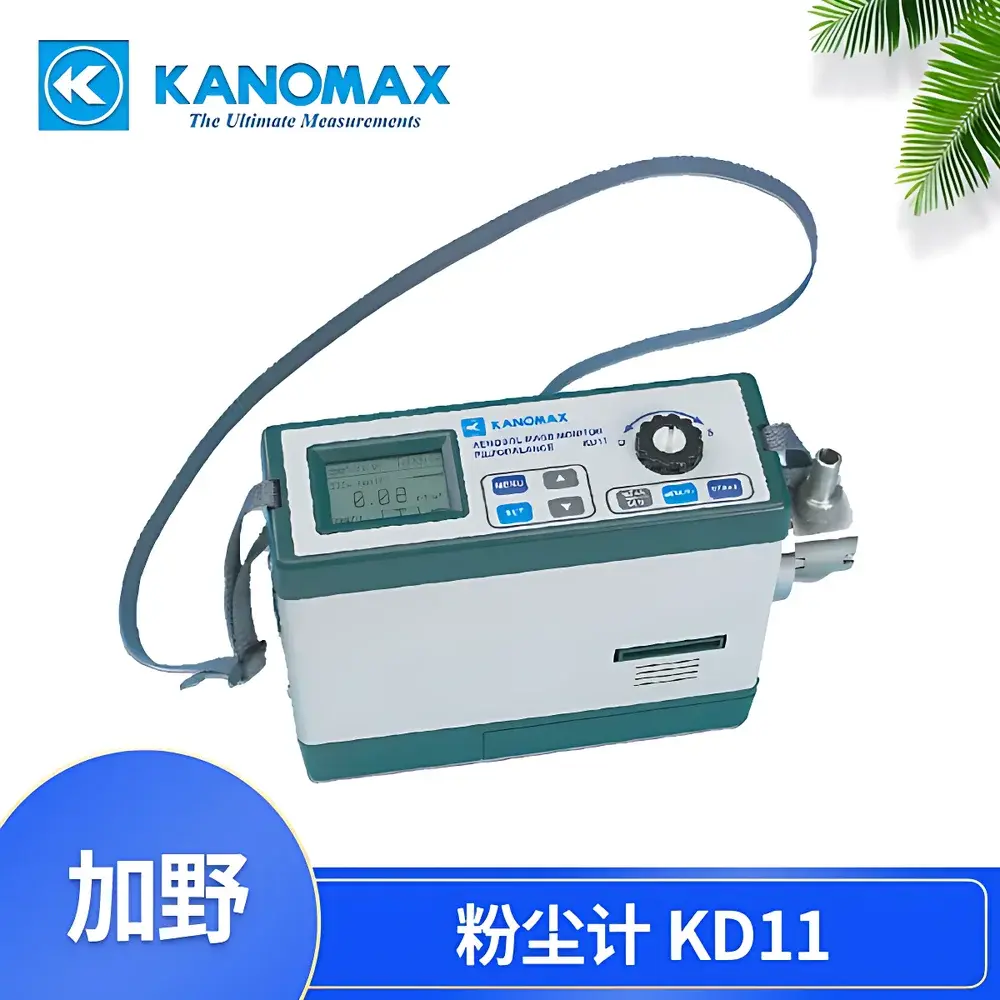
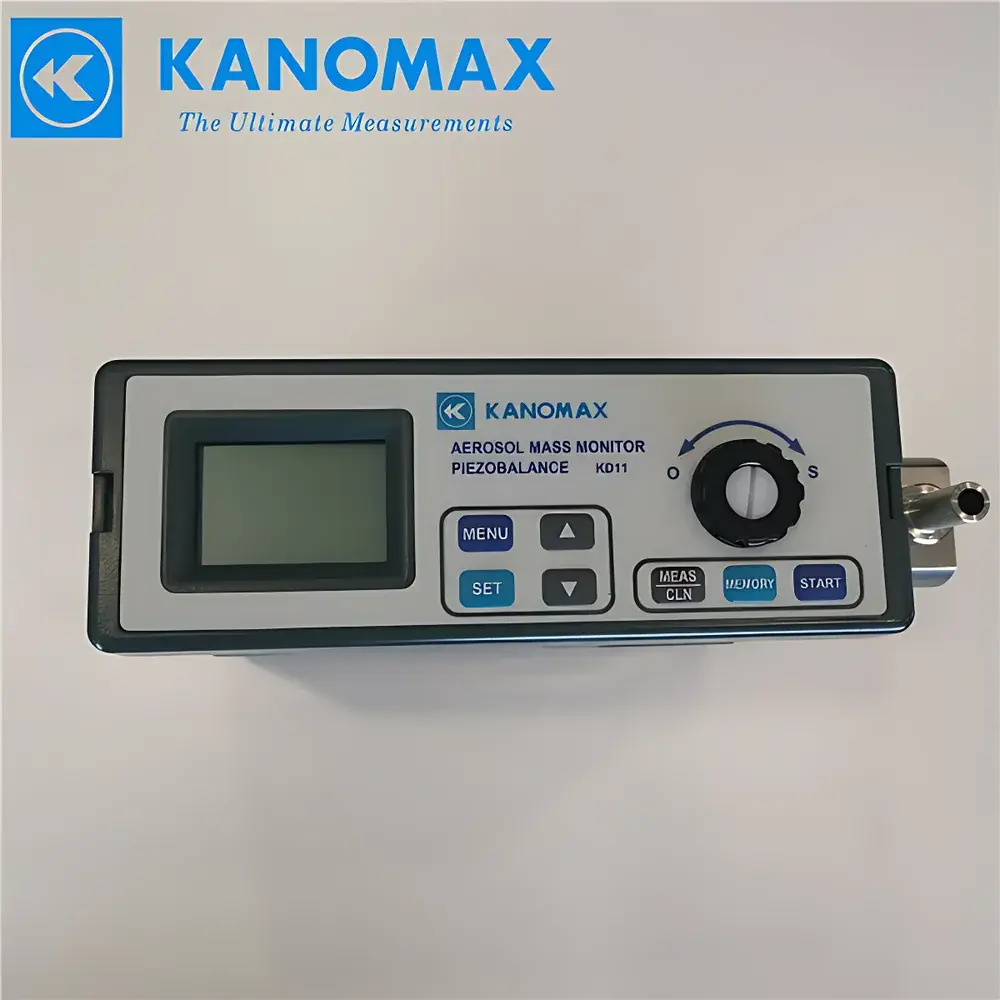
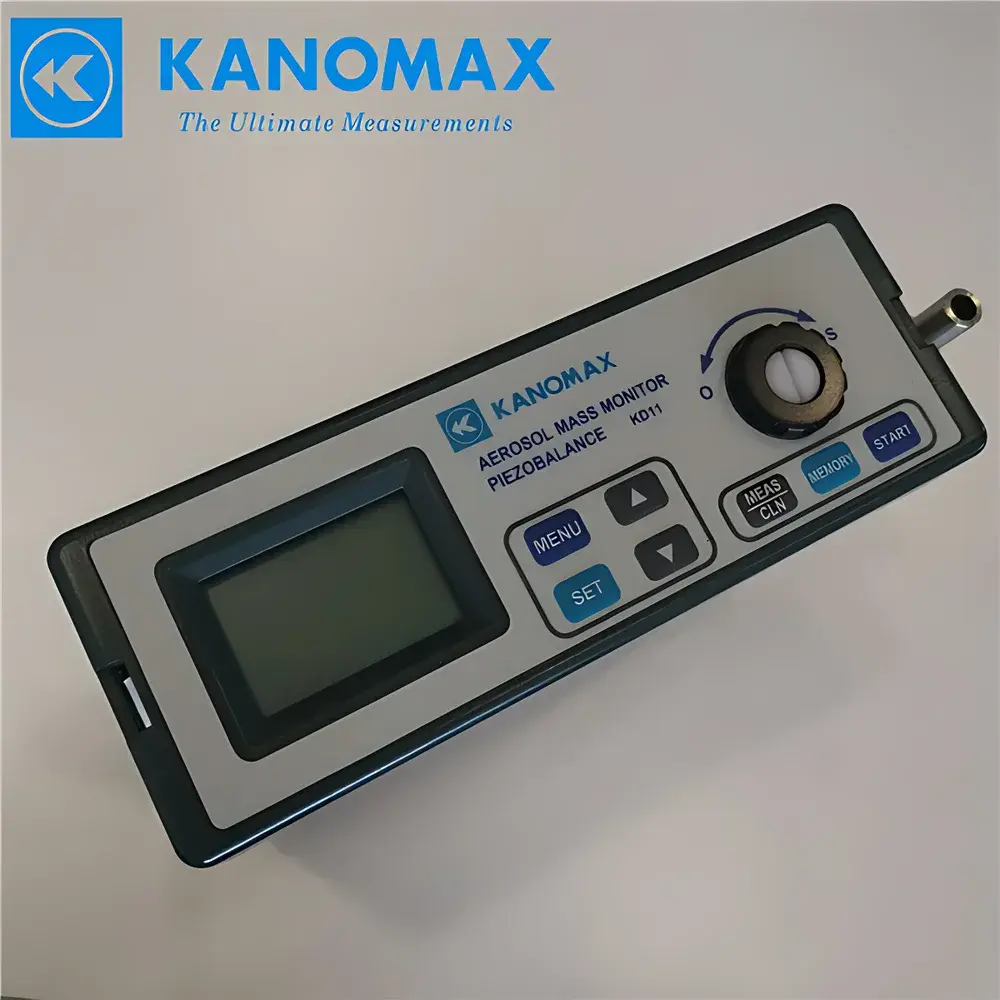
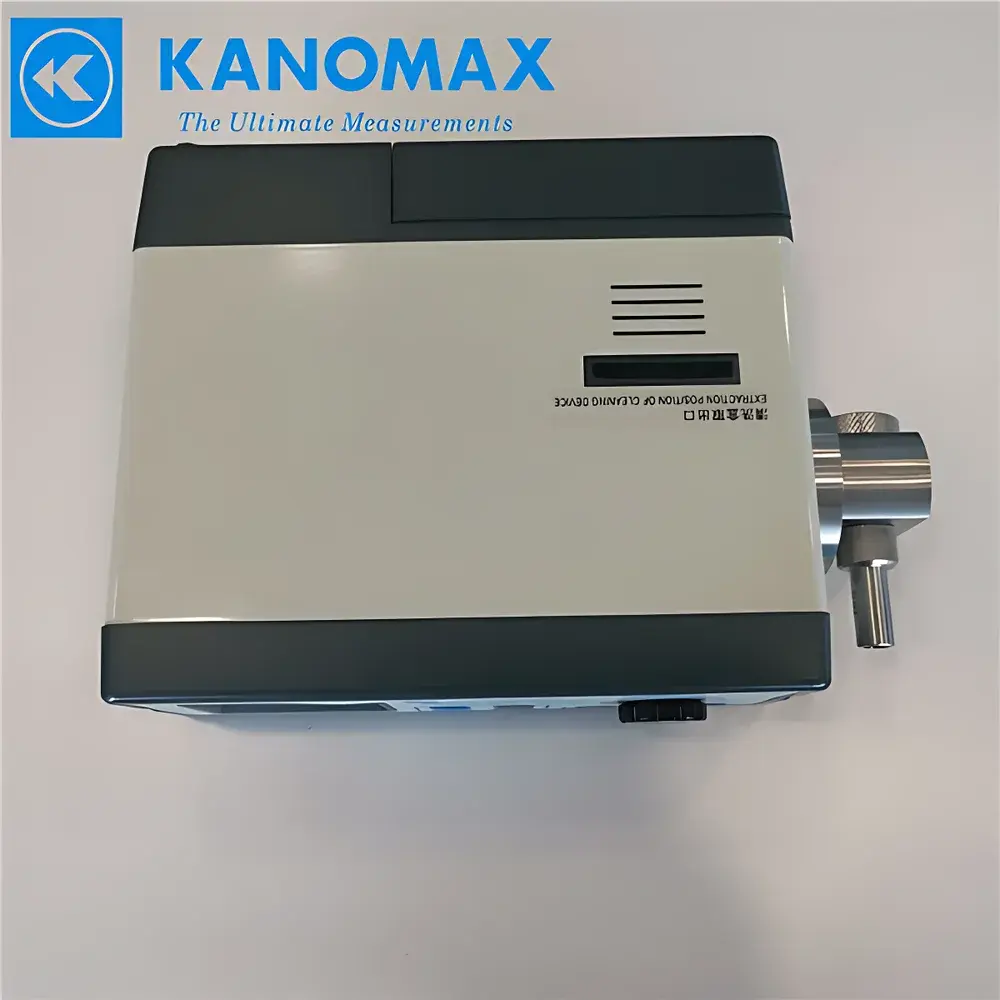
KANOMAX KD11 Piezoelectric Microbalance Dust Monitor
| Brand | KANOMAX |
|---|---|
| Model | KD11+ |
| Measurement Principle | Piezoelectric Microbalance (Quartz Crystal Microbalance, QCM) |
| Particle Size Range | 0.1–10 µm (PM10), 0.1–2.5 µm (PM2.5) |
| Concentration Range | 0.01–10.00 mg/m³ |
| Sampling Flow Rate | 1.0 L/min |
| Data Storage Capacity | 500 measurement records |
| Communication Interface | RS-232C |
| Power Supply | Rechargeable Ni-MH battery / AC adapter (100–240 V AC) |
| Battery Life | ~4.5 h continuous operation |
| Charging Time | 5–8 h |
| Operating Temperature | −20 to +70 °C |
| Operating Humidity | 0–100 % RH |
| Dimensions (W×L×H) | 65 × 182 × 150 mm |
| Weight | ~1.75 kg |
| Resolution | 0.01 m/s (for integrated anemometric function) |
| Velocity Range | Variable per probe (thermal anemometry) |
| Accuracy | ±3 % of reading |
| Sampling Duration | Programmable from 10 to 3600 s (default modes: 24 s and 120 s) |
| Auto-Cleaning Alert | Yes (triggered upon quartz crystal mass loading threshold exceedance) |
Overview
The KANOMAX KD11 Piezoelectric Microbalance Dust Monitor is a portable, real-time particulate mass concentration analyzer engineered for field-deployable environmental and occupational hygiene monitoring. It operates on the fundamental principle of quartz crystal microbalance (QCM) gravimetry: airborne particles are drawn through a calibrated inlet onto a resonant piezoelectric quartz crystal sensor; incremental mass deposition induces a measurable frequency shift proportional to accumulated particle mass. This direct, label-free, real-time gravimetric method provides traceable mass concentration data—expressed in mg/m³—for respirable fractions including PM2.5 and PM10. Unlike optical or beta-attenuation methods, the KD11 delivers inherently stable calibration with minimal drift over time, requiring no reference aerosol standards during routine operation. Its integrated thermal anemometer enables concurrent air velocity measurement (0.01 m/s resolution), supporting volumetric flow correction and localized airflow characterization in ducts, cleanrooms, and industrial workspaces.
Key Features
- Real-time, direct-reading gravimetric measurement of PM2.5 and PM10 mass concentrations (0.01–10.00 mg/m³)
- Piezoelectric quartz crystal sensor with automatic mass-loading threshold detection and cleaning alert functionality
- Programmable sampling duration (10–3600 seconds), with preset 24 s and 120 s modes for rapid screening or time-weighted average (TWA) assessment
- Fixed 1.0 L/min sampling flow rate maintained by internal diaphragm pump with flow monitoring circuitry
- Onboard storage of up to 500 timestamped measurement records, each including concentration, duration, ambient temperature/humidity, and velocity (if enabled)
- RS-232C serial interface compliant with standard terminal emulation protocols, enabling seamless integration with KANOMAX communication software for data export, report generation, and compliance documentation
- Dual power architecture: rechargeable Ni-MH battery pack (4.5 h typical runtime) and universal AC adapter (100–240 V AC)
- Ruggedized ergonomic housing (65 × 182 × 150 mm, 1.75 kg) designed for handheld field use and mounting in fixed-location monitoring stations
Sample Compatibility & Compliance
The KD11 is validated for continuous monitoring of ambient and indoor airborne particulates derived from combustion, resuspension, mechanical abrasion, and process emissions. Its 0.1–10 µm aerodynamic cut-point aligns with ISO 7708:1995 and EN 481:1993 definitions for inhalable and thoracic fractions. While not certified as a reference-grade instrument per ISO 10175-2 or EPA EQOA requirements, the KD11 meets performance criteria suitable for indicative monitoring, exposure screening, and engineering control verification under OSHA 29 CFR 1910.1200 and EU Directive 2004/108/EC (EMC). Its operating envelope (−20 to +70 °C, 0–100 % RH) ensures reliable function across diverse climatic and industrial environments—from cold storage facilities to high-humidity pharmaceutical production suites.
Software & Data Management
KANOMAX-supplied Windows-compatible communication software supports bidirectional data transfer via RS-232C. Users can download full datasets, assign site IDs and operator tags, generate CSV/Excel reports, and print annotated test summaries with metadata (date/time, location ID, sampling parameters). Audit-trail functionality logs all configuration changes and data export events. Though not natively 21 CFR Part 11 compliant, the system supports manual record retention practices aligned with GLP and ISO/IEC 17025 documentation requirements when used within a documented quality management framework.
Applications
- Workplace exposure assessment for silica, coal dust, wood flour, and metal fumes in mining, construction, and manufacturing
- Indoor air quality (IAQ) audits in schools, hospitals, and office buildings
- Verification of local exhaust ventilation (LEV) system performance and filter integrity
- Real-time feedback during dust suppression trials and abatement equipment commissioning
- Field validation of optical particle counters (OPCs) and beta attenuation monitors (BAMs) using gravimetric reference correlation
- Research-grade particulate dynamics studies requiring high temporal resolution and low detection thresholds
FAQ
How does the piezoelectric microbalance principle differ from optical scattering methods?
The KD11 measures actual deposited mass via resonant frequency shift of a quartz crystal, yielding absolute gravimetric concentration (mg/m³). Optical methods infer mass indirectly from light scatter intensity, requiring Mie theory assumptions and frequent calibration against gravimetric standards.
Can the KD11 be used for regulatory compliance reporting?
It serves as a robust screening and trend-monitoring tool but is not designated as a federal equivalent method (FEM) or reference method (RM) per US EPA or EU CEN standards. Confirm acceptance with local regulatory authorities prior to submission.
What maintenance is required between measurements?
The quartz crystal sensor must be cleaned manually when the auto-alert triggers; cleaning involves gentle solvent wipe and re-zeroing. The inlet nozzle and impactor plate require periodic inspection for clogging, especially in high-dust environments.
Is the velocity measurement traceable to NIST standards?
The integrated thermal anemometer is factory-calibrated against NIST-traceable wind tunnel references; calibration certificates are available upon request for metrological verification.
Does the KD11 support external data logging or network connectivity?
No native Ethernet, Wi-Fi, or SD card slot is provided. All data exchange occurs via RS-232C to a host PC; third-party serial-to-IP gateways may enable remote access in controlled IT environments.
Related Products







