
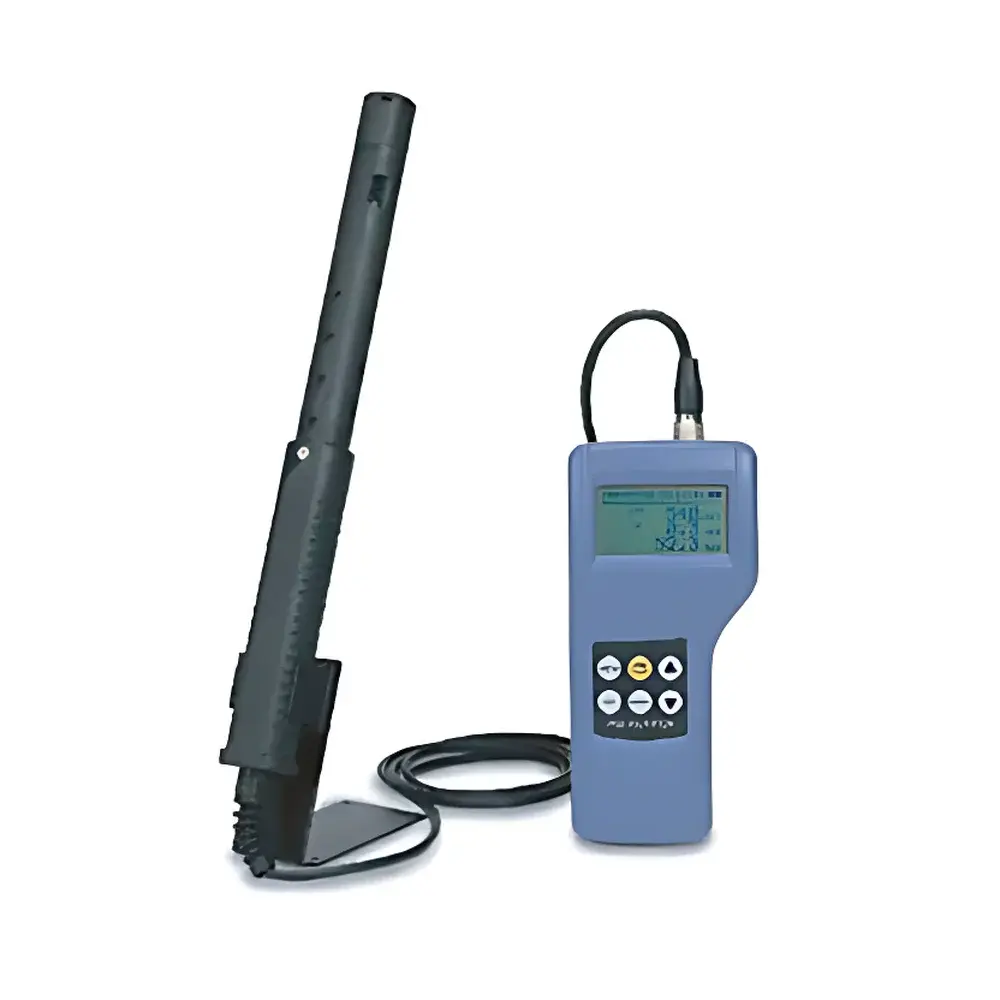
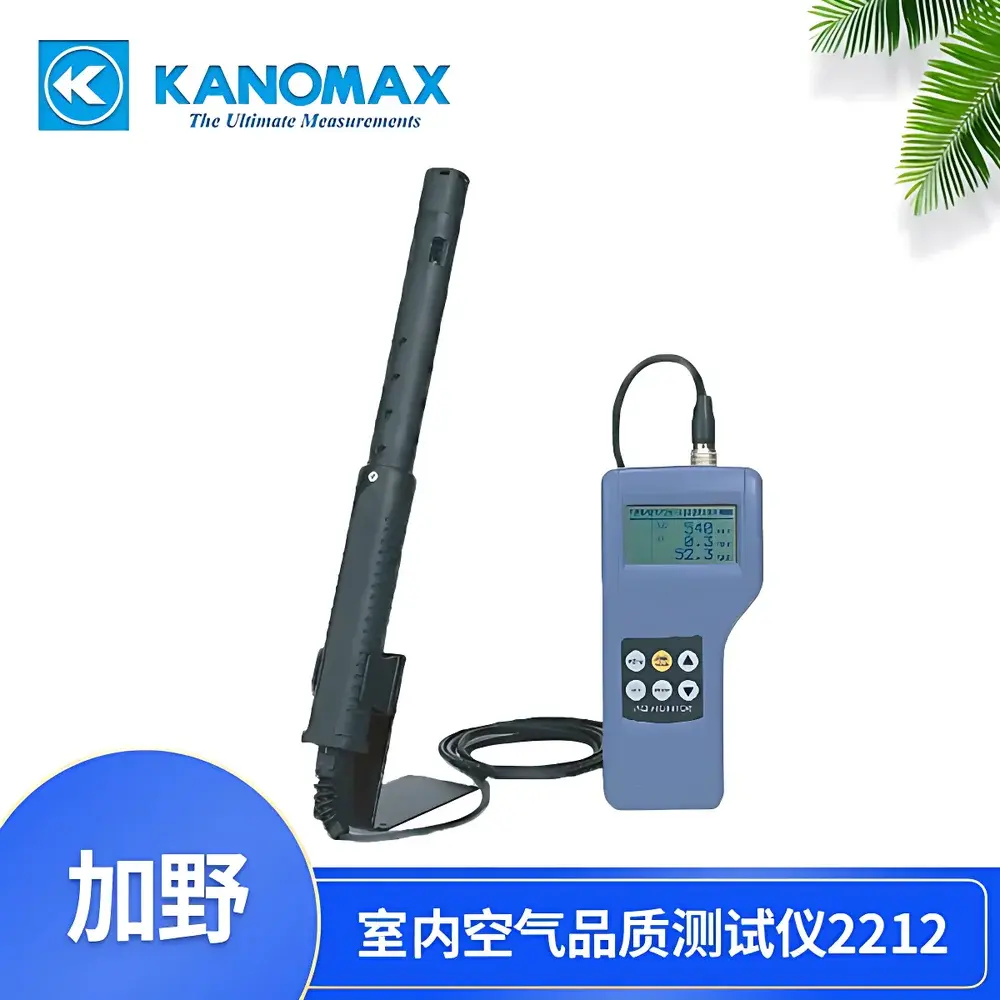
Kanomax Model 2212 Indoor Air Quality (IAQ) Monitor
| Brand | Kanomax |
|---|---|
| Origin | Japan |
| Model | 2212 |
| CO Range | 0–500 ppm |
| CO₂ Range | 0–5000 ppm |
| Temperature Range | −20 to +60 °C |
| Relative Humidity Range | 2–98 %RH |
| CO Accuracy | ±3% of reading or ±3 ppm (whichever is greater) |
| CO₂ Accuracy | ±3% of reading |
| Temp Accuracy | ±0.5 °C |
| RH Accuracy | ±2 %RH (2–80 %RH), ±3 %RH (80–98 %RH) |
| Data Storage | 1500 records |
| Interface | USB |
| Output | 0–1 V analog (optional) |
| Power | 6 × AA batteries or AC adapter (optional) |
| Weight | 400 g |
Overview
The Kanomax Model 2212 Indoor Air Quality (IAQ) Monitor is a portable, multi-parameter environmental measurement instrument engineered for real-time assessment of critical indoor air parameters in commercial buildings, laboratories, healthcare facilities, and HVAC commissioning environments. It employs electrochemical sensing for carbon monoxide (CO), non-dispersive infrared (NDIR) spectroscopy for carbon dioxide (CO₂), precision thermistor-based temperature detection, and capacitive polymer humidity sensing — all integrated into a single handheld platform. The device computes derived psychrometric parameters—including dew point temperature, wet-bulb temperature, absolute humidity (g/m³), and mixing ratio—based on simultaneous measurements of dry-bulb temperature and relative humidity. Its architecture supports field-deployable operation with battery-powered autonomy and compliance-ready data handling, making it suitable for both routine IAQ audits and technical validation tasks aligned with ASHRAE Standard 62.1, ISO 16814, and EN 13779.
Key Features
- Simultaneous real-time measurement of CO (0–500 ppm), CO₂ (0–5000 ppm), ambient temperature (−20 to +60 °C), and relative humidity (2–98 %RH)
- Onboard calculation of psychrometric indices: dew point, wet-bulb temperature, absolute humidity, and humidity ratio
- High-fidelity sensor calibration traceable to NIST-traceable standards; factory-calibrated CO and CO₂ sensors with documented drift compensation algorithms
- Internal data logger capable of storing up to 1500 timestamped measurement sets with automatic time-stamping and user-defined interval logging
- Statistical analysis functions including min/max/mean computation per parameter across stored datasets
- USB interface compliant with USB 2.0 full-speed specification for direct connection to Windows- and macOS-based PCs without proprietary drivers
- Optional analog output (0–1 V) configurable per parameter for integration into building management systems (BMS) or SCADA platforms
- Lightweight ergonomic design (400 g) with backlit LCD display optimized for low-ambient-light conditions
Sample Compatibility & Compliance
The Model 2212 is designed for gaseous sampling in non-corrosive, non-condensing indoor air environments. It is not intended for use in explosive atmospheres (ATEX/IECEx zones), high-particulate settings without optional particulate pre-filters, or ambient conditions exceeding 98 %RH sustained for >30 minutes. Sensor response times meet ANSI/ASHRAE Guideline 114-2022 requirements (<60 s for 90% step response). Device firmware and data export workflows support auditability under GLP and GMP frameworks: logged data includes UTC timestamps, sensor serial identifiers, and calibration status flags. While the instrument itself is not FDA 21 CFR Part 11-certified, its exported CSV and TXT files are compatible with validated LIMS and electronic lab notebook (ELN) systems when deployed within controlled procedural environments.
Software & Data Management
Data retrieval is performed via Kanomax’s proprietary KanView Lite software (Windows-compatible), which enables batch download, graphical trend visualization, statistical summary export (CSV, PDF), and customizable report generation. All stored records include embedded metadata: measurement epoch (ISO 8601 format), sensor ID, unit of measure, and raw ADC counts prior to linearization. The USB interface operates in CDC ACM (Communication Device Class) mode, eliminating need for vendor-specific drivers. No cloud connectivity or remote telemetry is implemented — ensuring data sovereignty and alignment with institutional IT security policies. Firmware updates are delivered as signed binary packages verified via SHA-256 checksums.
Applications
- Occupant health and comfort assessments per WELL Building Standard v2 ventilation and air quality credits
- HVAC system balancing and duct leakage verification using CO₂ differential mapping
- Post-occupancy evaluation (POE) studies supporting LEED IEQ Credit 1 documentation
- Pharmaceutical cleanroom environmental monitoring during non-productive periods (ISO 14644-1 Class 7–8 ambient corridors)
- Educational laboratory instruction in environmental engineering and occupational hygiene curricula
- Baseline IAQ characterization prior to renovation or retrofit projects governed by local building codes (e.g., California Title 24, Part 6)
FAQ
Is the Model 2212 suitable for outdoor ambient air monitoring?
No. It is calibrated and validated exclusively for indoor environments with stable thermal and humidity profiles; outdoor exposure may exceed operational limits and compromise sensor longevity.
Can calibration be performed in-house?
Zero and span calibration for CO and CO₂ requires certified gas standards and a dedicated calibration station; field recalibration is not supported. Annual factory recalibration is recommended per ISO/IEC 17025 guidelines.
Does the device support continuous unattended logging?
Yes — when powered via AC adapter and configured via KanView Lite, it can log at user-defined intervals (1 sec to 24 hrs) for up to 1500 records before requiring download.
What is the expected service life of the electrochemical CO sensor?
Typical functional lifespan is 24–36 months under normal indoor operating conditions; performance degradation is monitored via internal diagnostic routines and reported in the status menu.
Are measurement uncertainties stated in the manual traceable to international standards?
Yes — accuracy specifications conform to ISO 12039 (CO), ISO 8573-4 (CO₂), and ISO 7726 (thermal environment), with uncertainty budgets provided in the technical appendix of the English-language operator manual.







