
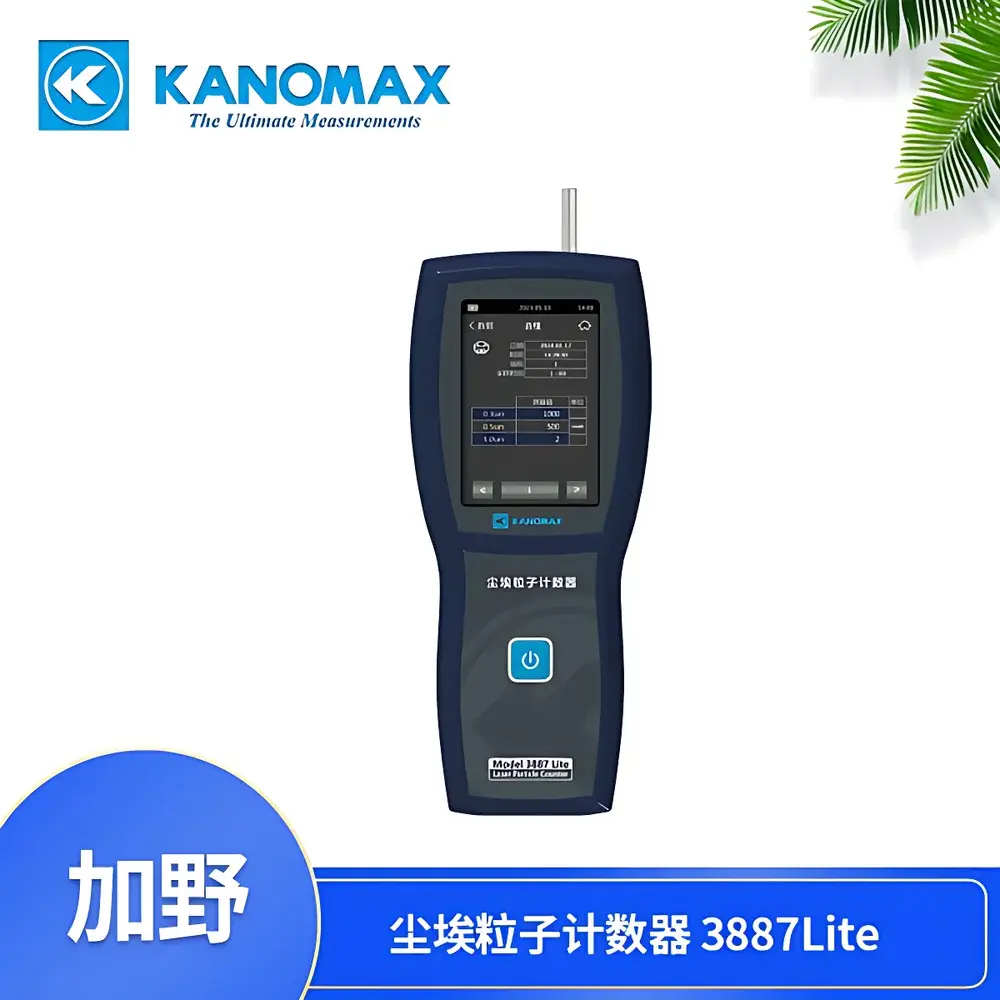
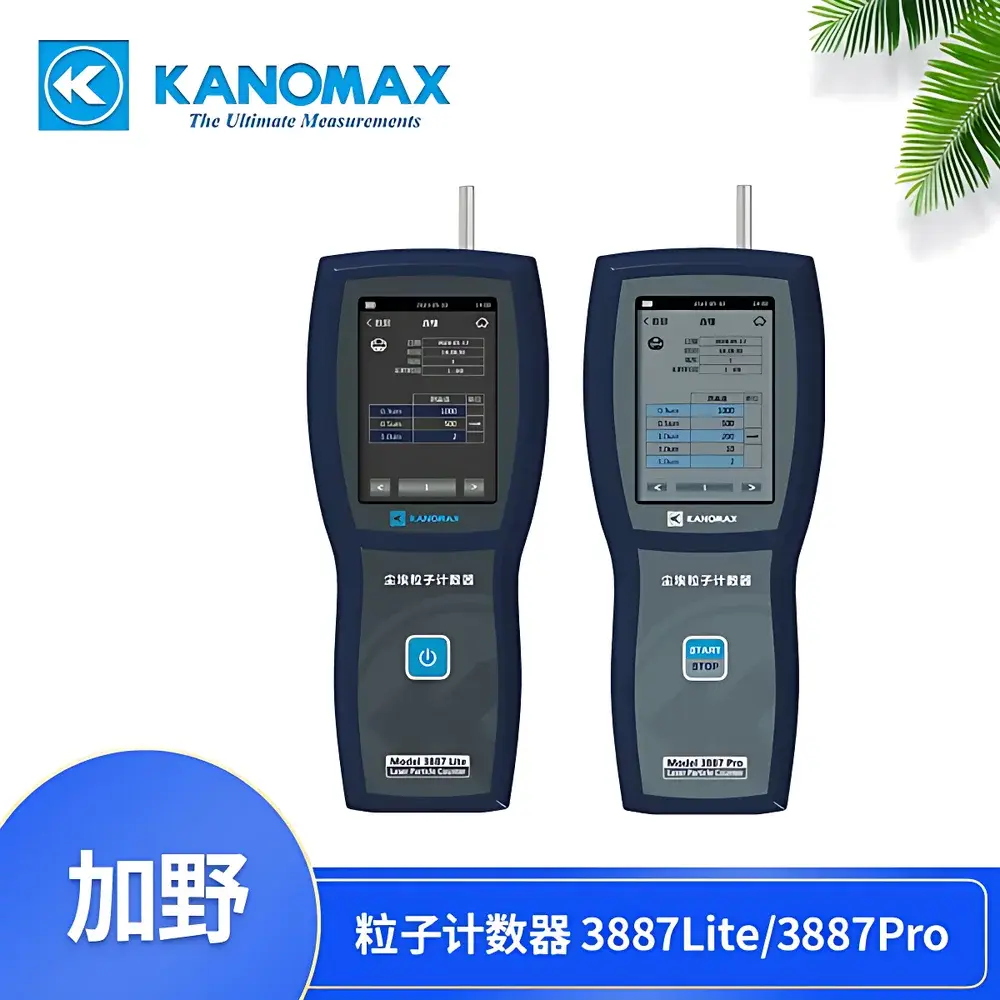
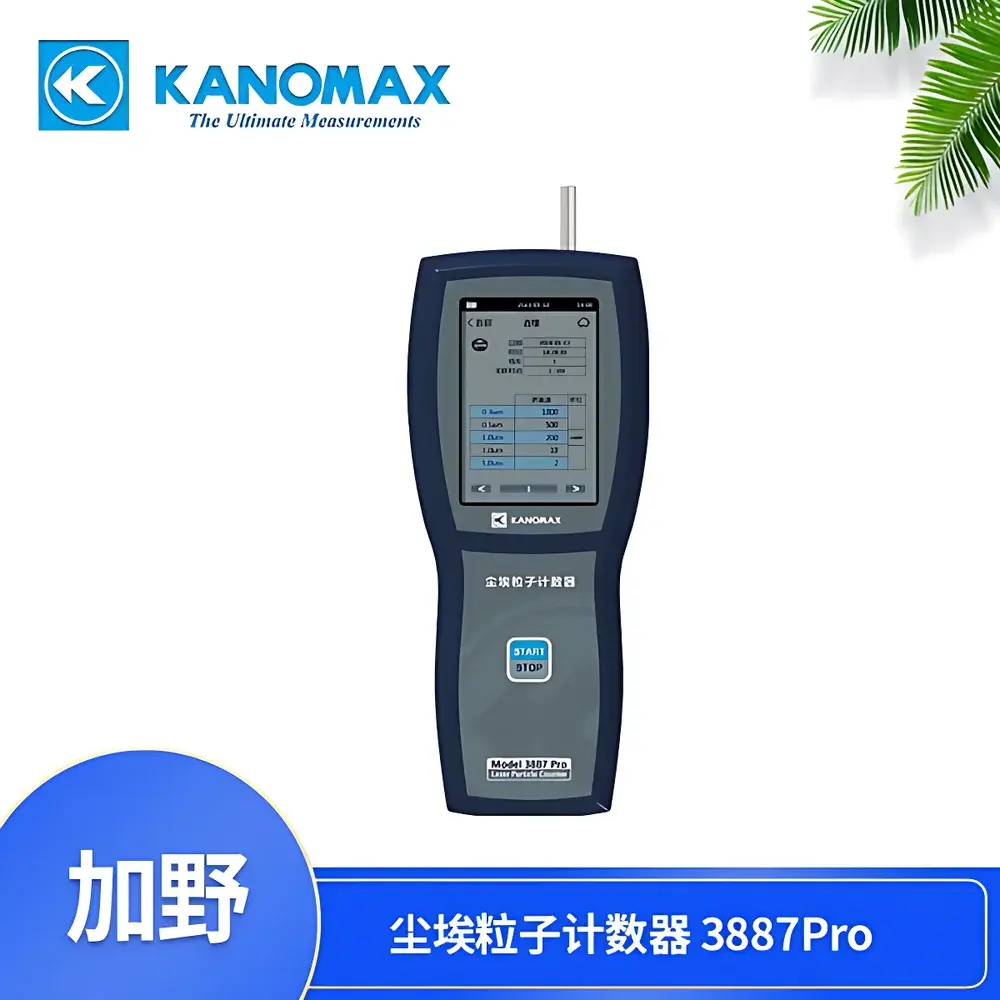
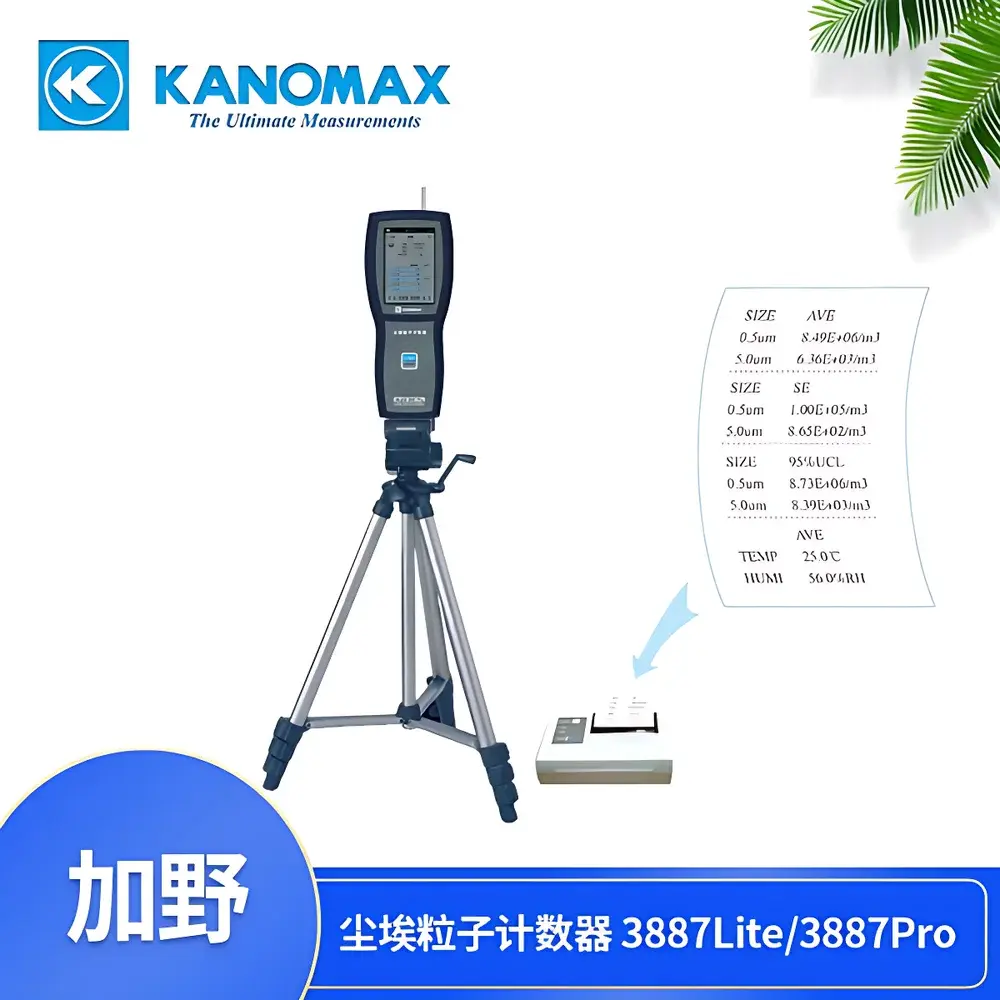
Kanomax Model 3887Lite / 3887Pro Handheld Laser Particle Counter with Intelligent PC Software
| Brand | Kanomax |
|---|---|
| Origin | Japan |
| Instrument Type | Handheld Particle Counter |
| Flow Rate | 2.83 L/min ±5% |
| Detectable Particle Sizes | 0.3, 0.5, 1.0, 3.0, 5.0 µm (3887Pro) |
| Display | 3.5-inch resistive touchscreen |
| Light Source | Laser diode |
| Counting Efficiency | Compliant with ISO 21501-4 and JIS B9921 |
| Maximum Detectable Concentration | 2,000,000 particles/ft³ |
| Coincidence Loss | <5% at 2,000,000 particles/ft³ |
| Count Range | 1–70,000,000 counts |
| Sampling Modes | Single, Repeat, Continuous, Calculate, Remote, GB/T 16292, ISO 14644-1 |
| Data Storage Capacity | 7,000 sample records |
| Power | Rechargeable Li-ion battery (≈5 h operation) + USB-C AC adapter |
| Dimensions | 87 × 200 × 55 mm |
| Weight | ≈600 g |
| Operating Environment | 10–40 °C, 0–85% RH (non-condensing) |
Overview
The Kanomax Model 3887Lite and 3887Pro are portable, laser-based optical particle counters engineered for high-precision airborne particulate monitoring in cleanroom validation, environmental qualification, and process control applications. Both models operate on the principle of light scattering: a collimated laser beam illuminates aerosol particles drawn through the sensing volume at a controlled flow rate of 2.83 L/min; scattered photons are detected by a photodiode array and classified into user-selectable size channels based on calibrated pulse height analysis. The 3887Pro extends capability to five discrete size bins (0.3, 0.5, 1.0, 3.0, and 5.0 µm), while the 3887Lite supports three (0.3, 0.5, and 5.0 µm), enabling targeted compliance verification per application requirements. Designed and manufactured in Japan, these instruments meet the metrological rigor defined in ISO 21501-4 and JIS B9921 for counting efficiency, size resolution, and false count performance—critical for audits under ISO 14644-1, GB/T 16292-2010, and China’s revised GMP Annex 1.
Key Features
- Laser diode light source with stable output and long service life, ensuring consistent sizing accuracy over extended operational cycles
- 3.5-inch resistive touchscreen interface with intuitive icon-driven navigation—designed for gloved operation in cleanroom environments
- Real-time flow monitoring with automatic compensation and audible/visual alerts for deviations exceeding ±5% tolerance
- Seven programmable sampling modes: Single, Repeat, Continuous, Calculate (statistical evaluation), Remote (via RS485 or USB), GB/T 16292, and ISO 14644-1—each enforcing standardized dwell time, sampling duration, and data aggregation logic
- Auto-resume functionality: In case of unexpected power loss during GB or ISO mode testing, the instrument restores prior sampling state—including remaining count intervals and cumulative statistics—without data corruption
- Onboard statistical engine computes min/max/mean values across stored datasets; all calculations conform to ISO 14644-1 Annex B protocols for cleanroom classification
Sample Compatibility & Compliance
The 3887Lite/3887Pro is validated for use with ambient air, HEPA-filtered supply air, and laminar flow cabinet effluents. Its inlet design minimizes aspiration bias and particle bounce, supporting representative sampling per ISO 21501-4 sampling geometry requirements. All firmware and reporting outputs are traceable to national standards referenced in calibration certificates issued by Kanomax Japan. The device satisfies data integrity expectations under GLP and GMP frameworks: audit trails for parameter changes, timestamped event logs, and immutable storage of raw channel counts are retained locally. Optional RS485 integration enables connection to SCADA or BMS systems for centralized environmental monitoring—fully compatible with FDA 21 CFR Part 11-compliant software architectures when paired with validated Kanomax PC software.
Software & Data Management
The included Kanomax PC software (Windows-compatible) provides full post-acquisition analysis, visualization, and report generation. It imports native .csv and proprietary binary files, enabling dynamic overlay of multiple test locations, temporal trend charts, and pass/fail overlays against ISO 14644-1 class limits. Reports export in PDF format with embedded metadata—including instrument ID, operator name, location tag, environmental conditions, and calibration due date—supporting regulatory submissions. USB and RS485 communication ports allow bidirectional control: remote start/stop, real-time data streaming, and firmware updates. Data encryption and user-level access controls (admin/operator roles) are enforced within the software to align with ICH E6(R3) and EU Annex 11 principles.
Applications
These instruments serve critical roles in semiconductor fab line certification, pharmaceutical aseptic processing zones, hospital isolation room verification, HVAC filter integrity testing, and optical assembly cleanrooms. Their portability and rapid deployment make them ideal for routine monitoring, commissioning studies, and periodic requalification per ISO 14644-2. In R&D labs, the dual-channel flexibility (Lite vs. Pro) allows cost-optimized deployment where only sub-micron or coarse particulate tracking is required—for example, monitoring tool exhausts (0.3/0.5 µm) versus packaging area settle plates (5.0 µm). Aerospace component manufacturers utilize the 3887Pro’s 3.0 µm channel to verify particulate shedding from composite layup tools—a known contributor to surface defect formation.
FAQ
What standards does the 3887Pro comply with for calibration and performance verification?
It adheres to ISO 21501-4 for optical particle counter performance, ISO 14644-1 for cleanroom classification reporting, and GB/T 16292-2010 for pharmaceutical facility monitoring.
Can the instrument store and export data without connecting to a PC?
Yes—7,000 complete sample records (including timestamps, channel counts, and environmental flags) are retained internally and can be exported via USB mass storage mode.
Is battery life sufficient for full-shift cleanroom audits?
With typical intermittent sampling (e.g., 1-min cycles over 4 hours), the rechargeable Li-ion battery delivers >5 hours of continuous operation; AC adapter support ensures uninterrupted use during extended validation protocols.
How is flow accuracy maintained over time and temperature variation?
An integrated thermal mass flow sensor continuously monitors and compensates for viscosity and density shifts; factory calibration includes temperature cycling from 10–40 °C to ensure stability across rated operating conditions.
Does the PC software support electronic signatures and audit trail generation?
When deployed in validated environments, the software supports role-based login, electronic signature capture for report approval, and tamper-evident audit logs meeting 21 CFR Part 11 Subpart B requirements.
Related Products







