
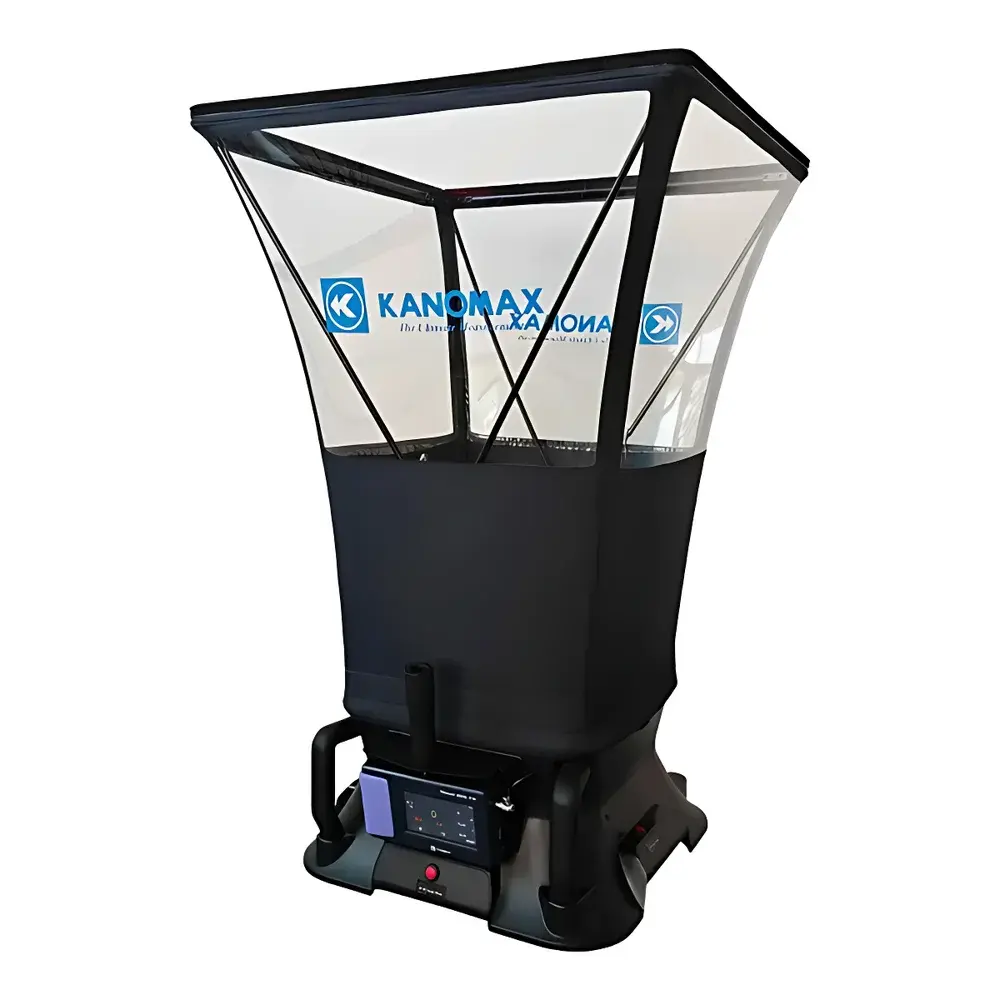
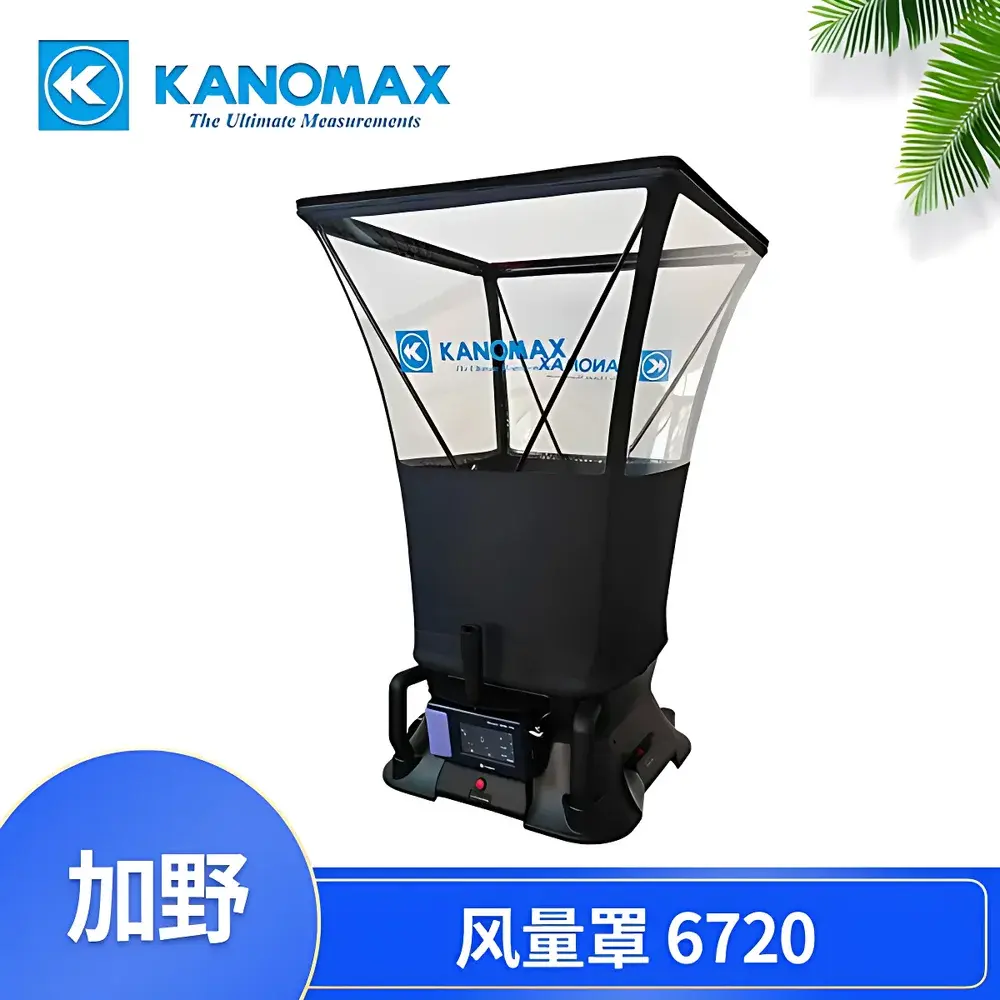
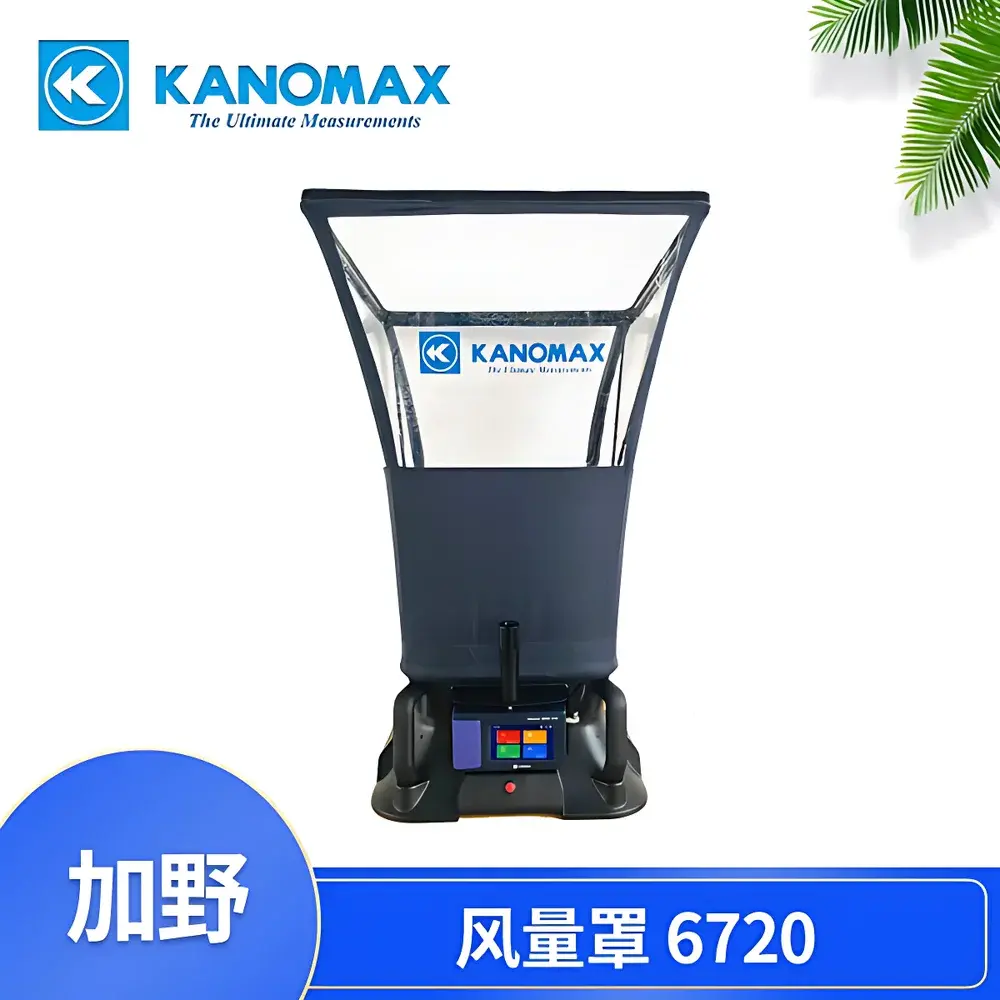
Kanomax Model 6720 Air Flow Hood
| Brand | Kanomax |
|---|---|
| Origin | Japan |
| Model | 6720 |
| Air Flow Range | 40–4300 m³/h |
| Accuracy | ±3% of reading ±8 m³/h |
| Air Velocity Range (with Pitot tube) | 0.15–40 m/s |
| Air Velocity Range (with Matrix Sensor) | 0.15–15 m/s |
| Velocity Accuracy | ±3% of reading ±0.05 m/s |
| Differential Pressure Range | −2500 to +2500 Pa |
| DP Accuracy | ±1.5% of reading ±0.25 Pa |
| Temperature Range | 0–60 °C |
| Temp Accuracy | ±0.5 °C |
| Humidity Range | 0–100 %RH |
| RH Accuracy | ±3 %RH (10–90 %RH) |
| Operating Environment | 0–60 °C, 0–100 %RH |
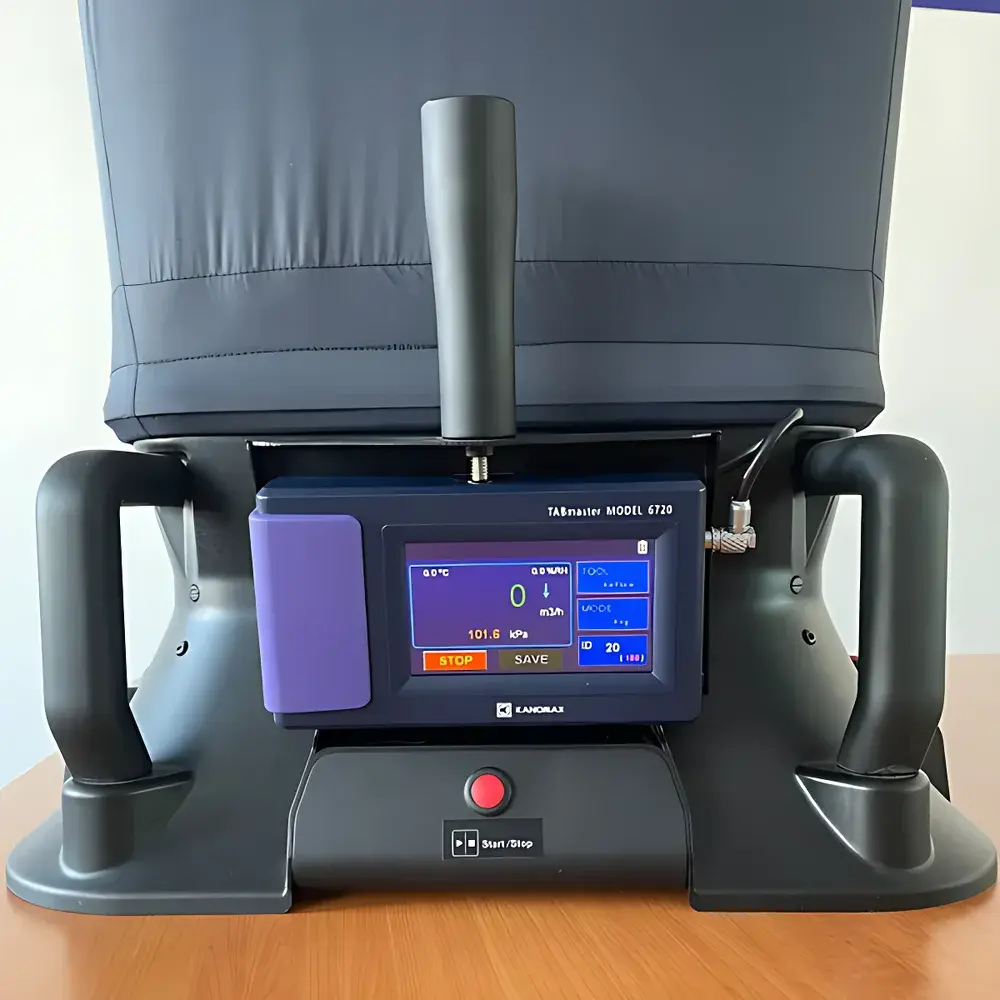
| Display | 4.3-inch full-color touchscreen LCD |
| Data Storage | 8,000 measurements (instrument), 10,000 (mobile app) |
| Power | 4 × AA batteries (≈9 h), DC 5 V adapter |
| Weight | 3.6 kg |
| Standard Hood Size | 610 × 610 mm |
| Optional Hood Sizes | 610×1220 mm, 305×1220 mm, 500×500 mm, 915×915 mm, 915×610 mm, 800×1400 mm |
| Key Functions | Backpressure compensation, inlet/exhaust mode detection, atmospheric pressure & temperature correction, 16-point differential pressure sampling, Bluetooth 5.0, USB data export, real-time thermal printing |
Overview
The Kanomax Model 6720 Air Flow Hood is an engineered field instrument designed for high-fidelity volumetric air flow measurement in HVAC commissioning, cleanroom certification, and laboratory ventilation system validation. It operates on the principle of integrated velocity-area integration: a calibrated matrix sensor array (or optional Pitot tube) measures localized air velocities across a defined cross-section, while simultaneous differential pressure, temperature, and relative humidity readings enable real-time environmental correction—ensuring traceable accuracy under variable ambient conditions. Unlike single-point anemometers, the 6720 applies ISO 17025-aligned methodology by capturing spatially distributed velocity profiles (16 discrete pressure taps), applying backpressure compensation algorithms, and correcting for local barometric pressure and air density deviations. Its modular architecture supports rapid reconfiguration between inlet and exhaust modes—critical for bidirectional airflow verification in fume hoods, biosafety cabinets (BSCs), and AHU terminal units per NSF/ANSI 49, ISO 14644-3, and ASHRAE Guideline 12 protocols.
Key Features
- Simultaneous multi-parameter acquisition: air volume (m³/h), face velocity (m/s), differential pressure (Pa), ambient temperature (°C), and relative humidity (%RH) — all displayed in real time on a 4.3-inch capacitive touchscreen.
- Backpressure compensation algorithm actively corrects for static pressure losses induced by hood resistance, enabling stable readings across duct configurations with varying resistance characteristics.
- Atmospheric pressure and temperature correction applied automatically during calculation—essential for compliance with ISO 5801 and EN 12599 where air density variations affect volumetric accuracy.
- Modular sensor interface: interchangeable matrix sensor (for low-velocity uniform flows) and Pitot tube (for high-velocity turbulent or ducted applications) — both supported via same instrument firmware.
- Bluetooth 5.0 connectivity enables secure pairing with iOS/Android devices running the official Kanomax AirFlow Connect app for remote configuration, live data streaming, and synchronized timestamped logging.
- Optical transparency window allows visual confirmation of hood-to-grille alignment—minimizing misalignment-induced errors common in manual hood placement per ASTM D6413 Annex A3.
- Expandable hood system: six optional physical hood sizes (including 610×1220 mm and 800×1400 mm) accommodate non-standard diffusers, VAV boxes, and large exhaust canopies without recalibration.
Sample Compatibility & Compliance
The Model 6720 is validated for use with rectangular, square, and irregularly shaped supply/exhaust openings up to 1.4 m × 0.8 m. Its matrix sensor design ensures laminar-flow compatibility across ISO Class 5–8 cleanrooms, while Pitot tube mode extends utility to high-velocity HVAC ducts (up to 40 m/s). Instrument calibration adheres to NIST-traceable standards, with factory documentation supporting GLP-compliant audit trails. Firmware implements data integrity safeguards including immutable timestamps, user-accessible audit logs, and encrypted USB export—meeting foundational requirements for FDA 21 CFR Part 11 adherence when paired with validated software workflows. The device satisfies performance criteria outlined in ISO 16813 (HVAC testing), EN 15239 (energy performance verification), and IEST-RP-CC006.2 (cleanroom airflow characterization).
Software & Data Management
The bundled AirFlow Connect mobile application provides full instrument control—including K-factor adjustment, unit switching (CFM/m³/h), statistical analysis (min/max/avg/cumulative), and configurable auto-save triggers. All measurements are stored locally (8,000 records) and mirrored to the app (10,000 records), with CSV/Excel export supporting LIMS integration. Bluetooth-enabled thermal printers generate compliant field reports with embedded metadata: operator ID, location tag, date/time stamp, environmental conditions, and measurement uncertainty values. USB-C data transfer enables direct ingestion into Excel, MATLAB, or LabVIEW environments for QA/QC trending and deviation analysis. Firmware updates are delivered via signed OTA packages, preserving cryptographic integrity.
Applications
- HVAC system balancing and TAB (Testing, Adjusting, and Balancing) per ASHRAE Guideline 1 and NEBB Procedural Standards.
- Cleanroom airflow uniformity and total air change rate validation per ISO 14644-3 and EU GMP Annex 1.
- Biosafety cabinet inflow and downflow velocity mapping per NSF/ANSI 49 and EN 12469.
- Fume hood face velocity surveys and containment verification per ANSI Z9.5 and UK HSE Guidance Note EH40.
- Exhaust stack and kitchen hood volumetric verification under variable backpressure conditions.
- Energy audit pre- and post-retrofit airflow quantification aligned with IPMVP Option B protocols.
FAQ
Does the Model 6720 require annual recalibration?
Yes. Kanomax recommends annual NIST-traceable recalibration performed by an ISO/IEC 17025-accredited laboratory, particularly when used in regulated environments (e.g., pharmaceutical cleanrooms or clinical labs). Calibration certificates include uncertainty budgets per ISO/IEC 17025:2017 Clause 7.6.
Can the instrument measure negative pressure differentials accurately?
Yes. The differential pressure sensor is bidirectional (−2500 to +2500 Pa) with linearity verified across full range; accuracy specification (±1.5% of reading ±0.25 Pa) applies equally to suction and positive pressure modes.
Is the Bluetooth connection secure for regulated environments?
Bluetooth communication uses AES-128 encryption for parameter transmission and employs device-pairing authentication. No measurement data is stored on the mobile device unless explicitly exported—supporting data governance policies under HIPAA and GDPR.
How does backpressure compensation improve measurement fidelity?
It dynamically adjusts volumetric calculations based on real-time static pressure drop across the hood fabric and frame—mitigating systematic bias caused by flow resistance that would otherwise cause under-reporting in high-resistance grilles or perforated plates.
Are optional hood sizes supplied with individual calibration coefficients?
No. All optional hoods are geometrically referenced to the base 610×610 mm calibration; the instrument applies area-scaling factors internally using certified dimensional tolerances (±0.5 mm) and validated flow coefficient matrices per hood geometry.
Related Products







