
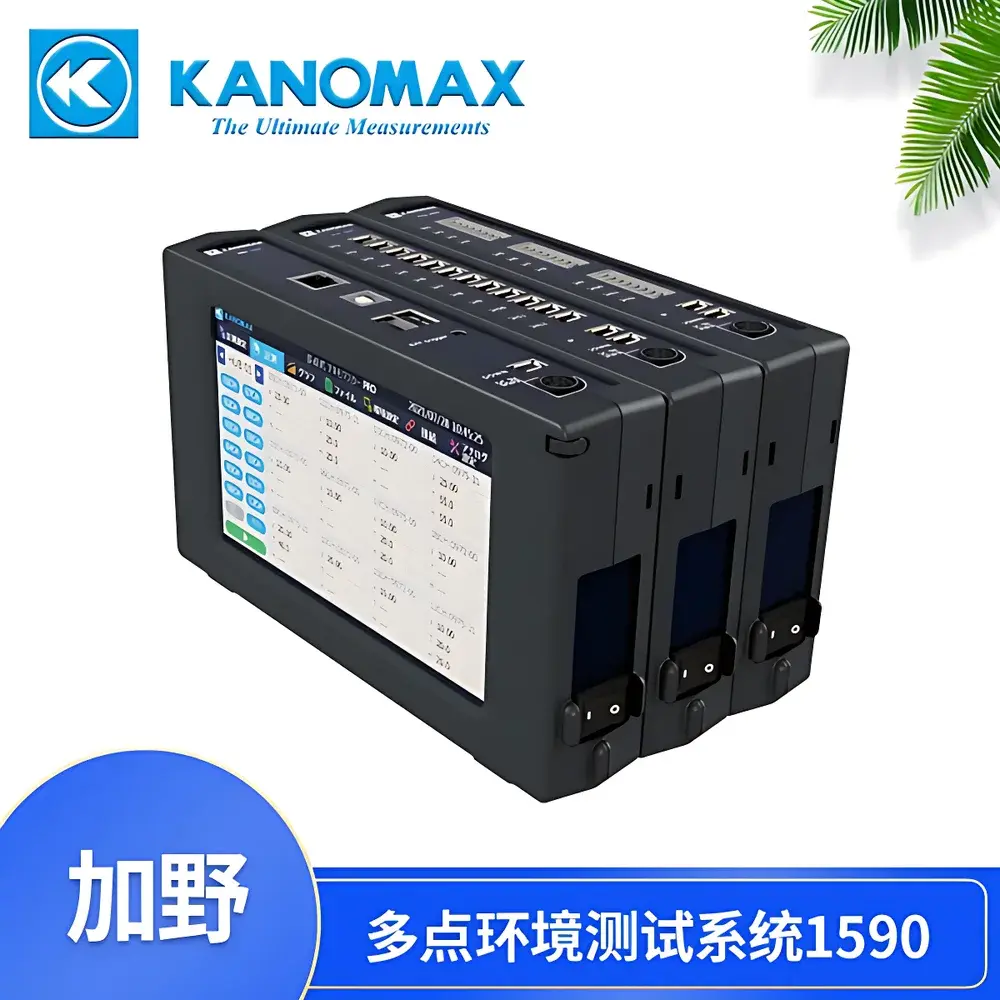
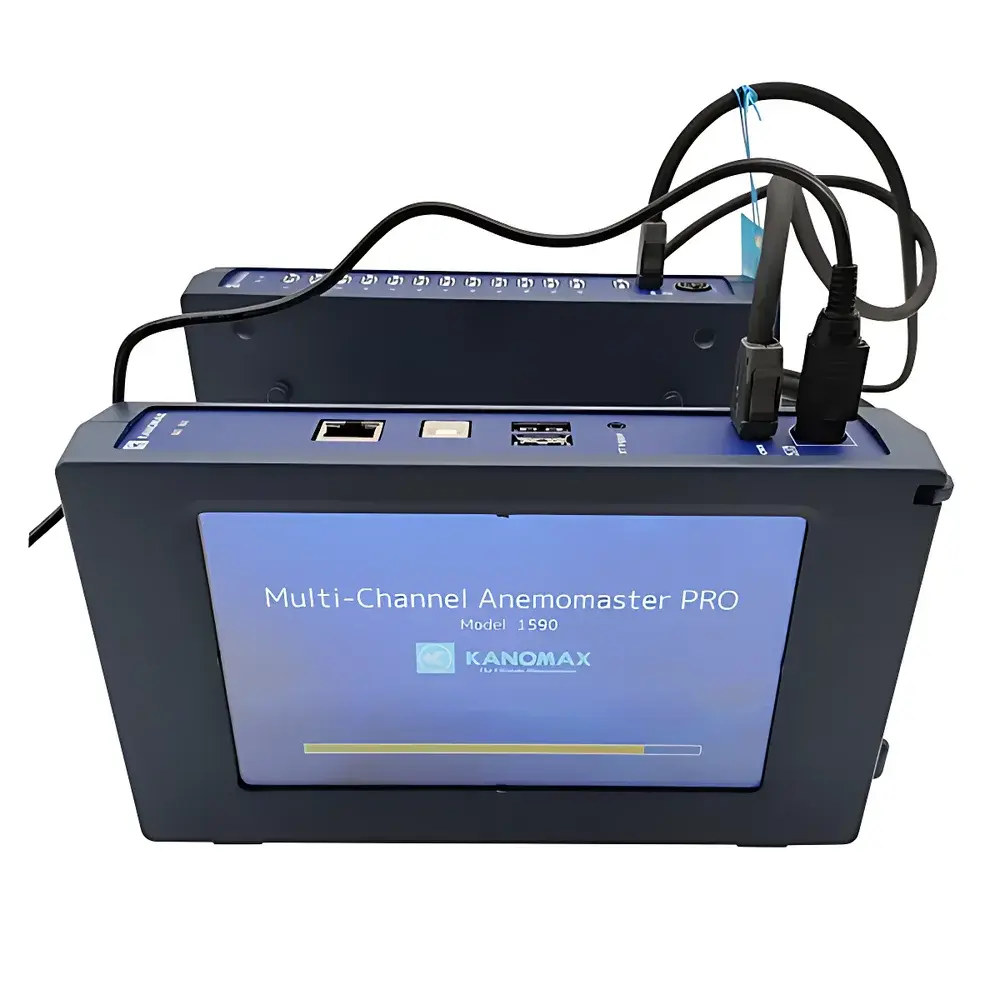
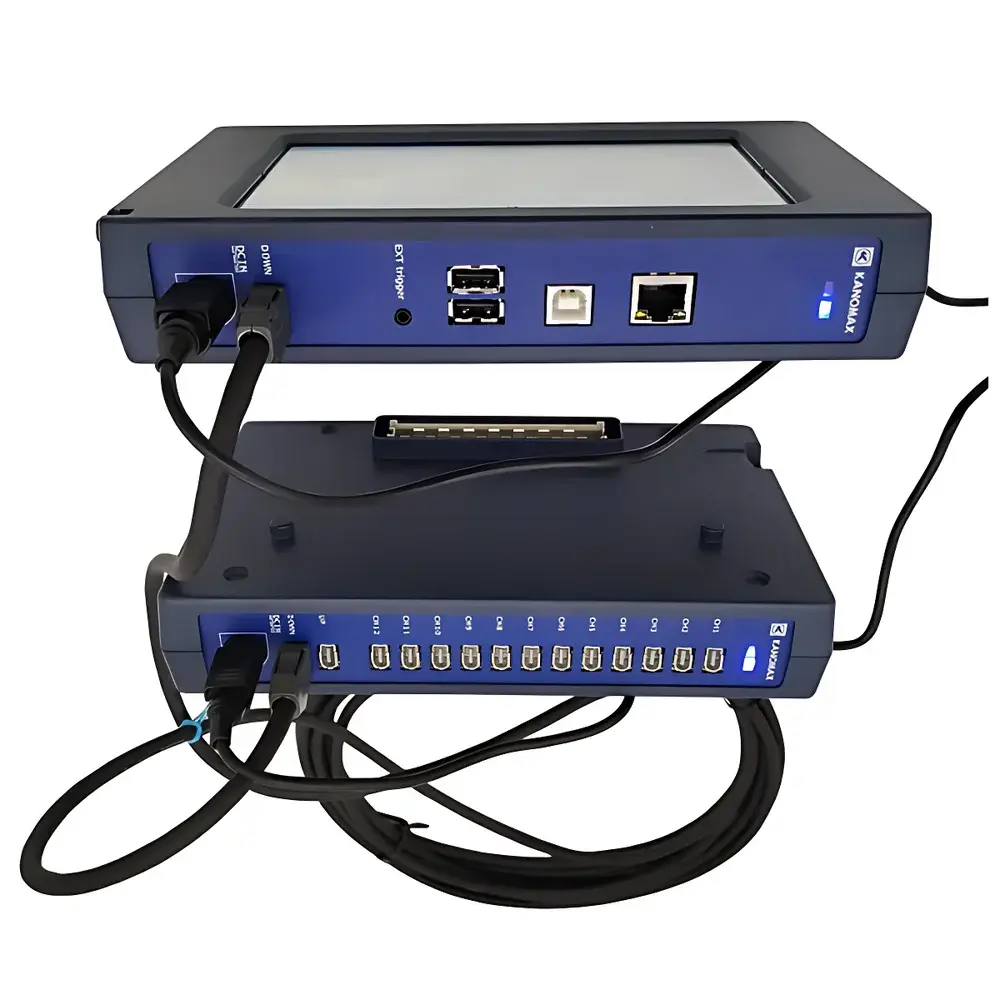
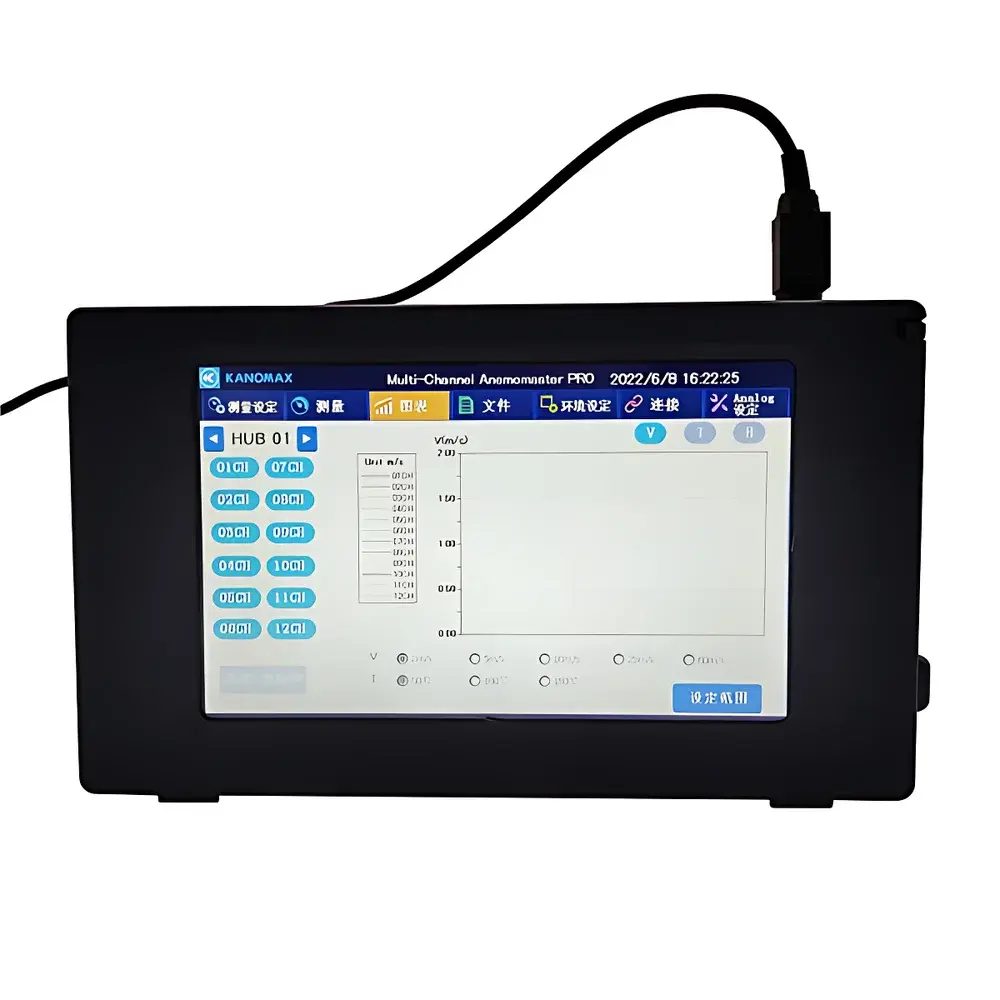
Kanomax Multi-Point Environmental Monitoring System Model 1590-0C
| Brand | Kanomax |
|---|---|
| Origin | Japan |
| Manufacturer Type | Authorized Distributor |
| Product Category | Imported Instrument |
| Model | 1590-0C |
| Instrument Type | Thermal Anemometer |
| Resolution | 0.01 m/s |
| Measurement Range | Probe-Dependent (0.01–50.0 m/s) |
| Accuracy | ±2% or ±0.02 m/s (whichever greater), ±3% for select probes |
| Operating Temperature | 0–60 °C |
| Operating Humidity | 0–90 %RH (non-condensing) |
| Display | 7-inch color TFT touchscreen |
| Data Storage | 8 GB internal memory (24,500 measurements per module) |
| Communication | USB 2.0, LAN (RJ45), serial interface |
| Power Supply | AC 100–240 V / DC 12–24 V |
| Dimensions (H×W×D) | 40 × 220 × 130 mm |
| Weight | 0.6 kg |
| Compliance | CE, RoHS, ISO/IEC 17025-compatible operation |
Overview
The Kanomax Multi-Point Environmental Monitoring System Model 1590-0C is a modular, high-fidelity platform engineered for simultaneous, synchronized measurement of air velocity, temperature, and relative humidity across up to 144 spatially distributed points. Built upon thermal anemometry principles—where convective heat transfer from a heated sensor element correlates directly with local airflow velocity—the system delivers traceable, repeatable data in laminar and turbulent flow regimes typical of cleanrooms, laboratories, HVAC validation zones, and controlled pharmaceutical environments. Its architecture supports scalable deployment: a single Model 1590-0C main unit interfaces with up to 12 Model 1591-0C measurement modules (12 channels each), enabling full 144-channel acquisition without external PC dependency. The system operates autonomously via its integrated 7-inch capacitive touchscreen interface, supporting real-time waveform visualization, statistical summaries (min/max/mean), and on-device data export in CSV format—critical for audit-ready documentation under GLP and GMP frameworks.
Key Features
- Modular scalability: Expand from 1 to 144 measurement channels via standardized hot-pluggable interfaces between Model 1590-0C (controller), Model 1591-0C (12-channel measurement module), and Model 1592-0C (12-channel analog output module).
- Probe interoperability: 15 thermally compensated probe variants—including directional and omnidirectional anemometers, high-temperature (up to 120 °C), ultra-miniature (Ø3.5 mm), and combined vane/thermistor/hygrometer configurations—share common electrical and mechanical interfaces.
- High-resolution low-velocity detection: Minimum detectable air velocity of 0.01 m/s, validated per ISO 14644-3 Annex B protocols for unidirectional airflow characterization in ISO Class 5–8 cleanrooms.
- Onboard intelligence: Embedded firmware enables per-probe calibration coefficient storage, user-defined averaging intervals (1–600 sec), and automatic drift compensation based on ambient temperature feedback.
- Dual power flexibility: Operates from universal AC input (100–240 V) or regulated DC (12–24 V), supporting mobile applications including vehicle-mounted environmental surveys and temporary facility qualification.
- Analog output configurability: Each Model 1592-0C module supports independent channel assignment to 0–5 V (1 kΩ load) or 4–20 mA (250 Ω) outputs, compliant with PLC, DCS, and SCADA integration requirements per IEC 61000-4 EMC standards.
Sample Compatibility & Compliance
The Model 1590-0C accommodates diverse sampling geometries through its interchangeable probe portfolio. Directional probes (e.g., Model 0972-00) are optimized for duct traverses and laminar flow hoods; non-directional variants (e.g., Model 0975-00) suit turbulent mixing zones and open-space mapping. All probes feature NIST-traceable calibration certificates (available optionally), with temperature compensation algorithms validated across 0–120 °C operating ranges. The system meets essential regulatory expectations for environmental monitoring in life sciences facilities: it supports 21 CFR Part 11-compliant electronic records when used with the included Windows-based software (v3.x), including audit trails, user access controls, and electronic signatures. Hardware design conforms to IEC 61326-1 (EMC) and IEC 61010-1 (safety), while measurement uncertainty budgets align with ISO/IEC 17025 clause 7.6 for accredited laboratories performing HVAC performance verification.
Software & Data Management
Kanomax’s proprietary WinLog Pro software (Windows 10 compatible, multilingual UI: English/Japanese/Chinese) provides full system configuration, real-time multi-channel visualization, and post-processing analytics. Data streams from all active channels are time-synchronized with microsecond precision using internal hardware timestamps. Users define custom display templates—overlaying velocity vectors on floor plans, generating contour maps via interpolation, or exporting time-series datasets directly to Excel (.xlsx) or comma-separated values (.csv) for statistical process control (SPC) analysis. The software enforces ALCOA+ data integrity principles: attributable, legible, contemporaneous, original, accurate, complete, consistent, enduring, and available. Audit trail logs record all parameter changes, calibration events, and user logins—exportable as PDF or XML for regulatory submissions. Optional API integration (TCP/IP socket protocol) enables automated data ingestion into LIMS or MES platforms.
Applications
- Cleanroom qualification and routine monitoring per ISO 14644-1/2, EU GMP Annex 1, and FDA Aseptic Processing Guidance.
- HVAC system commissioning, balancing, and requalification—including air change rate (ACH) calculations and uniformity assessments.
- Pharmaceutical isolator and RABS performance mapping under dynamic operational conditions.
- University research labs conducting fluid dynamics studies, ventilation efficiency modeling, or thermal comfort investigations (ASHRAE 55).
- Electronics manufacturing clean zones requiring particle-free airflow stability verification.
- Mobile environmental audits across multi-site GMP facilities using battery-powered DC operation.
FAQ
What is the maximum number of simultaneous measurement points supported?
A fully expanded system comprises one Model 1590-0C controller, twelve Model 1591-0C modules (12 channels each), and supports up to 144 independent sensor inputs.
Can the system operate without a connected computer?
Yes—the integrated 7-inch touchscreen enables full configuration, real-time monitoring, data review, and CSV export without external computing resources.
Are calibration certificates provided with probes?
Each probe ships with a factory calibration report; NIST-traceable certificates with uncertainty budgets are available upon request for regulated applications.
Does the system support alarm thresholds and event-triggered logging?
Yes—user-defined upper/lower limits per channel generate visual alerts and initiate time-stamped data capture at configurable pre/post-trigger durations.
How is data integrity ensured during long-term unattended operation?
Internal 8 GB flash memory buffers all measurements continuously; power-loss recovery preserves timestamp continuity and prevents data gaps.







