
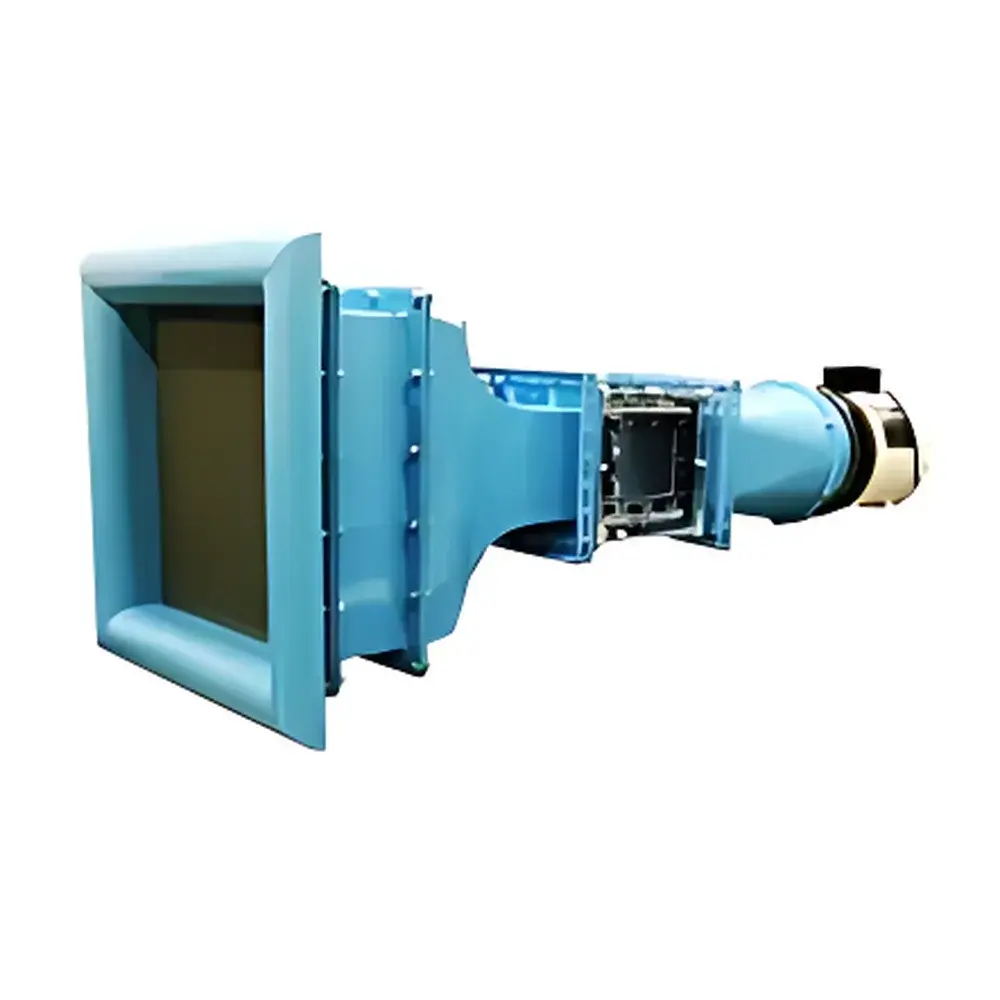
Kanomax S980338 Compact Eiffel-Type Visualization Wind Tunnel
| Brand | Kanomax |
|---|---|
| Origin | Japan |
| Model | S980338 |
| Maximum Airflow Velocity | 10 m/s |
| Tunnel Cross-Section | Standard Eiffel Profile (Typical 150 mm × 150 mm test section) |
| Flow Quality | Laminar, Turbulence Intensity < 0.5% (at centerline, nominal speed) |
| Construction | Precision-machined aluminum alloy frame with optical-grade acrylic viewing windows |
| Power Supply | 100–240 VAC, 50/60 Hz |
| Noise Level | ≤ 58 dB(A) at 1 m |
| Dimensions (L×W×H) | Approx. 1200 × 600 × 850 mm |
| Weight | ~75 kg |
| Compliance | CE marked, RoHS compliant |
| Optional Integration | PIV/LDV/PDI synchronization ports, particle seeding inlet, temperature/humidity monitoring interface |
Overview
The Kanomax S980338 Compact Eiffel-Type Visualization Wind Tunnel is an engineered aerodynamic test platform designed for controlled, high-fidelity flow visualization in academic laboratories, R&D centers, and quality assurance environments. Based on the classical Eiffel wind tunnel configuration—characterized by a contraction nozzle, test section, diffuser, and closed-loop recirculation—it delivers stable, low-turbulence airflow optimized for optical diagnostics. Its core function is to generate laminar-to-moderately transitional flow regimes (Retest-section up to ~1.5×10⁵, based on 150 mm hydraulic diameter and 10 m/s velocity), with measured turbulence intensity consistently below 0.5% at the test section centerline under nominal operating conditions. This level of flow uniformity and spectral purity enables reliable quantitative imaging—particularly when coupled with time-resolved techniques such as Particle Image Velocimetry (PIV), Laser Doppler Velocimetry (LDV), or Phase Doppler Interferometry (PDI). The tunnel’s compact footprint (under 1.2 m length) and modular optical access make it suitable for integration into constrained lab spaces without compromising measurement integrity.
Key Features
- Precision-engineered Eiffel-type geometry with 8:1 area contraction ratio and low-blockage diffuser, minimizing flow separation and pressure recovery losses
- Optical-grade acrylic viewing windows on all four sides of the test section (150 mm × 150 mm cross-section), providing unobstructed 360° line-of-sight for multi-angle camera placement
- Brushless DC centrifugal blower with closed-loop speed control, enabling stepless velocity regulation from 0.5 to 10 m/s with ±0.1 m/s repeatability
- Integrated flow straightening honeycomb and fine-mesh screens upstream of the test section to suppress large-scale eddies and ensure velocity profile uniformity
- Dedicated particle seeding port with calibrated aerosol injector for consistent introduction of polyamide, titanium dioxide, or oil-based tracer particles (1–10 µm diameter)
- Front-panel digital interface with real-time airflow velocity display, motor status, and fault logging; supports analog (0–10 V) and digital (RS-485) external control inputs
Sample Compatibility & Compliance
The S980338 accommodates physical scale models up to 120 mm in maximum dimension, including airfoil sections, bluff bodies, microfluidic inserts, and HVAC component mock-ups. Its non-intrusive design avoids mechanical interference with model mounting fixtures—supporting both sting-mounted and pedestal configurations. All wetted surfaces are chemically inert (anodized aluminum, borosilicate glass seals, FDA-compliant elastomers), ensuring compatibility with common tracer fluids and ambient particulate standards. The system complies with EU Machinery Directive 2006/42/EC, Electromagnetic Compatibility Directive 2014/30/EU, and RoHS 2011/65/EU. While not certified for medical device validation, its stable output and traceable calibration protocol support GLP-aligned experimental workflows where documentation of flow conditions (velocity, temperature, humidity) is required per ISO/IEC 17025 clause 7.7.
Software & Data Management
The wind tunnel operates autonomously but integrates seamlessly with third-party acquisition platforms via TTL trigger outputs and analog feedback signals. Kanomax provides optional LabVIEW-compatible drivers and a basic PC utility for velocity setpoint logging and runtime monitoring (CSV export). When used with PIV systems (e.g., TSI Insight, LaVision DaVis), the S980338 synchronizes shutter timing and laser pulse triggers through standard BNC I/O ports. All operational parameters—including motor RPM, supply voltage, and thermal sensor readings—are timestamped and accessible via Modbus RTU over RS-485, facilitating audit-ready data linkage in regulated environments. No proprietary cloud service or mandatory firmware updates are required; local firmware versioning (v2.1+) supports backward-compatible communication protocols.
Applications
- Educational fluid mechanics demonstrations: boundary layer development, separation point identification, vortex shedding visualization
- Validation of CFD simulations for low-Mach-number external flows around automotive grilles, drone airframes, or architectural façades
- Calibration and performance benchmarking of hot-wire anemometers, thermal anemometers, and MEMS flow sensors
- Aerodynamic optimization of miniature heat sinks, fan shrouds, and electronic enclosure ventilation paths
- Particle-laden flow studies relevant to inhalation toxicology, dry powder inhaler (DPI) dispersion, and cleanroom airflow mapping
FAQ
What is the recommended tracer particle size for optimal PIV resolution with this tunnel?
For 150 mm × 150 mm test section imaging at 10 m/s, spherical polyamide particles (3–5 µm diameter) with refractive index ~1.59 provide optimal light scattering efficiency and Lagrangian tracking fidelity.
Can the tunnel operate continuously for extended durations (e.g., >8 hours)?
Yes—the brushless motor and thermal management system are rated for continuous duty at ≤8 m/s; derating to 6 m/s is advised for >24-hour unattended runs.
Is NIST-traceable velocity calibration available?
Kanomax offers optional factory calibration using a certified pitot-static probe and reference manometer (NIST-traceable to SRM 2140a), delivered with uncertainty budget per ISO 5167-3.
Does the system include vibration isolation mounts?
No—vibration-damping feet are supplied as standard; active isolation tables are recommended only when coupling with high-magnification long-working-distance microscope objectives.
What maintenance intervals are specified for the blower assembly?
Inspection of inlet filters and bearing lubrication status is recommended every 1,000 operating hours; full preventive maintenance (seal check, impeller balance verification) every 5,000 hours.



