
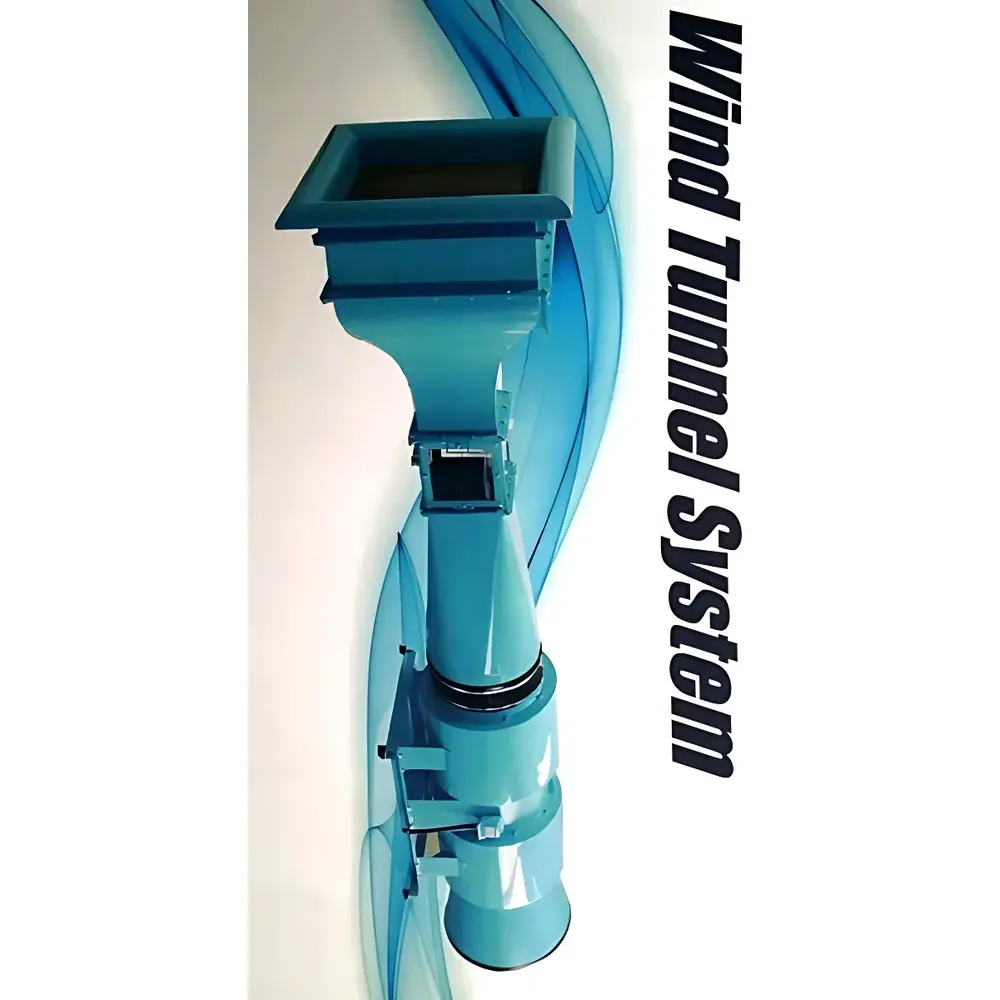
KANOMAX S980349 Compact Experimental Wind Tunnel
| Brand | KANOMAX |
|---|---|
| Origin | Japan |
| Model | S980349 |
| Maximum Air Velocity | 33 m/s |
| Test Section Cross-Section (Max) | 300 mm × 300 mm |
| Test Section Length | 1050 mm |
| Overall Dimensions | 1150 mm (W) × 1475 mm (H) × 5410 mm (L) |
| Weight | 650 kg |
Overview
The KANOMAX S980349 Compact Experimental Wind Tunnel is a precision-engineered, bench-scale aerodynamic testing system designed for controlled airflow simulation in academic research laboratories, R&D centers, and quality assurance environments. Based on classical open-circuit or semi-closed circuit configurations (configurable per installation), it employs a high-efficiency centrifugal blower assembly coupled with calibrated flow straightening vanes, contraction nozzles, and low-turbulence diffusers to generate stable, uniform laminar-to-transitional flow profiles. Its core operational principle relies on momentum transfer and boundary layer development within a defined test section, enabling quantitative evaluation of drag coefficients, pressure distribution, wake dynamics, and flow separation behavior. With a maximum attainable freestream velocity of 33 m/s and a fully adjustable test section cross-section—scalable up to 300 mm × 300 mm—the system supports reproducible aerodynamic characterization under ISO/IEC 17025-aligned conditions. The 1050 mm test section length provides sufficient streamwise development distance for most small-scale models (e.g., UAV components, HVAC duct fittings, sensor housings, and biomimetic surfaces), while the rigid steel frame and acoustic-dampened enclosure ensure mechanical stability and low ambient noise interference during PIV, hot-wire anemometry, or pressure tap measurements.
Key Features
- Modular test section design with interchangeable nozzle inserts and cross-sectional adapters—enabling rapid reconfiguration between square (150×150 mm, 200×200 mm, 300×300 mm) and rectangular aspect ratios without structural modification.
- Integrated variable-frequency drive (VFD) controlling blower motor speed, allowing continuous air velocity regulation from 1.5 m/s to 33 m/s with ±0.2 m/s repeatability over 24-hour operation.
- Flow conditioning system comprising honeycomb flow straighteners (cell size: 8 mm), three-tier anti-turbulence screens, and a 6:1 contraction ratio nozzle—achieving turbulence intensity <0.4% at mid-span centerline under nominal operating conditions.
- Structural frame fabricated from welded carbon steel with powder-coated finish; vibration-isolated mounting feet compliant with ISO 2372 Class A requirements for laboratory-grade instrumentation.
- Standard instrumentation interface: 4-channel analog output (0–10 V / 4–20 mA) for integration with external DAQ systems; RS-485 Modbus RTU port for remote parameter monitoring and setpoint adjustment.
Sample Compatibility & Compliance
The S980349 accommodates physical test models up to 280 mm in width, 280 mm in height, and 800 mm in depth—ensuring adequate blockage ratio (<5%) for valid low-speed aerodynamic data acquisition. It supports mounting via standardized floor plates (M6 threaded inserts, grid pitch: 50 mm) and optional traversing mechanisms for automated probe positioning. All internal surfaces are non-corrosive and compatible with standard calibration fluids (e.g., mineral oil-based particle seeding for laser sheet illumination). The system conforms to JIS B 8350 (Wind Tunnel Performance Testing Methods) and aligns with relevant clauses of ASTM D3574 (for airflow-dependent material testing protocols) and ISO 5801 (Industrial fans — Performance testing using standardized airways). While not certified as medical or explosion-proof equipment, its electrical architecture complies with IEC 61000-6-3 (EMC emission limits) and IEC 61000-6-2 (immunity standards) for laboratory use.
Software & Data Management
The wind tunnel operates independently of proprietary software but includes native support for third-party control and acquisition platforms including LabVIEW™ (with provided VI libraries), MATLAB® Data Acquisition Toolbox, and Python-based PyDAQmx implementations. Optional KANOMAX-supplied configuration utility (Windows 10/11 compatible) enables real-time visualization of velocity setpoints, motor current draw, and thermal load status. All analog outputs are timestamped and logged at user-defined intervals (1 Hz to 100 Hz); raw data exports in CSV and HDF5 formats facilitate traceability and post-processing in tools such as Tecplot, ParaView, or custom CFD validation workflows. Audit trails—including operator ID, parameter changes, and session timestamps—are retained locally for GLP-compliant documentation when deployed in regulated QA/QC settings.
Applications
- Aerodynamic coefficient determination for micro-air vehicles (MAVs), drone propellers, and scaled architectural façade elements.
- Thermal management validation of electronic enclosures, heat sink geometries, and fan-cooled PCB layouts under forced convection.
- Particle-laden flow behavior studies—including deposition efficiency of airborne particulates on filter media or sensor surfaces.
- Educational demonstration of Bernoulli’s principle, boundary layer transition, vortex shedding (via Strouhal number correlation), and pressure recovery in diffuser sections.
- Pre-validation of CFD boundary conditions—providing empirical inlet profiles and turbulence spectra for RANS or LES model calibration.
FAQ
Is the S980349 suitable for supersonic or transonic testing?
No. This system is strictly subsonic, optimized for Mach <0.1 (incompressible flow regime). For compressible flow analysis, dedicated blow-down or continuous-run transonic facilities are required.
Can it be integrated with Particle Image Velocimetry (PIV) systems?
Yes. The low-turbulence flow field, optical access ports (standard 100 mm diameter quartz windows on two opposing sides), and synchronization trigger output (TTL-compatible) make it fully compatible with commercial PIV setups.
What maintenance intervals are recommended for long-term accuracy?
Blower belt tension and bearing lubrication should be verified every 500 operational hours; flow straightener elements require ultrasonic cleaning every 1,000 hours if used with dusty or humid airstreams.
Does KANOMAX provide calibration certificates traceable to NMIJ/JCSS?
Upon request and prior to shipment, factory calibration with NMIJ-traceable pitot-static probes and hot-wire anemometers can be arranged—certificates include uncertainty budgets per ISO/IEC 17025 requirements.



