
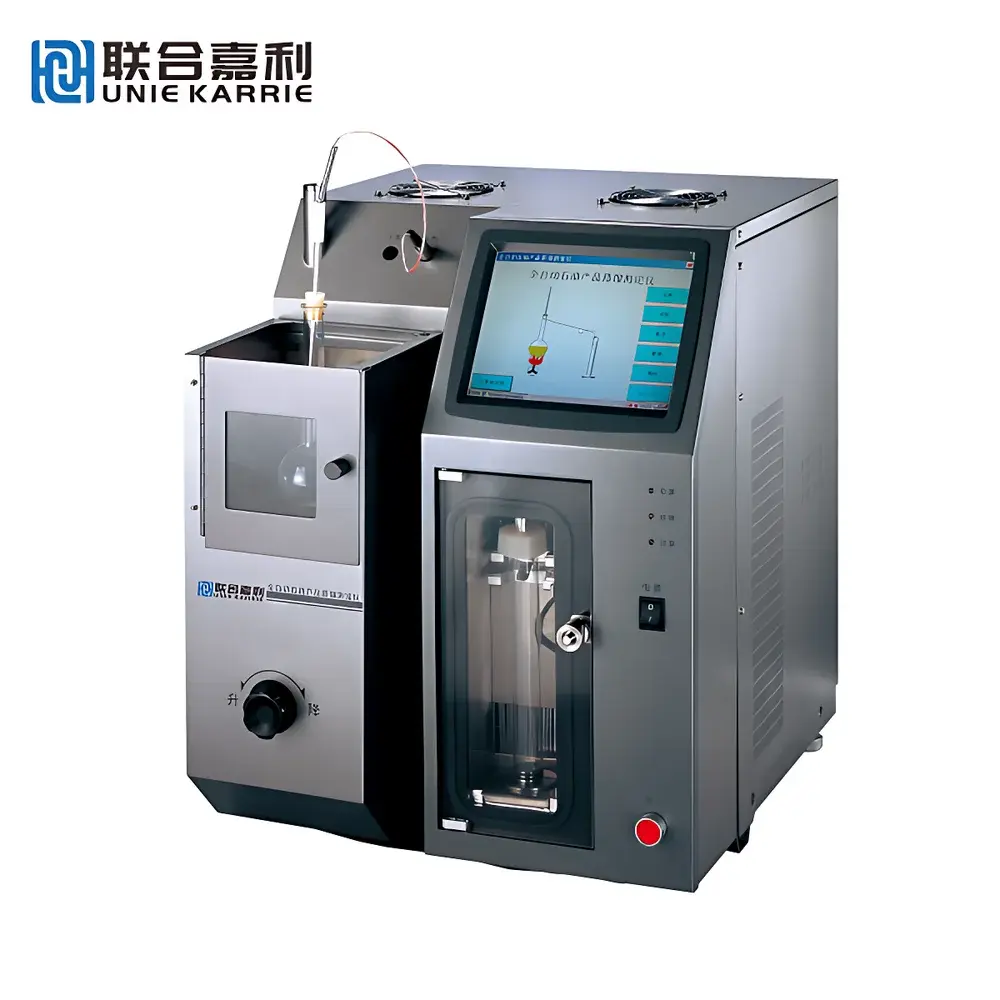
KARRIE EDS110 Fully Automated Petroleum Distillation Apparatus
| Brand | KARRIE |
|---|---|
| Model | EDS 110 |
| Origin | Guangdong, China |
| Temperature Range | Ambient to 370 °C |
| Temperature Accuracy | ±0.1 °C |
| Safety Cut-off Temperature | 400 °C |
| Cold Bath & Recovery Chamber Temperature Control Range | 0 °C to 60 °C |
| Distillation Rate Resolution | 0.1 mL/min |
| Volume Detection Range | Up to 12 mL/min |
| Volume Measurement Resolution | 0.1 mL |
| Heating Power | 1000 W |
| Total Power Consumption | 2500 W |
| Display | 10.4″ TFT LCD (640×480), Touchscreen + Keyboard + Mouse |
| Dimensions (L×W×H) | 565×515×660 mm |
| Weight | 55 kg |
Overview
The KARRIE EDS110 Fully Automated Petroleum Distillation Apparatus is an ASTM D86, ASTM D850, ISO 3405, and GB/T 6536–compliant benchtop instrument engineered for precise, repeatable, and fully automated distillation analysis of volatile petroleum fractions. It implements standardized batch distillation under atmospheric pressure using a calibrated glass distillation assembly—comprising ASTM-specified 125 mL flask, 100 mL graduated cylinder, and vapor temperature sensor—while continuously monitoring vapor temperature, recovered volume, cold bath temperature, and recovery chamber temperature in real time. The system operates on the fundamental principle of equilibrium-stage distillation: as the sample is heated at a controlled rate, successive vapor-phase condensates are collected and quantified, enabling derivation of key specification parameters including initial boiling point (IBP), 10%, 50%, 90%, and final boiling point (FBP), as well as loss and residue percentages. Designed for QC laboratories in refineries, fuel testing centers, and third-party certification facilities, the EDS110 eliminates manual intervention after sample loading, ensuring operator safety, inter-laboratory reproducibility, and strict adherence to regulatory reporting requirements.
Key Features
- Dual-architecture control system: Industrial-grade embedded PC (Windows CE 5.0, 256 MB RAM, 4 GB flash storage) manages user interface, data logging, and report generation; dedicated microcontroller handles real-time PID regulation of heating rate, cold bath thermoelectric cooling, and high-speed liquid-level tracking.
- True-color 10.4″ TFT touchscreen with 640×480 resolution, supplemented by physical keyboard and optical mouse for flexible operation in gloved or high-noise environments.
- Thermoelectric (Peltier) cooling for both cold bath and recovery chamber—enabling bidirectional temperature control (cooling/heating) from 0 °C to 60 °C with no refrigerants, zero ozone-depleting potential, and reduced maintenance intervals versus compressor-based systems.
- High-fidelity metrology chain: German-sourced four-wire PT100 sensors (calibration-certified), Japan-imported mechanical liquid-level tracking mechanism, and industrial infrared photoelectric couplers rated for extended thermal stability (−20 °C to 120 °C ambient).
- Comprehensive self-diagnostic suite: Automatic pre-test verification of all temperature sensors, fan status, door interlock switches, and level detection circuitry; runtime fault detection with audible alarm and on-screen diagnostic text (e.g., “Recovery chamber door open”, “No volume change detected for >120 s”).
- Multi-point correction framework: Software-supported corrections for barometric pressure, vapor temperature sensor drift, cylinder volumetric calibration, cold bath offset, and recovery chamber thermal lag—each traceable and auditable per GLP requirements.
Sample Compatibility & Compliance
The EDS110 is validated for routine analysis of gasoline-range hydrocarbons (including automotive, aviation, and jet fuels), naphthas, petroleum solvents, kerosene, diesel, light cycle oil, and related distillate fractions. Its hardware configuration and procedural logic conform strictly to ASTM D86 (Standard Test Method for Distillation of Petroleum Products at Atmospheric Pressure), ASTM D850 (for low-boiling solvents), ISO 3405 (identical scope to ASTM D86), and Chinese national standards GB/T 6536 and GB/T 7534. All temperature sensors are traceably calibrated to NIST-traceable references; volume measurement components carry valid metrological verification certificates. The system supports full audit trails—including operator ID, test timestamp, environmental conditions, raw sensor outputs, and applied corrections—required for FDA 21 CFR Part 11–aligned environments when configured with electronic signature modules.
Software & Data Management
The embedded Windows CE 5.0 platform hosts a bilingual (English/Chinese) graphical application supporting customizable distillation protocols. Users define up to 16 standard volume–temperature checkpoints (IBP through FBP) plus up to 15 user-defined points—either volume-triggered (e.g., record temperature at 10 mL recovered) or temperature-triggered (e.g., record volume at 150 °C vapor temp). Stop conditions (e.g., “halt at 95 mL” or “terminate above 360 °C”) prevent over-distillation. Real-time data visualization includes dual-pane display: tabular numeric output synchronized with dynamic distillation curve plotting (volume vs. temperature). Data export is supported via USB 2.0 (CSV, PDF, XML), RS-232 (SCPI-compatible), and Ethernet (RJ-45) for LIMS integration. Internal non-volatile storage retains ≥10,000 test records searchable by date, sample ID, analyst name, or method ID. Optional firmware updates and report templates are distributed via encrypted USB media.
Applications
- Quality assurance of gasoline blending components and finished fuels per refinery specifications.
- Regulatory compliance testing for EN 228, ASTM D4814, and GB 17930 gasoline standards.
- Distillation characterization of jet fuel (ASTM D1655 Annex A1) and kerosene-type turbine fuels.
- Volatility assessment of industrial solvents (e.g., VM&P naphtha, Stoddard solvent) per ASTM D850.
- R&D screening of cracked fractions, hydrotreated distillates, and bio-blendstocks during process optimization.
- Third-party certification and contract testing in ISO/IEC 17025-accredited laboratories.
FAQ
Which international standards does the EDS110 fully support?
ASTM D86, ASTM D850, ISO 3405, GB/T 6536, and GB/T 7534—all implemented via hardware design, sensor calibration, and software algorithm validation.
Can the instrument operate unattended for full distillation cycles?
Yes. Once the sample flask and receiving cylinder are loaded and a method is selected, the system executes heating, condensation, volume tracking, temperature recording, and endpoint detection without manual intervention.
What is the maximum allowable sample volume and typical analysis duration?
Standard test uses 100 mL sample in a 125 mL ASTM flask; typical D86 analysis requires 15–25 minutes depending on boiling range and desired endpoint precision.
How is temperature sensor accuracy maintained over time?
Four-wire PT100 elements provide inherent lead-resistance compensation; factory calibration is documented with certificate of conformity; field verification is supported using external reference thermometers per ASTM E77.
Is the system compatible with laboratory information management systems (LIMS)?
Yes—via RS-232 (ASCII/SCPI), USB virtual COM port, or TCP/IP Ethernet, enabling automated result transfer, method push-down, and instrument status polling.
Does the EDS110 meet cybersecurity requirements for network-connected lab instruments?
The Windows CE 5.0 OS employs a read-only file system with no background services, eliminating common attack vectors; network interfaces support configurable firewall rules and static IP assignment to align with enterprise IT policies.





