
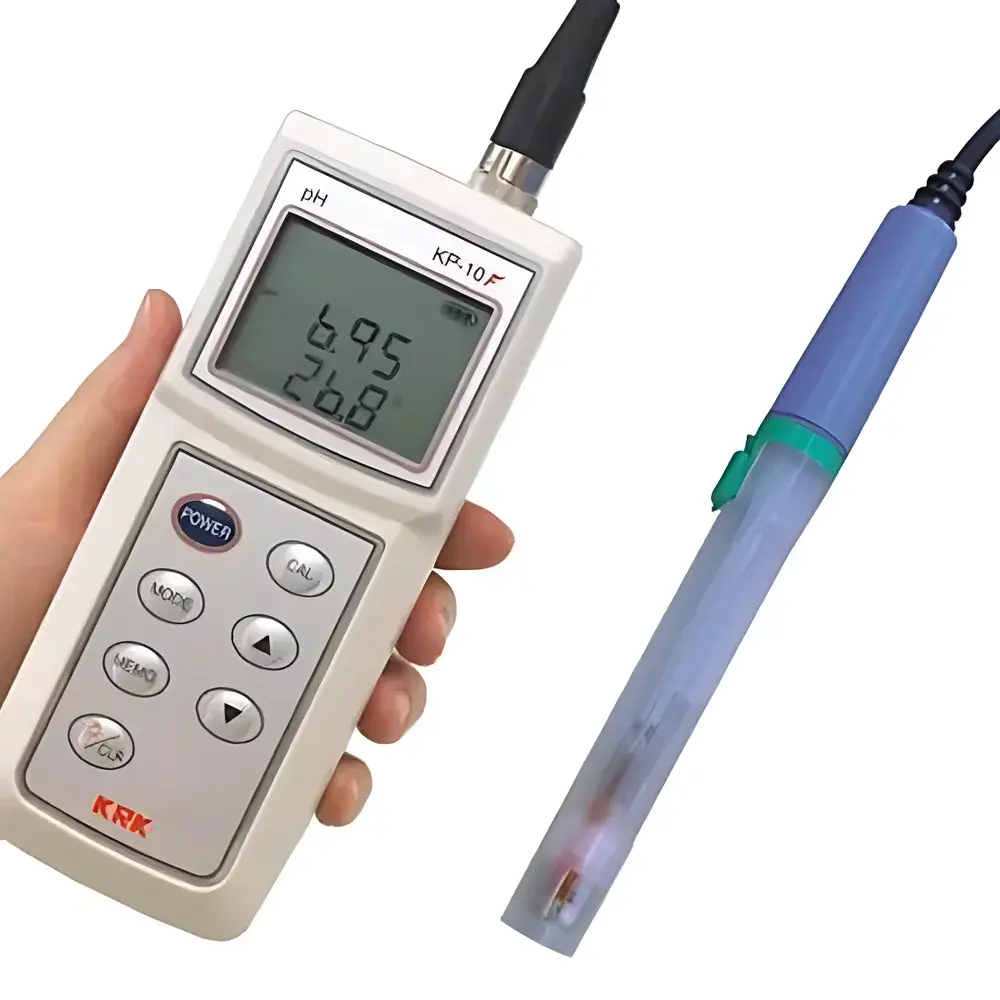
Kasuri KP-11Z Portable pH/ORP/Temperature/mV Meter
| Brand | Kasuri |
|---|---|
| Model | KP-11Z |
| Measurement Principle | Glass Electrode (pH), Platinum Electrode (ORP), Thermistor (Temperature) |
| pH Range | 0.00–14.00 (0.01 resolution) |
| ORP Range | −1999 to +1999 mV (1 mV resolution) |
| mV Range | −1999 to +1999 mV (1 mV resolution) |
| Temperature Range | 0.0–50.0 °C (0.1 °C resolution) |
| Accuracy (pH) | ±0.02 pH |
| Accuracy (ORP/mV) | ±0.2% of reading |
| Accuracy (Temp) | ±0.2 °C |
| Repeatability | pH ≤ ±0.02, ORP/mV ≤ ±0.2%, Temp ≤ ±0.2 °C |
| ATC | Yes (0–45 °C) |
| Memory Capacity | 30 data sets |
| Power | 4.5 V DC (3 × AAA/LR03 batteries) |
| Auto-off | 30 min |
| IP Rating | IP67 (with properly mated probe connector) |
| Dimensions (main unit) | 70 × 40 × 173 mm (W×H×D) |
| Weight (unit only) | ~290 g |
| Housing Material | ABS plastic |
| Electrode | PHD-11 (glass pH/platinum ORP, 3 m cable) |
| Compliance | JIS T 1201 (pH meters), JIS K 0101 (water analysis), SS242 & S251 certified electrode types |
Overview
The Kasuri KP-11Z is a compact, field-deployable multiparameter meter engineered for reliable, on-site measurement of pH, oxidation-reduction potential (ORP), millivolt (mV), and water temperature in environmental monitoring, wastewater treatment, aquaculture, and industrial process control applications. It operates on fundamental electrochemical principles: pH is determined via the Nernst potential across a sealed glass membrane relative to an internal Ag/AgCl reference; ORP is measured using a platinum sensing element that responds to electron transfer activity in solution; temperature is acquired via a calibrated thermistor embedded in the PHD-11 combination electrode. The instrument features automatic temperature compensation (ATC) across 0–45 °C, ensuring thermally corrected pH and ORP values per ISO 7888 and ASTM D1293 protocols. Its rugged, IP67-rated housing—validated only when the electrode connector is fully seated—enables operation in rain, splashing, or temporary submersion, making it suitable for unattended sampling in rivers, reservoirs, stormwater outfalls, and effluent discharge points.
Key Features
- Single-probe, four-parameter measurement: simultaneous acquisition of pH, ORP, mV, and temperature without manual mode switching.
- SS242-certified PHD-11 combination electrode with integrated glass pH sensor and platinum ORP element, supplied with 3 m shielded cable and refillable KCl electrolyte reservoir.
- Real-time electrode health diagnostics: displays open-circuit mV output during standby to assess junction integrity and membrane hydration status prior to immersion.
- High-stability analog front-end with 16-bit ADC resolution, delivering pH repeatability ≤ ±0.02 and ORP/mV reproducibility ≤ ±0.2% of reading under controlled conditions.
- Backlit LCD display with contrast adjustment for low-light field use; readable at viewing angles up to 60° off-axis.
- Non-volatile memory stores up to 30 timestamped measurements (date/time stamp enabled via manual entry), supporting basic traceability in GLP-aligned workflows.
- Energy-efficient design with auto-power-off after 30 minutes of inactivity; battery life exceeds 200 hours under typical intermittent use.
Sample Compatibility & Compliance
The KP-11Z is validated for aqueous samples within 0–45 °C and conductivity ≥ 50 µS/cm. It is unsuitable for non-aqueous solvents, highly viscous slurries, or solutions containing sulfides, cyanides, or high concentrations of heavy metals that may poison the platinum ORP surface or foul the glass membrane. Electrode performance adheres to JIS T 1201 (General Requirements for pH Meters) and JIS K 0101 (Methods of Testing Water Quality). While not FDA 21 CFR Part 11–compliant as a standalone device, its data export capability (via manual transcription) supports audit-ready documentation in ISO 17025-accredited laboratories. The PHD-11 electrode meets Japanese Ministry of Health, Labour and Welfare (MHLW) notification standards for drinking water surveillance (Notification No. 101, 2003).
Software & Data Management
The KP-11Z operates as a self-contained, firmware-driven instrument with no proprietary software dependency. All configuration—including calibration point selection (1–3 point pH), mV offset correction, and temperature unit preference—is managed via intuitive button navigation. Stored measurements are recalled sequentially with date/time metadata (manually entered during setup); no USB, Bluetooth, or cloud connectivity is provided. For regulatory environments requiring electronic records, users may integrate the device into validated SOPs by logging readings directly into LIMS-compatible spreadsheets or ELN platforms. Calibration history must be maintained separately per ISO/IEC 17025 clause 7.7, and electrode verification checks (e.g., mV drift < ±5 mV in pH 7.00 buffer) are recommended before each measurement session.
Applications
- Regulatory compliance monitoring: Effluent discharge testing per EPA Method 150.1 (pH) and Method 150.2 (ORP), municipal wastewater influent/effluent profiling.
- Aquatic ecosystem assessment: In-situ pH and redox mapping in wetlands, lakes, and estuaries to evaluate eutrophication trends and anaerobic zone development.
- Industrial pretreatment verification: Monitoring neutralization tank performance, electroplating bath stability, and chlorine disinfection potential (via ORP–Cl₂ correlation).
- Drinking water distribution: Spot-checking residual disinfectant efficacy and corrosion control indices (e.g., Langelier Saturation Index inputs).
- Educational field labs: Undergraduate environmental science courses requiring portable, robust instrumentation for hypothesis-driven water quality investigations.
FAQ
Does the KP-11Z support automatic calibration?
No. Calibration requires manual two-point (pH 4.01/7.00 or 7.00/10.01) or three-point procedures using certified NIST-traceable buffers. Slope and offset are displayed post-calibration for verification.
Can the PHD-11 electrode be used in seawater or high-salinity samples?
Yes, but prolonged exposure requires frequent cleaning and refilling of the KCl electrolyte to prevent clogging of the liquid junction. A double-junction variant (PHD-11-DJ) is recommended for long-term marine deployment.
Is the IP67 rating valid when the electrode is connected?
Only if the waterproof connector is fully engaged and torque-locked. An improperly seated plug compromises dust and water ingress protection.
How often should the PHD-11 electrode be recalibrated?
Before each field session and after every 2–3 hours of continuous use—or immediately following measurement of aggressive samples (e.g., strong acids/bases, oxidizers).
What does the standby mV reading indicate?
It reflects the electrode’s asymmetry potential and reference junction stability. A drift > ±15 mV from baseline in pH 7.00 buffer suggests membrane dehydration or junction blockage requiring reconditioning or replacement.







