
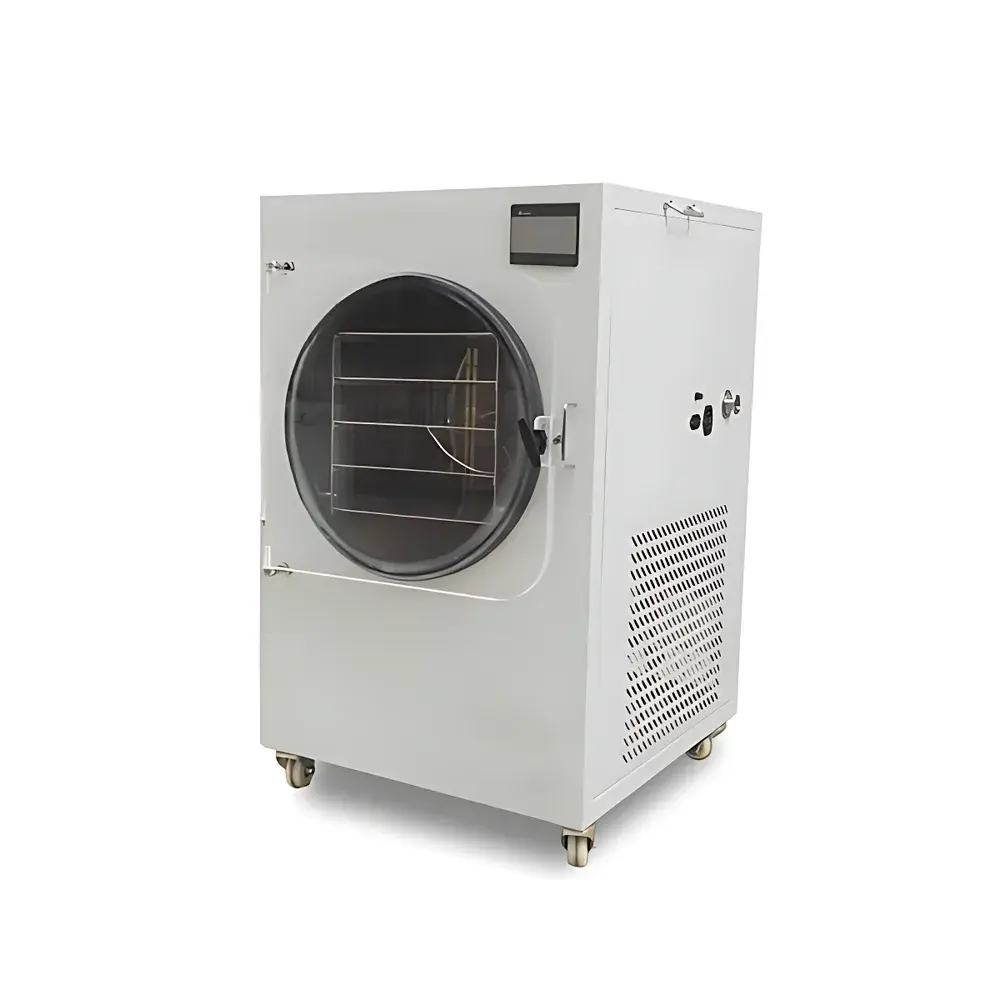
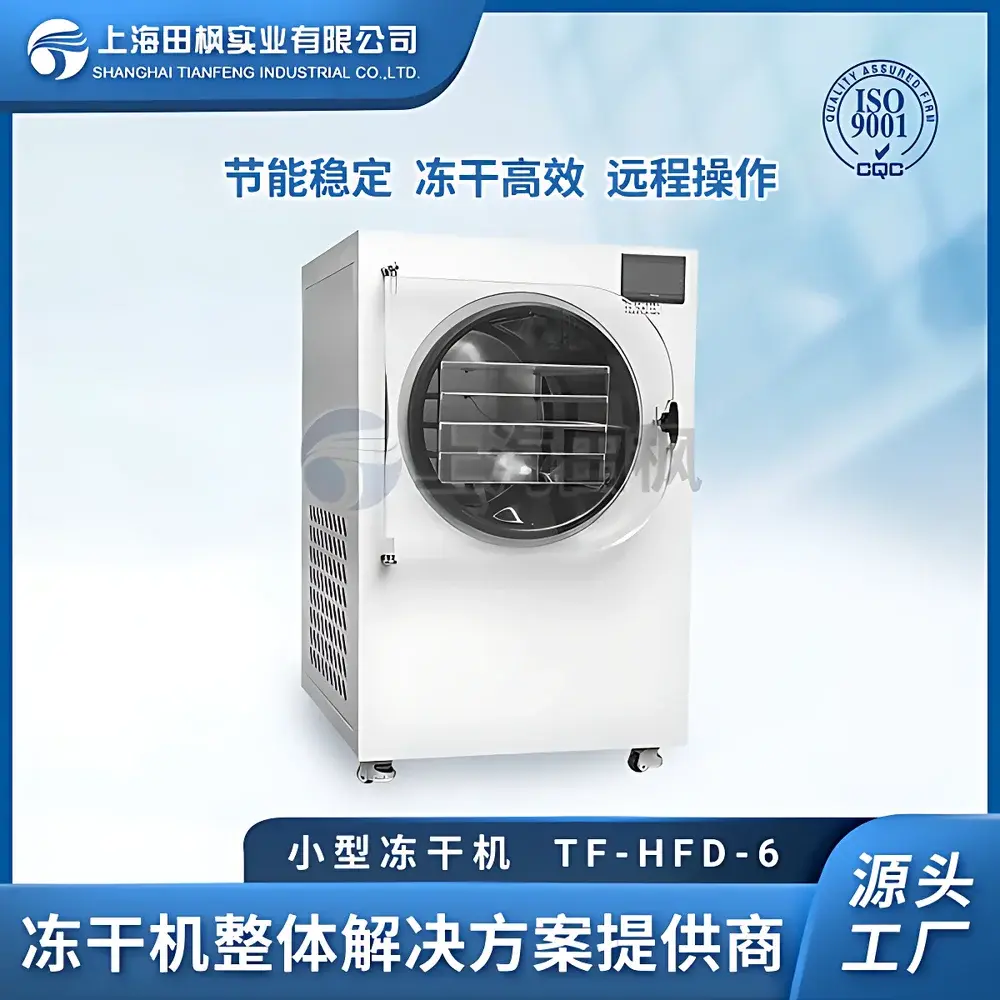
Tianfeng HFD-6 Laboratory Freeze Dryer for Cordyceps sinensis
| Brand | Tianfeng |
|---|---|
| Origin | Shanghai, China |
| Manufacturer Type | Direct Manufacturer |
| Product Category | Domestic |
| Model | HFD-6 |
| Instrument Type | Standard Shelf-Type Freeze Dryer |
| Application | Laboratory Use |
| Freeze-Drying Area | 0.6 m² |
| Ultimate Vacuum | 10 Pa (empty chamber) |
| Condenser Temperature | −40 °C |
| Water Capture Capacity | 10 kg/24 h |
| Overall Dimensions | 710 mm × 850 mm × 1080 mm (excluding door panel and handles) |
| Power Supply | 220 V, 50 Hz |
| Rated Power | 2300 W |
| Shelf Configuration | Four 330 mm × 440 mm trays |
| Control System | Real-time shelf temperature and process curve display, intelligent PID temperature control |
| Defrost Function | One-touch automatic defrost |
Overview
The Tianfeng HFD-6 is a purpose-engineered laboratory-scale freeze dryer designed specifically for the gentle, high-fidelity lyophilization of delicate biological materials—most notably Cordyceps sinensis (Chinese caterpillar fungus). Unlike general-purpose freeze dryers, the HFD-6 integrates structural and thermal optimizations to accommodate the unique morphology, moisture distribution, and thermal sensitivity of whole-cordyceps specimens. Its operation follows the fundamental principles of lyophilization: first, rapid freezing to solidify intracellular and extracellular water into ice crystals; second, primary drying under deep vacuum (≤10 Pa), where ice sublimates directly from solid to vapor without passing through the liquid phase; and third, secondary drying to remove bound water via desorption at elevated shelf temperatures. This three-stage process preserves bioactive compounds—including cordycepin, adenosine, and polysaccharides—at levels unattainable with conventional hot-air or vacuum drying methods.
Key Features
- Optimized shelf geometry: Four stainless-steel trays (330 mm × 440 mm each) arranged in a staggered vertical configuration to maximize airflow uniformity and minimize shadowing during sublimation.
- Precision cold trap: Dual-stage refrigeration system maintaining ≤−40 °C condenser temperature, ensuring stable vacuum integrity and efficient vapor capture—even during high-moisture-load cycles typical of fresh C. sinensis.
- Intelligent process control: Embedded microprocessor-based controller with real-time graphical display of shelf temperature profiles, chamber pressure trends, and cumulative drying time—enabling reproducible cycle development and validation.
- One-touch defrost function: Automated condenser defrost sequence initiated via front-panel interface, minimizing operator intervention and reducing downtime between batches.
- Robust mechanical architecture: All-welded stainless-steel chamber housing, reinforced door seal, and vibration-damped compressor mounting for long-term operational stability in continuous lab environments.
- Energy-efficient design: Optimized refrigerant circuit and adaptive compressor modulation reduce power consumption without compromising drying kinetics or final residual moisture content (<2.5% w/w typical for cordyceps).
Sample Compatibility & Compliance
The HFD-6 accommodates intact, non-powdered Cordyceps sinensis specimens ranging from 3–8 cm in length and 0.2–0.6 g per unit. Its 0.6 m² effective drying area supports batch sizes of 3,000–5,000 individual specimens—subject to natural variation in size, hydration level, and pre-freezing orientation. The system complies with ISO 22042:2016 (freeze-drying equipment performance verification) and supports documentation practices aligned with GLP and GMP frameworks. While not certified for pharmaceutical manufacturing (e.g., FDA 21 CFR Part 11), its data logging capability—including timestamped temperature/pressure records and user-accessible export (CSV format)—facilitates audit-ready process documentation for research-grade applications.
Software & Data Management
The integrated control system provides local, non-networked data acquisition with no cloud dependency. All process variables—including shelf setpoint, actual temperature (±0.3 °C accuracy), chamber pressure (capacitance manometer, ±5% full scale), and elapsed time—are logged at 10-second intervals. Data is stored onboard for up to 100 complete cycles and exportable via USB port to standard spreadsheet software. No proprietary drivers or vendor-specific analysis tools are required. Audit trails include operator ID entry (manual text field), cycle start/stop timestamps, and alarm event logs—sufficient for internal quality review and method transfer documentation.
Applications
- Preservation of bioactive metabolites in Cordyceps sinensis for pharmacognosy and natural product research.
- Stabilization of fungal mycelia and fruiting bodies prior to extraction, HPLC analysis, or storage at ambient conditions.
- Development of lyophilization protocols for other thermolabile entomopathogenic fungi (e.g., Ophiocordyceps unilateralis, Beauveria bassiana).
- Preparative-scale drying of botanicals with high polysaccharide or nucleoside content where structural integrity and enzymatic activity retention are critical.
- Teaching laboratories demonstrating phase-change thermodynamics, mass transfer limitations in porous media, and vacuum engineering fundamentals.
FAQ
What is the maximum recommended batch size for Cordyceps sinensis on the HFD-6?
Typical batch capacity ranges from 3,000 to 5,000 specimens per cycle, assuming average specimen weight of 0.3–0.4 g and uniform tray loading. Actual throughput depends on initial moisture content and pre-freezing protocol.
Does the HFD-6 support programmable multi-step shelf temperature ramps?
Yes—the controller allows up to 32 user-defined segments per cycle, including ramp rates (°C/min), hold durations, and pressure-controlled drying transitions.
Is the vacuum pump included with the system?
No. A compatible two-stage oil-sealed rotary vane pump (≥4 L/s pumping speed, ultimate vacuum ≤5 × 10⁻² Pa) must be supplied separately.
Can the HFD-6 be validated for IQ/OQ protocols?
Yes. The unit provides accessible calibration ports for independent verification of shelf temperature sensors and chamber pressure transducers using NIST-traceable standards.
What maintenance intervals are recommended for routine operation?
Compressor oil and refrigerant levels should be inspected annually; vacuum pump oil changed every 500 operating hours; door gasket and condenser coil cleaned quarterly.



