
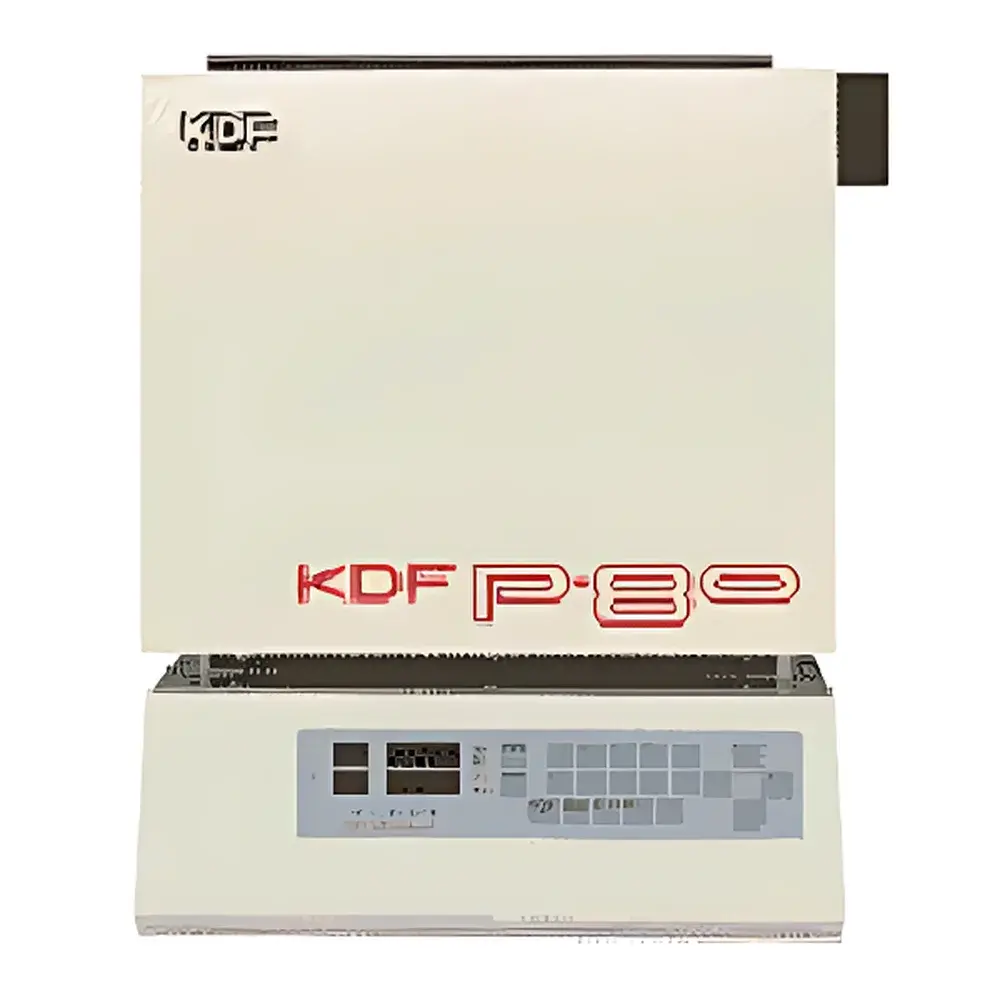
KDF P100G Desktop Muffle Furnace
| Brand | KDF |
|---|---|
| Origin | Japan |
| Instrument Type | Box-Type Muffle Furnace |
| Maximum Temperature | 1100 °C |
| Temperature Control Accuracy | ±3 °C at 1000 °C |
| Rated Power | 8.0 kW |
| Heating Rate to Max Temp | 49 min |
| Heating Method | Resistance Wire Heating |
| Internal Chamber Dimensions | 350 × 300 × 500 mm (W × H × D) |
| Chamber Volume | 52.5 L |
| Temperature Resolution | 0.5 °C |
| Temperature Uniformity | ±3 °C at 1000 °C |
| Insulation Material | Ceramic Fiber |
| Thermocouple Type | JIS K (Chromel–Alumel) |
| Heating Element | Kanthal AF (Fe–23% Cr–6% Al) |
| Gas Inlet Option | Standard N₂ supply (20 L/min for P100G model) |
| Programmable Steps | 40 programs / 20 categories |
| Control Algorithm | Multi-zone PID with auto-tuning capability |
| Communication Interface | RS-232C (D-sub 25-pin female), baud rates: 1200–9600 bps |
| Safety Systems | Overtemperature cut-off, thermal fuse, current overload breaker, rear-panel temperature sensor, microcomputer fault detection (heater open, thermocouple break, memory error, ramp overshoot) |
Overview
The KDF P100G is a high-performance desktop muffle furnace engineered for precision thermal processing in research laboratories and quality control environments. Designed according to ISO 8573-1 clean air standards for inert atmosphere operation, it employs a robust ceramic fiber insulation architecture and Kanthal AF alloy heating elements to deliver stable, repeatable heating across a wide operational range of 100 °C to 1100 °C. Unlike conventional furnaces relying on simple on/off or basic proportional control, the P100G implements a three-parameter PID algorithm with real-time auto-tuning—enabling dynamic compensation for load mass variation, chamber geometry effects, and ambient thermal drift. This ensures consistent thermal profiles critical for ASTM E1113-compliant ashing, ISO 5660 cone calorimetry sample conditioning, USP heavy metal residue testing, and controlled oxidation studies in advanced ceramics and battery cathode material synthesis.
Key Features
- High-efficiency ceramic fiber insulation (density ≥ 128 kg/m³) minimizing heat loss and enabling rapid thermal recovery after door opening.
- Dual-point JIS K-type thermocouples—one embedded in the heating zone wall, one centrally suspended—providing redundant measurement and improved spatial uniformity verification per IEC 60584-2.
- Modular gas introduction system (standard on PG variants; optional on P series) supporting continuous nitrogen purging at up to 20 L/min, compliant with ASTM D5630 for inert-atmosphere polymer decomposition studies.
- 20-category programmable logic engine allowing nested program structures: up to 40 base programs can be chained into cascaded sequences totaling 400 discrete segments, supporting complex multi-stage sintering, carburizing, and annealing protocols.
- RS-232C serial interface (D-sub 25-pin female) compatible with KDM-232 data acquisition software for GLP/GMP-compliant audit trails, including timestamped temperature logs, event markers (soak start/end, gas valve actuation), and fault diagnostics.
- Comprehensive safety architecture: independent overtemperature limiter (mechanical backup), thermal cutoff fuse, electronic current monitoring, rear-panel thermal sensor, and microcontroller self-diagnostic routines covering heater continuity, thermocouple integrity, EEPROM corruption, and ramp deviation alerts.
Sample Compatibility & Compliance
The P100G accommodates standard crucibles (up to Φ120 mm × 80 mm height) and flat-bottom quartz or alumina boats within its 52.5 L chamber. Its internal dimensions (350 × 300 × 500 mm) support batch processing of up to 12 × 25 mL porcelain crucibles or single-piece ceramic substrates measuring 300 × 250 mm. The furnace meets EN 61000-6-3 electromagnetic compatibility requirements and operates within Class II pollution degree per IEC 61010-1. It is validated for use in FDA 21 CFR Part 11–aligned workflows when paired with KDM-232 software, providing electronic signatures, role-based access control, and immutable audit logs for thermal validation reports required under ISO/IEC 17025 accreditation.
Software & Data Management
KDM-232 software provides full remote supervision—including real-time temperature graphing, parameter editing, and program upload/download—via Windows-compatible RS-232 connection. All thermal events are time-stamped to millisecond resolution and stored in CSV format for integration with LIMS platforms. The software enforces user authentication (admin/operator tiers), supports electronic signature capture for SOP execution, and generates PDF-formatted calibration certificates traceable to NIST SRM 1749. Data export includes raw thermocouple voltage, calculated temperature, power output percentage, and gas flow status—enabling post-run statistical process control (SPC) analysis per ASTM E2587.
Applications
- Ash content determination in food, pharmaceuticals, and environmental samples per AOAC 942.05 and ISO 2171.
- Thermal gravimetric pre-conditioning of catalyst supports prior to BET surface area analysis (ISO 9277).
- Controlled oxidation of Ni–Co–Al layered double hydroxides for Li-ion battery precursor synthesis.
- Debinding cycles for metal injection molding (MIM) feedstocks under nitrogen atmosphere (ASTM F2885).
- Heat treatment of dental zirconia blanks (ISO 6872) and sintering of SiC-based refractory composites.
- Residue quantification in lubricant additives per ASTM D874 and ASTM D4294.
FAQ
What is the maximum recommended sample mass for uniform heating at 1100 °C?
For optimal temperature uniformity (±3 °C), the recommended maximum load is 1.8 kg of ceramic or metallic material. Exceeding this may require recalibration of the auto-tuning PID parameters.
Does the furnace support vacuum operation?
No—the P100G is designed exclusively for atmospheric or inert-gas-purged environments. Vacuum compatibility requires specialized flanged models not covered under the P/PG series.
Can multiple furnaces be daisy-chained via RS-232 for centralized control?
Yes—using RS-232 multiplexers compliant with TIA/EIA-485, up to eight units can be addressed individually via address-select jumpers on the rear terminal block.
Is third-party calibration certification available?
KDF provides factory calibration certificates (traceable to JCSS-accredited labs) upon request. On-site UKAS or DAkkS-certified calibration services are coordinated through authorized regional partners.
What maintenance intervals are recommended for the heating elements and insulation?
Visual inspection every 200 operating hours; ceramic fiber integrity assessment every 1,000 hours; Kanthal AF element resistance check every 500 hours. Replacement intervals depend on thermal cycling frequency and peak temperature usage profile.



