
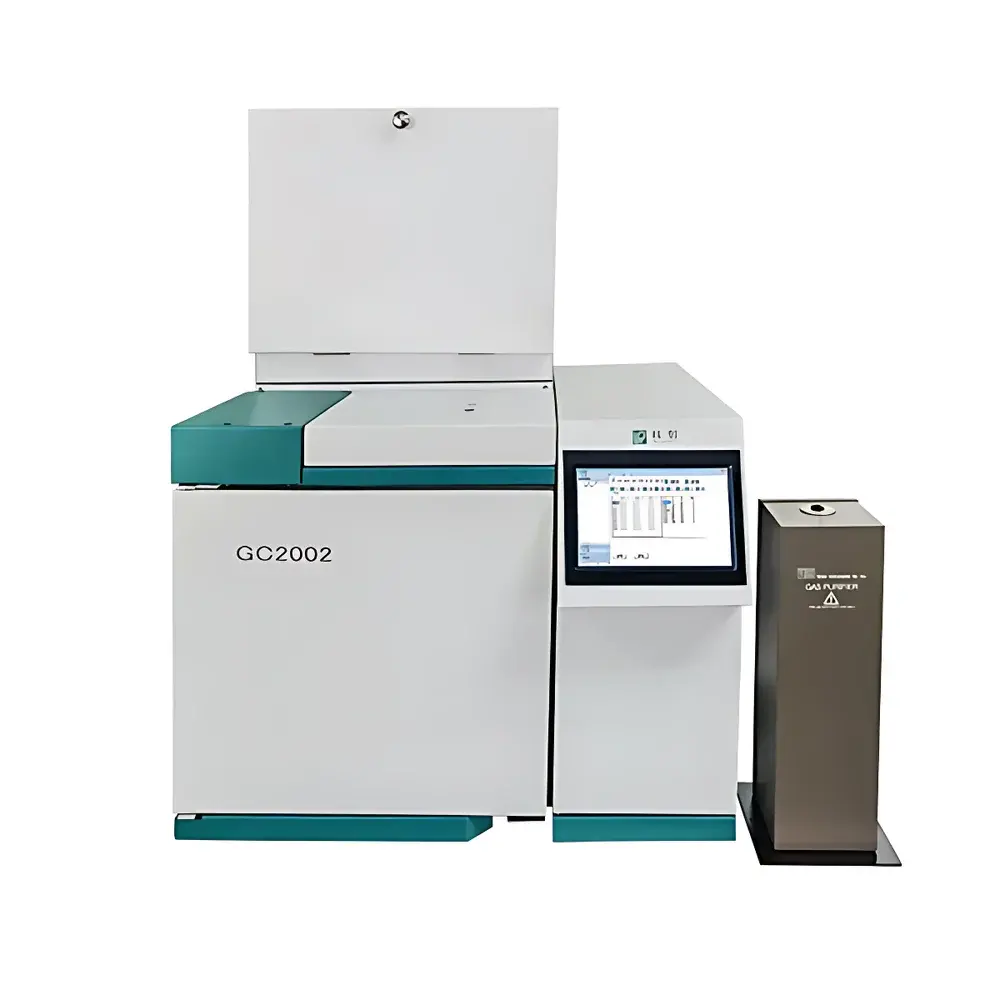
KeChuang GC2002N/PDHID Helium Ionization Gas Chromatograph for Trace Impurity Analysis in High-Purity and Ultra-High-Purity Argon
| [Brand | KeChuang |
|---|---|
| Origin | Shanghai, China |
| Manufacturer Type | Direct Manufacturer |
| Instrument Type | Laboratory Gas Chromatograph |
| Application Field | Dedicated to High-Purity Gas Analysis |
| Oven Temperature Range | 0–400 °C |
| Maximum Ramp Rate | 60 °C/min |
| Cooling Time (from 350 °C to 50 °C) | ≤4 min |
| Carrier Gas Flow Control Range | 0–500 mL/min |
| Carrier Gas Pressure Control Range | 0–0.4 MPa |
| Injector Maximum Operating Temperature | 300 °C |
| Injector Pressure Setting Range | 0–0.4 MPa |
| Injector Total Flow Setting Range | 0–500 mL/min |
| Detection Principle | Pulsed Discharge Helium Ionization Detection (PDHID)] |
Overview
The KeChuang GC2002N/PDHID is a purpose-built gas chromatograph engineered for the quantitative determination of trace-level impurities—such as H₂, O₂, N₂, CH₄, CO, and CO₂—in high-purity (5N, 99.999%) and ultra-high-purity (6N–7N, ≥99.9999%) argon matrices. Unlike conventional flame ionization (FID) or thermal conductivity (TCD) detectors, this system employs a pulsed discharge helium ionization detector (PDHID), which generates a stable, low-background helium plasma capable of ionizing nearly all permanent gases and hydrocarbons with near-universal sensitivity and sub-ppb detection capability. The PDHID operates without hydrogen or air supply, eliminating combustion-related safety concerns and baseline drift associated with reactive carrier gases. Its design adheres to the analytical requirements specified in ISO 8573-5, ASTM D1946, GB/T 4842–2006, and IEC 60376 for electronic-grade and semiconductor-process gases.
Key Features
- Optimized oven architecture with dual-zone temperature control ensures precise thermal management during rapid heating and cooling cycles—critical for resolving closely eluting impurities in argon (e.g., O₂/N₂ separation at sub-ppm levels).
- High-stability PDHID with <0.13 ppb (v/v) detection limit for H₂ and <0.02 ppb for CO₂ and CH₄, validated per ICH Q2(R2) guidelines for method sensitivity and specificity.
- Digital pressure and flow controllers (EPC/EFC) deliver ±0.001 MPa and ±0.1 mL/min accuracy across the full operating range (0–0.4 MPa, 0–500 mL/min), enabling robust retention time reproducibility (<0.02 min RSD over 7 injections).
- Injector with split/splitless operation and programmable temperature ramping up to 300 °C supports both direct gas sampling and cryo-trapped preconcentration for sub-ppb analytes.
- Robust stainless-steel pneumatic path with electropolished internal surfaces minimizes adsorption and memory effects—essential for analyzing reactive species such as CO and NO in ultrapure argon streams.
Sample Compatibility & Compliance
The GC2002N/PDHID is validated for use with cylinder-sourced, pipeline-fed, or on-line sampled argon streams conforming to SEMI F57, ISO 8573-1 Class 1, and ASTM D7607 specifications. It accommodates standard 1/8″ or 1/16″ stainless-steel capillary or packed columns (e.g., Molecular Sieve 5A, Porapak Q, Hayesep D) selected for optimal resolution of permanent gases. All hardware materials meet USP extractables criteria, and system validation documentation supports GLP/GMP environments. Data integrity complies with FDA 21 CFR Part 11 requirements when paired with compliant chromatography data systems (CDS), including audit trail, electronic signatures, and user-access controls.
Software & Data Management
The instrument integrates with KeChuang’s GC-Studio v3.x software, a Windows-based platform supporting automated method development, sequence scheduling, peak integration via valley-to-valley and tangent skim algorithms, and customizable report templates aligned with ISO/IEC 17025 reporting clauses. Raw data files (.raw) are stored in vendor-neutral format with embedded metadata (instrument parameters, calibration history, operator ID). Software features include automatic baseline correction, retention time locking (RTL), and multi-point calibration curve generation with forced zero-intercept options for trace gas quantification. Audit trails record all parameter modifications, injection events, and report exports with timestamps and user attribution.
Applications
- Quality control of argon used in semiconductor CVD and etching processes, where O₂ and H₂O impurities <10 ppb directly impact film stoichiometry and defect density.
- Verification of argon purity in medical oxygen blending systems, ensuring compliance with ISO 8573-7 for breathable gas applications.
- Monitoring of argon supply lines in synchrotron beamline environments, where hydrocarbon contamination degrades vacuum integrity and X-ray optics performance.
- Supporting ISO 14644-8 cleanroom certification by validating inert gas purging efficacy in classified manufacturing zones.
- Method transfer from research labs to production QC labs under ASTM E2655–21 guidelines for interlaboratory precision assessment.
FAQ
What detection principle does the GC2002N/PDHID employ, and why is it preferred for argon impurity analysis?
It uses pulsed discharge helium ionization detection (PDHID), which provides universal, non-destructive, and highly sensitive response to all permanent gases and hydrocarbons—without requiring hydrogen or air. This eliminates combustion risks and ensures stable baselines in high-purity argon, where trace moisture or oxygen would otherwise quench conventional detectors.
Can the system quantify impurities below 1 ppb in 6N argon?
Yes—when configured with appropriate column selection, cryogenic preconcentration, and optimized PDHID operating parameters, the system achieves method detection limits of 0.02–0.13 ppb for key impurities, as verified per EPA Method TO-15 and ISO 10156 Annex B protocols.
Is the GC2002N/PDHID compliant with pharmaceutical GMP requirements?
The hardware and optional CDS configuration support 21 CFR Part 11 compliance, including electronic signature workflows, audit trail generation, and role-based access control—enabling use in QC laboratories governed by ICH Q7 and EU Annex 11.
What column types are recommended for separating O₂ and N₂ in argon?
Molecular Sieve 5A (60/80 mesh, 2 m × 1/8″ SS) operated at 55–65 °C provides baseline resolution of O₂/N₂ in <5 min, with retention time stability <0.015 min over 24-hour continuous operation.
Does the system support automated calibration and drift correction?
Yes—the GC-Studio software includes scheduled auto-calibration routines using certified gas standards, with real-time correction of retention time shifts and response factor drift based on internal standard peaks or periodic bracketing injections.





