
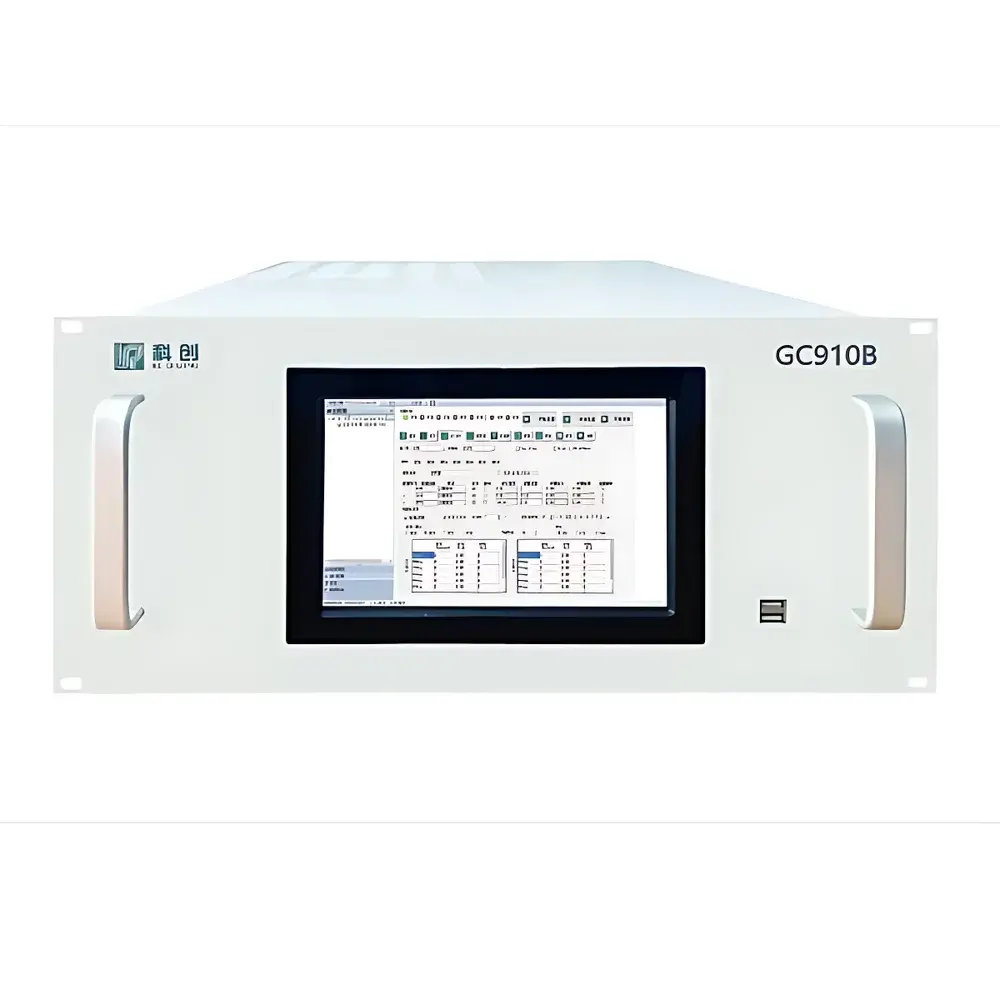
Kechuang GC910 Mobile Gas Chromatograph for Clinical Blood Analysis
| Brand | Kechuang |
|---|---|
| Origin | Shanghai, China |
| Manufacturer Type | OEM Manufacturer |
| Instrument Type | Laboratory Gas Chromatograph |
| Model | GC910 Mobile |
| Temperature Control Range | Ambient + 3 °C to 450 °C |
| Maximum Ramp Rate | 120 °C/min |
| Cooling Time | ≤3.5 min (350 °C → 50 °C) |
| Carrier Gas Flow Control | 0–1200 mL/min (EPC/EFC) |
| Carrier Gas Pressure Control | 0–100 psi (0–689 kPa) |
| Injector Max Temp | 300 °C |
| Detector Options | TCD, FID, ECD, FPD |
| Detection Limits | FID ≤3.0×10⁻¹² g/s (n-hexadecane), ECD ≤10 fg/mL (lindane), TCD ≥6000 mV·mL/mg |
| Baseline Noise | ≤10 µV (FID/TCD), ≤20 µV (ECD/FPD) |
| Linearity | FID 10⁷, TCD 10⁵, ECD/FPD 10⁴ |
| Retention Time RSD | <0.008% |
| Peak Area RSD | <1.0% |
| Dimensions (W×D×H) | 482×450×222 mm |
| Weight | ≤20 kg |
Overview
The Kechuang GC910 Mobile Gas Chromatograph is an integrated, compact benchtop gas chromatography system engineered for high-precision volatile organic compound (VOC) and small-molecule metabolite analysis in clinical blood specimens. Designed specifically for point-of-care and mobile laboratory environments—including mobile health units, forensic vans, and field-deployable clinical testing platforms—the instrument employs capillary column separation coupled with flame ionization (FID), thermal conductivity (TCD), electron capture (ECD), or flame photometric (FPD) detection to quantify analytes such as ethanol, methanol, acetone, free fatty acids, and therapeutic drug metabolites directly from serum or whole blood extracts. Its core architecture adheres to fundamental gas chromatographic principles: sample vaporization in a temperature-controlled inlet, carrier-gas-driven partitioning across a stationary phase, and selective elution detected via physicochemical signal transduction. The system meets the operational constraints of ISO 15197:2013 (in vitro diagnostic devices for blood glucose monitoring) and supports method development aligned with CLIA-waived and CAP-accredited workflows for quantitative toxicology and therapeutic drug monitoring (TDM).
Key Features
- 10-channel independent temperature control system, including dual programmable column ovens with ±0.01 °C stability and ramp rates up to 120 °C/min (0.1 °C/min increment)
- Integrated Ethernet (RJ45) interface enabling deterministic digital data transmission; supports remote operation, real-time spectral streaming, and centralized fleet management for up to 253 instruments via standard TCP/IP protocols
- Electronic Pressure and Flow Control (EPC/EFC) with 0.001 psi pressure resolution and 0.001 mL/min flow resolution; configurable in constant-pressure, constant-flow, or multi-step programmed pressure/flow modes (up to 8 steps)
- 8-inch capacitive touchscreen HMI with embedded baseline visualization, real-time chromatogram rendering, and direct instrument parameter adjustment without PC dependency
- Active column oven cooling via motorized rear door actuation; achieves 350 °C → 50 °C transition in ≤3.5 minutes, enabling rapid cycle times for high-throughput clinical assays
- Onboard fault diagnostics with real-time error logging, thermal runaway protection (automatic heater cutoff on any channel exceeding setpoint by >5 °C), and hardware-level watchdog timers
- 8-event external trigger sequence capability for synchronized autosampler integration, valve switching, or external detector triggering
Sample Compatibility & Compliance
The GC910 Mobile accommodates derivatized and underivatized liquid-phase blood extracts prepared per ASTM D3703-22 (standard practice for preparation of biological fluids for GC analysis) and ISO 17025:2017 Annex A.3 requirements for clinical specimen handling. Compatible sample introduction methods include split/splitless injection, cold-on-column (COC), and programmable temperature vaporizer (PTV) configurations. The system supports validated methods compliant with USP , EP 2.2.46, and FDA Guidance for Industry: Bioanalytical Method Validation (May 2018). All firmware and software modules are designed to meet audit-trail requirements under 21 CFR Part 11 for electronic records and signatures, including user authentication, immutable event logs, and version-controlled method storage.
Software & Data Management
The GC910 operates with Kechuang’s GC-Studio v4.x workstation—a Windows-based application certified for Windows 10/11 (64-bit) and compatible with VMware virtualized lab environments. The software provides full bidirectional instrument control, real-time spectral overlay, peak integration using valley-to-valley and tangent skim algorithms, and customizable report templates conforming to ISO/IEC 17025 reporting clauses. Raw data files (.GCX) are stored in vendor-neutral HDF5 format with embedded metadata (operator ID, method name, calibration status, environmental conditions). Audit trail functionality records all user actions—including method edits, integration parameter changes, and result reprocessing—with timestamps, IP addresses, and digital signatures. Data export supports CSV, PDF/A-2, and XML formats for LIMS integration (HL7 v2.5.1 and ASTM E1384-compliant).
Applications
- Quantitative ethanol and methanol screening in emergency toxicology panels
- Monitoring of antiepileptic drugs (e.g., phenytoin, carbamazepine) and antidepressants (e.g., amitriptyline, nortriptyline) in therapeutic drug monitoring programs
- Detection of volatile organic toxins (e.g., benzene, toluene, xylene) in occupational exposure assessments
- Analysis of ketone bodies (acetone, acetoacetate, β-hydroxybutyrate) in diabetic ketoacidosis evaluation
- Forensic confirmation of illicit substances (e.g., THC metabolites, cocaine benzoylecgonine) in blood matrices per SWGTOX guidelines
- Quality control of blood bank preservative solutions (e.g., citrate-phosphate-dextrose formulations)
FAQ
Is the GC910 Mobile certified for use in regulated clinical laboratories?
Yes — the instrument complies with IEC 61010-1 for electrical safety and EMC, and its software architecture supports 21 CFR Part 11 compliance when deployed with appropriate access controls and audit-trail configuration.
Can the system be integrated with existing hospital LIMS infrastructure?
Yes — GC-Studio supports HL7 ADT and ORU messages via configurable middleware; raw data export and result forwarding are scriptable using Python APIs included in the SDK.
What carrier gases are supported, and how is gas purity managed?
N₂, H₂, He, and Ar are fully supported; optimal performance requires ≥99.999% purity with inline moisture/oxygen traps. EPC calibration routines validate gas delivery integrity prior to each run.
Does the GC910 Mobile support GLP/GMP-compliant method validation?
Yes — built-in system suitability tests (SST), retention time locking, and automated calibration verification workflows align with ICH Q2(R2) and USP validation parameters.
What is the expected service life and maintenance interval for the FID detector?
Under routine clinical use (≤10 injections/day), the FID jet and collector require cleaning every 3 months; recommended preventive maintenance includes quarterly EPC recalibration and annual column oven thermocouple verification.





