
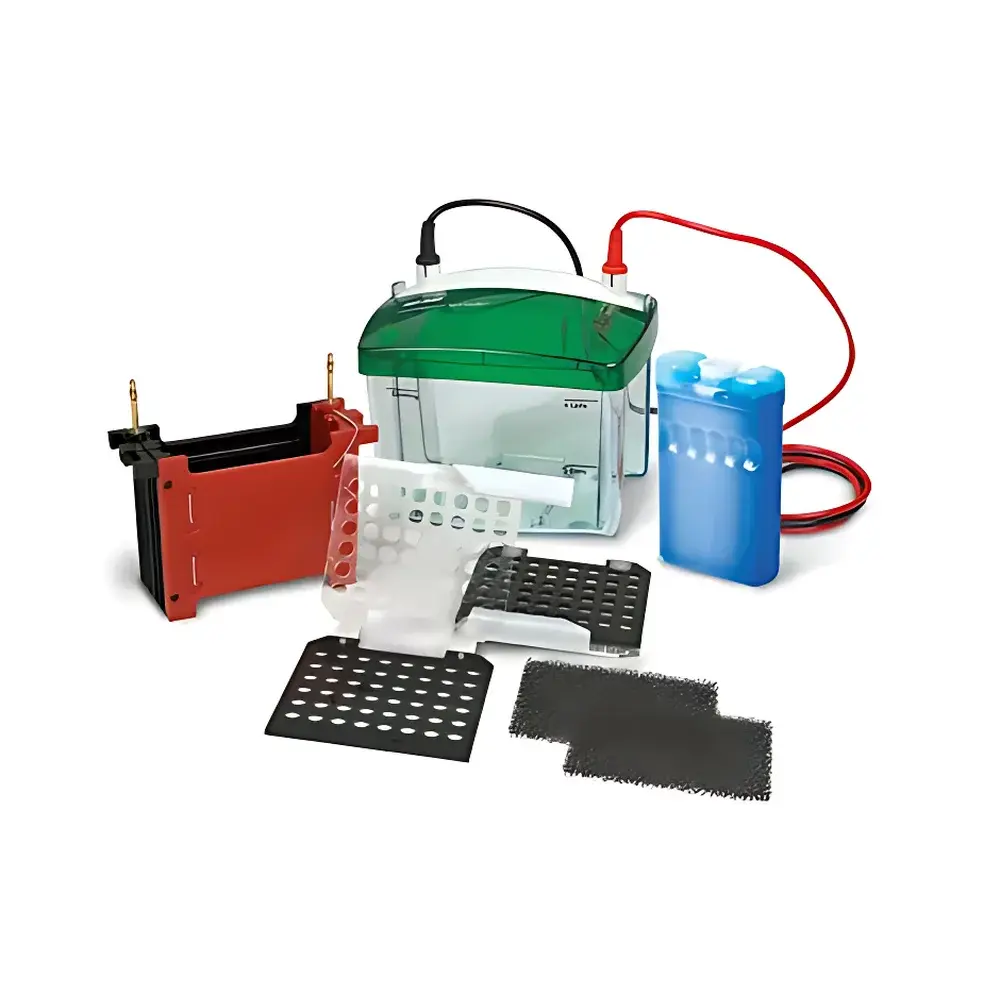
Keebio VE186 Semi-Dry Electroblotting Transfer Unit
| Brand | Keebio |
|---|---|
| Model | VE186 |
| Type | Semi-dry electroblotting transfer apparatus |
| Max Gel Size | 110 × 90 mm |
| Gel Capacity | 2 gels simultaneously |
| Electrode Spacing | 40 mm |
| Buffer Volume | 450 mL |
| Dimensions (L×W×H) | 180 × 140 × 155 mm |
| Weight | 1 kg |
| Electrode Material | 99.95% pure platinum wire |
| Cooling | Integrated ice chamber for temperature control during transfer |
| Compatible With | Keebio VE180 vertical electrophoresis system |
| Transfer Time Range | 30–60 min (standard) or low-voltage overnight protocol |
Overview
The Keebio VE186 Semi-Dry Electroblotting Transfer Unit is an engineered solution for efficient and reproducible protein transfer from polyacrylamide or agarose gels to solid supports—including nitrocellulose, PVDF, and nylon membranes—using the semi-dry electroblotting principle. Unlike wet transfer systems, this unit applies a high electric field across a thin buffer-saturated sandwich assembly (gel/membrane/filter paper stack), enabling rapid electrophoretic migration of proteins with minimal thermal buildup. Its compact footprint and integrated thermal management make it especially suited for routine Western blotting workflows in academic laboratories, QC environments, and core facilities where throughput, consistency, and space efficiency are prioritized.
Key Features
- Injection-molded polycarbonate tank body ensures structural integrity, chemical resistance to common electrophoresis buffers (e.g., Tris-glycine, CAPS), and zero risk of leakage during operation.
- Patented hinged gel cassette design allows single-handed loading and alignment of two 110 × 90 mm gels—reducing handling errors and improving inter-run reproducibility.
- Precision-spaced platinum-coated stainless steel electrodes (40 mm separation) deliver uniform field distribution and stable current output across the entire transfer surface.
- Color-coded electrode terminals (red/black) and orientation-marked transfer clamps eliminate misalignment of gel-membrane sandwiches—a frequent source of failed or uneven transfers.
- Dedicated ice chamber accommodates pre-frozen ice packs directly within the base housing, maintaining transfer temperatures below 25 °C without external chillers or recirculation systems.
- Push-button lid latch enables rapid access and secure closure, minimizing exposure to ambient contaminants during multi-gel runs.
- Modular compatibility with the Keebio VE180 vertical electrophoresis system allows seamless integration into SDS-PAGE–Western blotting pipelines.
Sample Compatibility & Compliance
The VE186 supports standard mini-gel formats up to 110 × 90 mm and accommodates common membrane types used in immunoassays and nucleic acid hybridization. It is validated for use with Laemmli, Bis-Tris, and native PAGE gels, as well as agarose gels for DNA/RNA transfer. All materials in contact with buffer or samples comply with ISO 10993-5 (cytotoxicity) and USP Class VI standards. The unit meets IEC 61010-1 safety requirements for laboratory electrical equipment and is designed for operation under GLP-compliant documentation practices. While not certified for GMP manufacturing environments, its consistent performance aligns with method validation criteria outlined in ASTM E2573 and ISO/IEC 17025 for analytical instrument qualification.
Software & Data Management
The VE186 operates as a standalone hardware platform without embedded microcontroller or digital interface. Voltage and current are regulated externally via compatible power supplies (e.g., 0–300 V, 0–400 mA DC). Users record transfer parameters—including voltage, time, buffer composition, and ambient temperature—in laboratory notebooks or LIMS-compatible electronic logbooks. For audit readiness, the device supports traceable parameter logging when paired with programmable power supplies compliant with FDA 21 CFR Part 11 (electronic signatures and audit trails). No proprietary software is required; experimental metadata may be archived using standard CSV or PDF report templates aligned with institutional SOPs.
Applications
- Routine Western blotting for qualitative and semi-quantitative protein detection in cell lysates, tissue homogenates, and purified fractions.
- Two-dimensional electrophoresis (2-DE) membrane transfer prior to mass spectrometry-based identification.
- Transfer optimization studies involving varying methanol concentrations, SDS inclusion, or pH-adjusted transfer buffers.
- High-throughput screening of antibody specificity across multiple gel lanes using multiplexed membrane strips.
- Teaching laboratory implementation due to intuitive setup, visual process monitoring, and low consumables cost per run.
FAQ
What gel thicknesses are supported by the VE186?
The unit is optimized for standard 1.0–1.5 mm thick mini-gels. Thicker gels (>1.5 mm) may require extended transfer times or buffer volume adjustment to maintain field homogeneity.
Can the VE186 be used for nucleic acid transfer?
Yes—it is routinely employed for Southern and Northern blotting of DNA and RNA, provided appropriate alkaline or neutral transfer buffers and positively charged membranes are selected.
Is the platinum electrode replaceable?
Electrode assemblies are field-serviceable; replacement kits (including pre-aligned platinum wires and terminal blocks) are available through Keebio’s authorized distribution network.
Does the unit include a built-in timer or voltage regulator?
No—the VE186 is a passive transfer chamber requiring an external DC power supply. This design enhances flexibility across protocols and simplifies maintenance.
How is temperature controlled during overnight transfers?
For extended low-voltage protocols, users place frozen ice packs in the integrated chamber before initiating transfer; internal thermal mass sustains sub-25 °C conditions for up to 16 hours without active cooling.




