
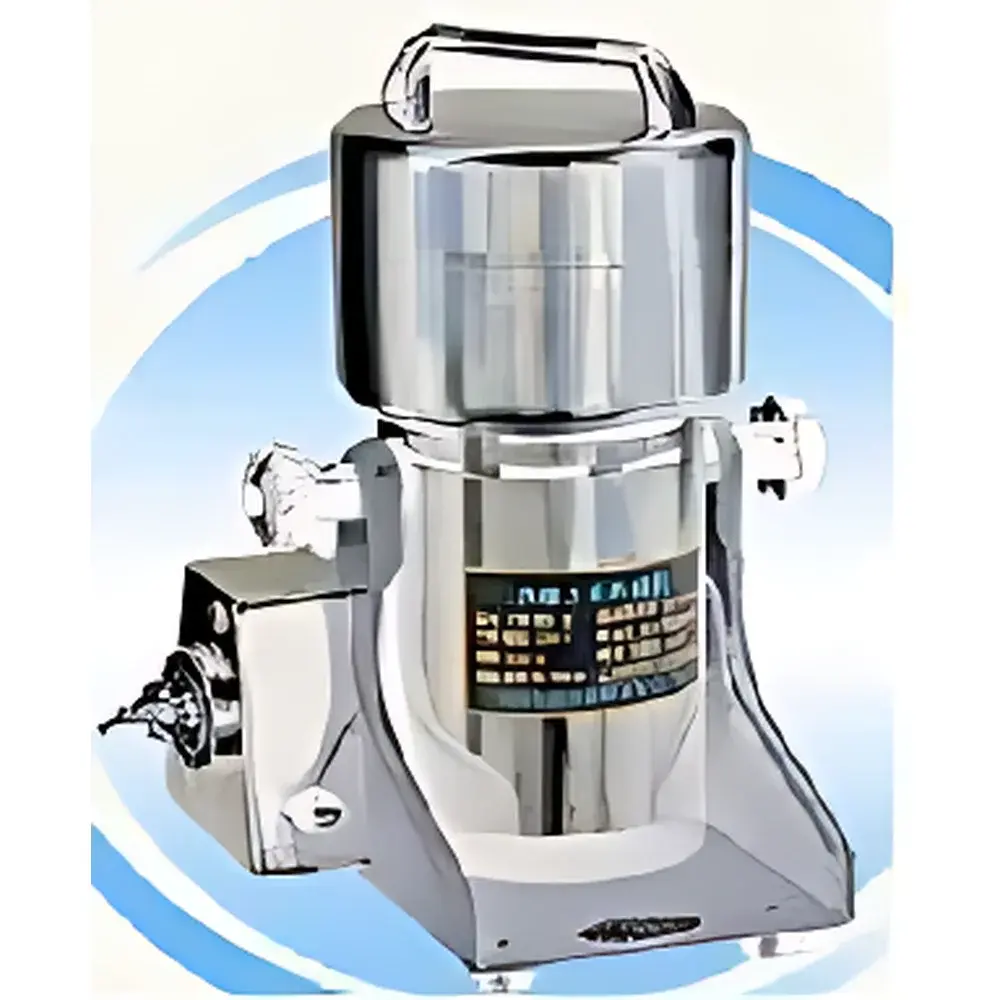
KeHeng FW177 Herbal Powder Mill
| Brand | KeHeng |
|---|---|
| Origin | Shanghai, China |
| Manufacturer Type | Authorized Distributor |
| Product Category | Domestic |
| Model | FW177 |
| Instrument Type | Laboratory Crusher |
| Sample Suitability | Hard & Brittle Materials (e.g., dried herbs, roots, bark, seeds) |
| Output Particle Size | 0.01–0.5 mm (10–500 µm) |
| Final Particle Size Distribution | ≤40 µm (D90, as measured by laser diffraction post-sieving) |
| Batch Capacity | 400 g per cycle |
| Compliance | Designed to meet general laboratory safety and electromagnetic compatibility (EMC) requirements per GB/T 18268.1–2010 (IEC 61326-1 equivalent) |
Overview
The KeHeng FW177 Herbal Powder Mill is a benchtop laboratory crusher engineered for consistent, low-heat comminution of dry, hard botanical materials—including traditional Chinese medicinal herbs, rhizomes, woody stems, mineral-based TCM ingredients, and other brittle organic solids. It operates on a high-speed rotor–impact principle: material is fed into a grinding chamber where centrifugal force accelerates particles against fixed tungsten-carbide-lined impact plates and a rotating stainless-steel rotor equipped with hardened alloy blades. This mechanical attrition mechanism ensures rapid size reduction without significant thermal degradation—critical for preserving thermolabile active compounds such as volatile oils, alkaloids, and glycosides commonly found in herbal matrices. Unlike cryogenic or ball-mill systems, the FW177 achieves reproducible sub-40 µm output in a single pass under ambient conditions, making it suitable for preparatory sample homogenization prior to HPLC, UV-Vis spectroscopy, or elemental analysis.
Key Features
- Stainless-steel grinding chamber with replaceable tungsten-carbide impact liners for extended service life and minimal metallic contamination
- Variable-speed motor (2800–3200 rpm) enabling precise control over particle size distribution and energy input
- Integrated air-cooling ducts and optimized airflow design to limit temperature rise to <15 °C above ambient during standard 400 g batch operation
- Interlocked safety cover with microswitch cutoff—grinding halts immediately upon lid opening
- Quick-release chamber assembly with tool-free disassembly for cleaning and cross-contamination prevention between batches
- CE-marked power supply and EMI shielding compliant with IEC 61000-6-3 for stable performance in shared lab environments
Sample Compatibility & Compliance
The FW177 is validated for use with low-moisture (<10% w/w), non-fibrous, non-oily botanical samples. It is not recommended for fibrous leaves (e.g., mullein), high-fat seeds (e.g., sesame), or hygroscopic powders without pre-drying. All wetted parts comply with ISO 8504-2:2000 surface finish standards (Ra ≤ 0.8 µm) to prevent residue retention. The device supports GLP-aligned documentation workflows: batch records may include operator ID, date/time stamp, sample ID, cycle count, and final sieve analysis results. While not certified to FDA 21 CFR Part 11, its mechanical design facilitates audit-ready traceability when paired with external electronic lab notebooks (ELNs).
Software & Data Management
The FW177 operates as a standalone electromechanical unit with no embedded firmware or digital interface. All operational parameters—including speed setting, runtime, and batch count—are manually configured via front-panel rotary dial and LED indicators. For laboratories requiring data capture, optional integration with third-party USB data loggers (e.g., Omega OM-DAQPRO-5300) enables timestamped recording of motor current draw and cycle duration—serving as indirect proxies for load consistency and wear monitoring. Raw particle size data must be acquired externally using laser diffraction (e.g., Malvern Mastersizer 3000) or sieve analysis (ISO 2591-1:2022 compliant test sieves).
Applications
- Preparation of homogeneous herbal powder reference standards for pharmacopoeial testing (ChP, USP , EP 2.9.12)
- Routine comminution of raw TCM materials prior to extraction, dissolution, or heavy metal screening (ICP-MS sample prep)
- Particle size optimization studies for tablet granulation or capsule fill uniformity assessment
- Supporting stability-indicating method development where physical form changes (e.g., crystallinity loss, agglomeration) must be excluded from analytical interference
- Teaching laboratories demonstrating mechanical size reduction principles in pharmaceutical technology courses
FAQ
Is the FW177 suitable for grinding wet or frozen samples?
No. The mill is designed exclusively for dry, free-flowing, brittle solids. Introducing moisture or ice risks rotor imbalance, chamber corrosion, and motor overload.
What maintenance intervals are recommended?
Inspect impact liners and rotor blades every 50 operating hours; replace when wear exceeds 0.3 mm depth. Lubricate main shaft bearings quarterly using ISO VG 32 synthetic oil.
Can the FW177 achieve nanoscale particles?
No. Its mechanical impact mechanism has a practical lower limit of ~10 µm (D50). Sub-micron grinding requires planetary ball milling or jet milling.
Does it comply with GMP requirements for production-scale use?
It is intended for R&D and QC lab use only—not for commercial manufacturing. GMP-compliant crushing requires fully documented validation protocols, including installation qualification (IQ), operational qualification (OQ), and performance qualification (PQ) per Annex 15.
How is cross-contamination minimized between different herbal batches?
The chamber allows full disassembly in <90 seconds; we recommend ethanol wipe-down followed by vacuum drying, then blank run with rice flour to verify residual mass <0.1 mg per 400 g batch.



